
Your ecommerce team has paid a creator, watched the content go live, and then opened a reporting dashboard that says almost nothing about sales. The post earned attention, comments looked positive, and the invoice is real. The commercial result is still unclear.
That's the point where influencer marketing either becomes a repeatable acquisition channel or gets dismissed as expensive awareness. Ecommerce brands have an advantage: purchases can usually be connected to a creator through UTM links, promo codes, affiliate links, platform-native shopping tags, and post-purchase surveys. The work is less glamorous than sending products and hoping for a viral post, but it's what turns creator activity into a performance program.
Table of Contents
- Put the conversion path inside the brief
- Review for watch-through and purchase clarity
- Choose formats that demonstrate value
Why Influencer Marketing Works Differently for Ecommerce
A brand team buying a billboard has to estimate its effect. An ecommerce team working with creators can often trace the customer journey from content to product page to checkout. That doesn't make attribution perfect, but it gives you far more control than likes, comments, or reach alone.
The difference matters because creator content can serve several jobs at once. A TikTok demonstration might generate direct sales, reveal an objection in the comments, and produce an asset that the paid media team can test later. An Instagram Story can push customers through a tracked link, while a YouTube review may influence a purchase that happens later through branded search. Your reporting model needs to separate those jobs instead of forcing every placement into one awareness bucket.
DTC checkout and closed-loop commerce
Your own store gives you deeper control over customer data, merchandising, email capture, and repeat purchase activity. The trade-off is friction. A viewer leaves the social platform, loads a product page, evaluates shipping and trust signals, and completes checkout through another environment.
Marketplace commerce reduces that distance. In Southeast Asia, creator-driven commerce accounts for about 20% to 24% of total ecommerce sales, with reported sales linked to the channel ranging from $38 billion to $46 billion, including $21 billion directly attributable to creator campaigns, according to Impact's analysis of influencer marketing ecommerce trends. Those figures illustrate why TikTok Shop, Shopee, and Lazada deserve a different operating model from a DTC program. The platform may simplify conversion and attribution, but commissions, marketplace fees, customer ownership, and reporting access change the margin calculation.
Practical rule: Decide where the transaction should happen before you choose the creator or content format. Checkout location changes the economics of the campaign.
What scalable performance looks like
A useful program produces more than a successful post. It gives you creator-level revenue data, a clear cost basis, reusable creative, and a reason to reinvest. You should know which creator, format, audience, offer, and checkout path produced the order.
The strongest programs also avoid treating every creator as a permanent media buy. A creator can be valuable because their content converts organically, because their audience is unusually relevant, or because their footage gives paid media a fresh angle. Those are different contributions, and each deserves a different decision about fees, commissions, and usage rights.
Setting Campaign Objectives and Forecasting Performance
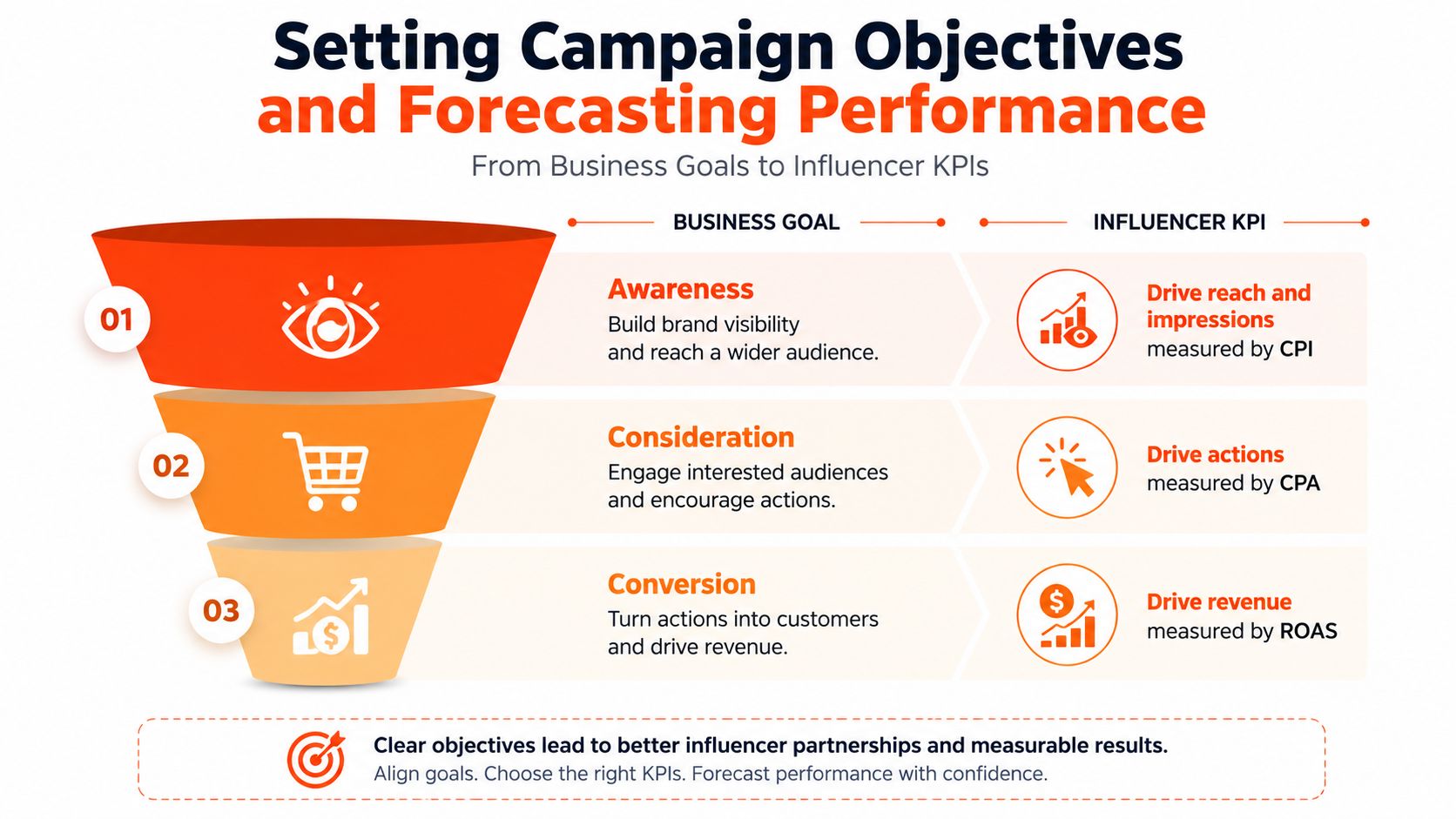
A creator campaign can generate impressive reach and still lose money at checkout. Set the commercial outcome first, then choose the platform, creator mix, and content format that can produce it. “We want TikTok creators” describes a channel preference. “We need profitable first purchases for a product with a defined margin” gives the team an operating target.
Match that target to one primary KPI:
- Cost per impression: Use CPI when the immediate job is qualified exposure and the required audience is defined.
- Cost per action: Use CPA for a measurable step before purchase, such as a click, lead, add-to-cart, or app install.
- Return on ad spend: Use ROAS when tracked revenue and total campaign cost are reliable enough to support a profitability decision.
A forecast should make its assumptions visible. Finance can then challenge the inputs, rather than treating an estimated result as a promise.
Build a forecast by platform and format
Create one row for every proposed placement or creator group. Record the platform, format, expected views, click assumption, conversion assumption, average order value, creator fee, product cost, commission, production cost, and paid amplification budget. Keep each input separate so observed results can replace estimates after launch.
Forecast separately for DTC checkout and marketplace sales. The same order may produce different contribution margins because commission, marketplace fees, customer ownership, and reporting access change the economics. A TikTok Shop placement can reduce checkout friction, while a DTC link may give the brand more control over customer data and retention.
Use benchmarks as planning references, not promises. Conversion varies by product, audience, offer, landing page, and format. A fashion Story with a weak product page should not inherit a beauty benchmark, and an unboxing video should not be judged against a blended platform average. Build a range, then stress-test the result against lower clicks, weaker conversion, and higher acquisition cost.
Allocate the test budget deliberately
Split the first budget across several hypotheses. Test creator sizes, hooks, offers, and formats instead of placing the full amount behind one recognizable name. YouTube can suit considered products and demonstrations, Instagram can support relationship-driven formats, TikTok can reward native short-form shopping content, and Twitch can fit live explanation or community-led products.
Your one-page finance model should answer five questions:
- What business result are we buying?
- What must happen for the campaign to break even?
- Which assumptions are uncertain?
- How will each placement be attributed?
- What result earns a second investment?
For a broader explanation of creator campaign mechanics, review this influencer marketing workflow guide. Give every creator a tracking method and a decision rule before publication. That means a unique link, code, or marketplace identifier, plus a defined threshold for pausing, revising, or funding the next test.
Finding and Vetting Creators Who Actually Convert
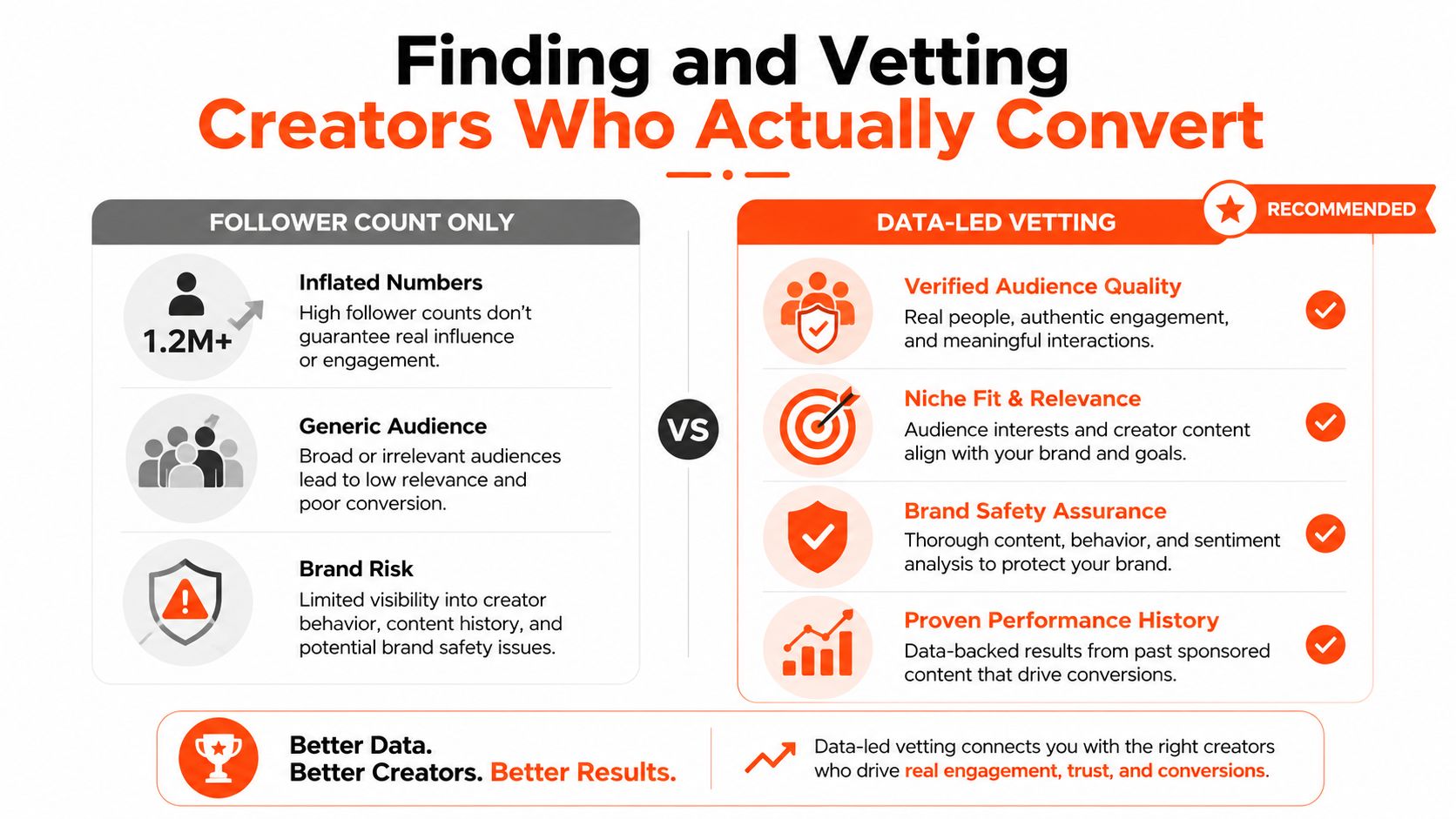
Follower count is a distribution signal, not a purchase-intent signal. A large audience can be poorly aligned, difficult to reach, or unresponsive to sponsored recommendations. A smaller creator with a focused audience may give you a more efficient test.
A comparative analysis reported 2.4% click-through rates for micro-influencers versus 1.1% for macro-influencers, while campaigns combining multiple micro-influencers in the same vertical achieved 27% higher conversion rates than single-influencer campaigns, as reported in this comparative analysis of micro and macro influencer performance. The useful lesson isn't that micro creators always win. It's that niche relevance and portfolio design can matter more than raw reach.
Compare creator tiers by job to be done
| Creator profile | Useful role | Main risk | What to inspect |
|---|---|---|---|
| Micro creator | Focused product discovery and testing | Limited distribution | Audience fit, comment quality, sponsored clicks |
| Mid-tier creator | Scalable trust and repeatable content | Higher fee and negotiation complexity | Past commercial performance and format consistency |
| Macro creator | Broad reach and launch visibility | Expensive concentration risk | Incremental reach, audience overlap, purchase evidence |
Treat those profiles as a portfolio, not a ranking. A mid-tier creator may be the strongest anchor for a product category, while several micro creators can provide message variation and audience coverage. A macro creator can still make sense when the objective is a launch moment or broad exposure, but the business case should include more than the creator's media kit reach.
Use a vetting screen before outreach
Check the audience geography, age profile, language, content themes, comment patterns, and recent brand partnerships. Read the comments on sponsored posts. “Where can I buy this?” is more commercially useful than a high volume of generic praise, although no single comment proves conversion.
Review the creator's content in context. Can they explain a product without turning the video into a script read? Do they show the product in use? Do they handle objections? Do they disclose partnerships clearly? A creator who produces attractive but vague content may create fewer sales than one who answers practical buyer questions.
Red flags include sudden audience spikes without corresponding content growth, repetitive engagement from suspicious accounts, broad category hopping, weak sponsored performance, and unwillingness to use trackable links or codes. Brand safety also belongs in the first screen, not after contracting.
Selection principle: Shortlist creators for the audience you need to persuade, then evaluate their ability to make that audience act.
Personalize outreach around a real content pattern. Mention a specific product demonstration or recurring audience question, explain the commercial test, and state the expected deliverables, disclosure, payment structure, approval process, and usage rights. A specialist creator marketing agency resource can help formalize that process when internal teams lack the time to review creators consistently.
Building Briefs That Keep Creator Voice and Drive Sales
A weak brief says, “Make an authentic video about our product.” That leaves the creator guessing about the customer, the offer, the proof, the compliance requirements, and the action you want viewers to take.
A useful brief gives the creator a clear commercial problem while leaving room for their delivery. Start with the audience and buying tension. Then provide the product facts that must be accurate, the claims they can make, the claims they can't make, and the destination for the sale.

Put the conversion path inside the brief
Include these fields:
- Opening hook: Define the problem or curiosity gap, such as a common use mistake, comparison, or first impression.
- Proof points: List the product features, demonstrations, ingredients, materials, or test conditions that matter.
- Creator freedom: Let the creator choose the wording, pacing, location, and personal framing.
- Offer and CTA: State the code, link, shop tag, landing page, and the exact action viewers should take.
- Disclosure: Specify the required paid partnership or advertising disclosure for the relevant market and platform.
- Usage rights: Define organic reposting, paid amplification, editing, duration, territories, and whitelisting permissions.
- Deliverables: Confirm aspect ratio, caption requirements, raw files, thumbnails, and any live or Story components.
The brief should also tell the creator what not to do. Don't bury the product under an unrelated trend. Don't make unsupported performance claims. Don't hide the product demonstration until the final seconds. Don't force a polished brand voice onto a creator whose audience expects direct, informal reviews.
Review for watch-through and purchase clarity
Ask for an outline or rough hook before full production when the campaign has strict compliance requirements. Review the first cut for factual accuracy, visible product use, audible brand and product names, disclosure placement, CTA clarity, and whether the viewer can understand the next step without reading the caption.
Too many revisions create a different problem. They make the content sound approved by a committee and delay the campaign. Give creators a short list of essentials, consolidate feedback into one review, and distinguish legal corrections from stylistic preferences.
For a practical reference on structuring creator instructions for short-form commerce, use this guide to creator briefs for TikTok sellers. It's particularly useful when the creator needs freedom to sound native while the brand still needs a controlled offer and compliant claims.
Choose formats that demonstrate value
Unboxing works when the package, setup, and first reaction help answer buyer questions. Product demonstrations work when the viewer can see the product solving a recognizable problem. Comparison content works when the creator explains the criteria rather than declaring a winner.
Live formats need a different brief. Give the host a product sequence, inventory or offer information, frequently asked questions, escalation contacts, and a way to answer objections quickly. Don't hand a live creator a paragraph of scripted copy and expect the session to feel credible.
Tracking Every Placement and Measuring What Matters
A creator campaign can appear profitable at creator level while losing money at placement level. One partner might publish a TikTok, Instagram Story, bio link, and live mention, each with different reach, intent, and conversion friction. A shared discount code collapses those results into one number, so the team can't tell which asset deserves another dollar.
Assign a separate identifier to every placement before publication. Use a unique UTM link for clickable traffic, a placement-specific promo code for code-led purchases, and a post-purchase survey question for customers who buy through an untracked path. Capture the creator, platform, format, posting date, offer, landing page, and paid amplification status in the same record.
Native commerce needs a reconciliation step. Compare platform-reported orders with internal revenue, refunds, commissions, product costs, and settlement reports. TikTok Shop, for example, can produce direct marketplace sales while the brand still needs to assess net contribution after platform and creator fees. Keep those orders separate from DTC revenue rather than combining them into one blended ROAS figure.
Build a weekly reporting view
Review performance at creator, placement, and channel level:
- Delivery: Published assets, views, reach, watch-through, saves, shares, and audience signals.
- Traffic: Link clicks, click-through rate, landing-page sessions, engaged sessions, and assisted behavior.
- Commerce: Orders, conversion rate, gross revenue, net revenue, refunds, and average order value.
- Economics: Creator fee, commission, product cost, paid media spend, total cost, contribution margin, and ROAS.
- Learning: Hook, format, offer, objection, audience segment, landing page, and the next test.
Use the category and format baselines established earlier as diagnostic reference points, not as pass or fail thresholds. A placement that converts below the relevant baseline may have a content problem, but it may also be sending qualified shoppers to a slow page, an unclear offer, an unsuitable product variant, or a checkout with unexpected shipping costs.
Compare placements in sequence. Strong view-through with weak clicks points toward a CTA, offer, or product relevance issue. Strong clicks with weak checkout conversion shifts attention to the landing page, price, trust signals, shipping, or payment options. Strong conversion with low reach suggests an efficient asset that needs distribution. High revenue with poor margin means the placement may scale volume while reducing profit.
Track time-to-purchase as well. A creator may generate few same-day orders but influence customers who return later through direct search, branded traffic, or email. Use the post-purchase survey and assisted-conversion view to identify that contribution, while keeping direct attribution and influenced revenue clearly separated.
Separate DTC and marketplace reporting
DTC and marketplace placements answer different commercial questions. DTC reporting can connect orders with analytics, customer records, repeat purchases, and post-purchase behavior. Marketplace reporting may offer strong native attribution and faster checkout, while giving the brand less customer ownership and a different fee structure.
Create separate dashboards for each route. For DTC, calculate net revenue after discounts, shipping subsidies, payment fees, refunds, and creator costs. For marketplace sales, include platform commission, fulfillment charges, creator commission, returns, and any promotional deductions. Compare contribution margin, not only attributed sales or ROAS.
A marketplace placement can win on conversion rate because checkout is shorter, while a DTC placement can produce greater long-term customer value. The right decision depends on margin, repeat purchase potential, inventory position, and the customer data the brand needs.
Teams formalizing their measurement process can use this guide to measuring influencer marketing ROI to structure attribution and reporting. Set the operating rule before launch: every placement receives an identifier, every result has a channel owner, and every budget renewal records the specific evidence behind it.
Scaling What Works With Seeding and Paid Amplification
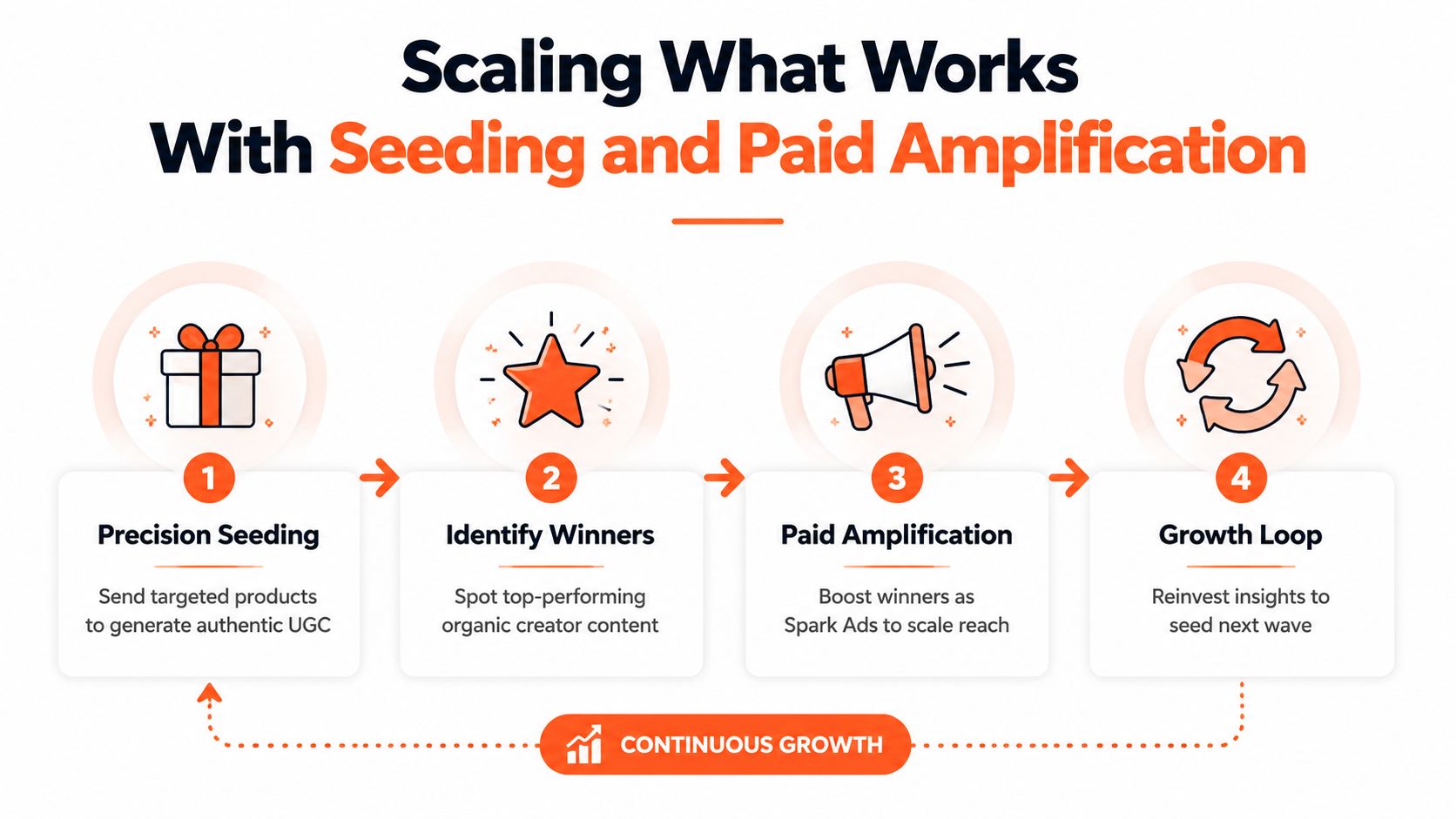
Scaling creator campaigns doesn't mean paying more creators to repeat the same idea. It means creating a feedback loop where targeted seeding generates new footage, organic results identify useful messages, and paid amplification distributes the strongest assets to a broader audience.
Start with precision seeding. Send products to creators whose audience, use case, and content style match the category. The objective isn't to maximize packages shipped. It's to create credible product demonstrations and learn which customer tensions produce useful content.
Turn organic evidence into paid creative
Review organic creator content for signals that paid media can use:
- Strong opening: Viewers understand the problem or benefit quickly.
- Visible proof: The product appears in a real use case rather than as a static pack shot.
- Comment demand: Viewers ask purchase, comparison, sizing, delivery, or usage questions.
- Clear action: The content gives people a practical next step.
- Reusable structure: The idea can be adapted without copying the creator's identity or audience context.
Secure usage rights before you need the asset. Your agreement should cover paid placement, editing, channel use, duration, territory, creator handle authorization, and whether the brand can create cutdowns or variants. A creator's organic post and an ad made from that post are related assets, but they aren't automatically interchangeable from a rights perspective.
TikTok Spark Ads can preserve the original creator post while adding paid distribution. Reels and Shorts variants may require different openings, captions, pacing, or framing. Don't export one file everywhere and call it a cross-platform strategy. Use the original performance signal, then adapt the creative to the platform's viewing behavior.
Protect efficiency while increasing spend
A winning creator can fatigue. The audience may see the same hook too often, or the content may lose credibility when the paid frequency rises. Maintain a rotation of creators, angles, offers, and product use cases. Refresh the first few seconds before changing the entire concept if the underlying message still works.
Compensation can evolve as evidence improves. Early seeding may involve product, while proven creators may receive a flat fee plus commission or an outcome-linked structure. Keep the economics tied to margin and attribution rather than treating every creator as a fixed media cost.
Teams choosing distribution priorities can consult these WaveGen.ai channel selection tips when adapting creator assets across platforms. The channel decision should follow the content's job, audience, and measured economics, not the platform with the loudest cultural momentum.
A practical 30-day sequence looks like this:
- Define the target CPA or ROAS and separate DTC from marketplace economics.
- Shortlist creators by audience fit, category relevance, content quality, and sponsored history.
- Brief a controlled test with unique links, codes, disclosures, and usage rights.
- Review placement-level results weekly and identify winning hooks, formats, and creators.
- Amplify the strongest assets, refresh fatigued creative, and seed the next group from the learnings.
Social Cloud offers end-to-end creator campaign management for ecommerce, including data-led selection, forecasting, briefing, contracting, placement-level attribution, weekly reporting, seeding, and paid amplification across YouTube, Instagram, TikTok, and Twitch. Visit Social Cloud to discuss a tracked influencer program built around your store's CPA, ROAS, and checkout model.