
Gaming influencer marketing stopped being a side bet a while ago. One industry report estimated the market at $4.4 billion in 2022, up from $2.5 billion in 2021, while another analysis projected about $2.09 billion in 2025, $2.36 billion in 2026, and $4.34 billion by 2031. The definitions differ, but the conclusion doesn't: creator-led promotion is now a scaled part of how games get discovered and bought in major markets (industry market overview).
Popular teams still talk about this channel like it's a branding exercise. That's the mistake. If you run influencer marketing for gaming the way you run paid social, affiliate, or partner spend, the channel gets easier to defend. If you run it on views, hype, and screenshots from chat, it becomes expensive theater fast.
Table of Contents
- Vet for player fit, not just content fit
- Choose creators by business model
- A shortlist should look like an investment memo
- Three briefs for three very different jobs
- What goes in the contract, not just the brief
- Protect the creator's voice while protecting performance
- Negotiate rights before you need them
- The repurposing workflow that scales
- A repeatable five-week launch motion
The Gaming Influencer Channel in 2026
YouTube, Twitch, TikTok, and Instagram do different jobs in a gaming funnel. Treating them as interchangeable creator distribution usually leads to bad buying decisions and weak attribution.
The teams getting value from this channel in 2026 sort platforms by traffic quality, shelf life, and what happens after the click. A YouTube review can keep driving wishlists, installs, or high-intent visits weeks after posting. A Twitch integration can produce a sharp spike in clicks and redemptions during the sponsored window, then fade fast. TikTok can fill the top of funnel cheaply, but that traffic often needs stronger onboarding, retargeting, or follow-up creator touchpoints to turn into retained players.
That distinction matters more than reach.
What each platform is actually for
YouTube is usually the safest place to spend when the game needs explanation before conversion. Reviews, first looks, patch coverage, guides, and creator-led comparisons give players enough context to decide whether your game is worth their time. That tends to produce better downstream quality than a short mention dropped into a crowded content format.
Twitch is a burst channel. It works best when your team is ready to capture demand in real time with clean landing pages, a visible code or offer, live community management, and product stability that can survive a traffic spike. If those pieces are missing, the stream can still look successful in screenshots while producing little durable value.
TikTok is useful for repetition and creative testing. It can generate volume, but gaming marketers should not assume volume equals revenue. Short-form placements often help most when they feed a retargeting pool, support a launch narrative already established elsewhere, or surface a mechanic that earns a click in under three seconds.
Instagram still plays a supporting role for many game campaigns. Analysts at Worldmetrics noted that a large share of gaming creators on the platform are nano creators, which fits community reinforcement and lightweight reminder content better than a major acquisition push (gaming creator benchmark data).
| Platform | Best use case | What to watch |
|---|---|---|
| YouTube | Evergreen discovery, reviews, guides, update coverage | Installs, wishlists, assisted revenue, returning-user quality |
| Twitch | Launch-day streams, sponsored live segments, event bursts | Same-day clicks, code redemptions, session starts, server impact |
| TikTok | Hook testing, broad short-form reach, clip distribution | CTR, install rate, retargeting pool growth, early retention |
| Community reminders, story support, creator reinforcement | Swipe traffic, code usage, content reuse value |
Views are cheap. Lifecycle value is not.
A placement with lower reach and stronger player intent usually beats a bigger creator who sends low-retention traffic. That is common in gaming, especially for strategy, RPG, extraction, gacha, and other categories where the player needs context before installing. Raw views hide that trade-off. Retention and payback expose it.
I usually separate creator output into two buckets. Durable assets and burst assets.
Durable assets include YouTube reviews, tutorials, update recaps, and creator videos that rank in search or keep getting recommended after launch week. These can justify higher rates because they keep working. Burst assets include Twitch streams, short sponsored mentions, and time-boxed live activations. These can still be worth paying for, but only if the campaign objective is immediate awareness, a coordinated launch beat, or a measurable same-day action such as redemptions, installs, or wishlists.
That mindset also changes production. A publisher trailer cut into creator inventory rarely converts as well as native creator footage with a real opinion, a useful demo, or a credible reason to act now. If your team is planning stream overlays, multi-angle gameplay capture, or repurposed creator footage, these multi-cam gaming editor picks 2026 are a practical reference. Editing speed becomes a real constraint once one sponsored stream turns into six assets across formats.
The maturity test is simple. Weak programs still report views, CPM, and chat activity as if those metrics settle the argument. Strong programs judge each creator by traffic quality, retained users, payer rate, and whether the placement generated value after the first 24 hours.
Setting Goals, KPIs, and Forecasts That Actually Hold Up
A forecast for influencer marketing for gaming should survive contact with finance. If it only survives contact with the creative team, it isn't a forecast. It's a wish.
Start with your paid social baseline. If your user acquisition team already knows what an install, purchaser, or returning player costs through Meta, TikTok Ads, Google App Campaigns, or AppLovin, use that as the control. Creator spend then gets judged against a known benchmark instead of against vibes.
Build the model backward from a target outcome
Set one commercial target first. That might be target CPI, target CPA for registration, or target ROAS by a defined time window. Then work backward.
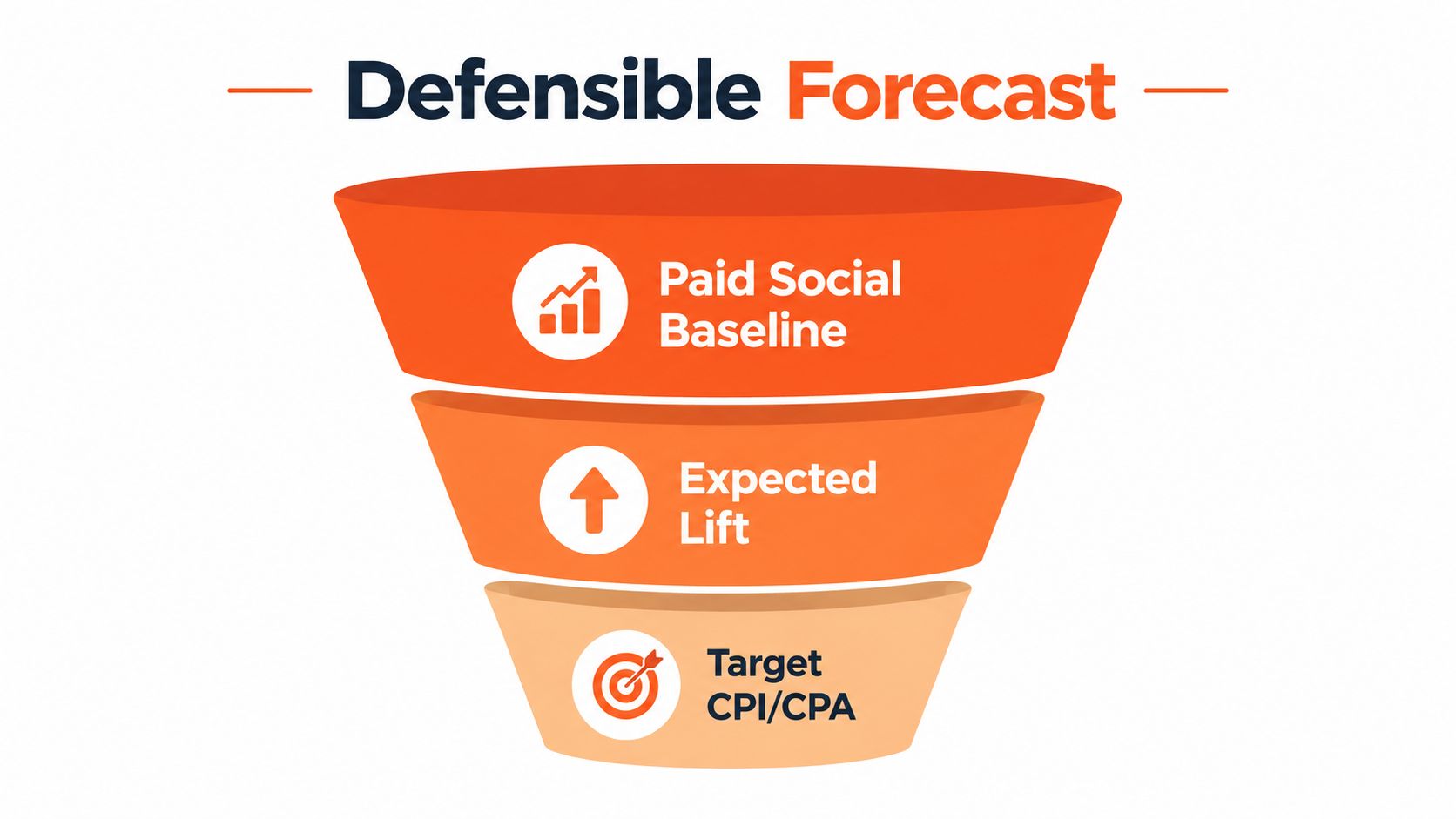
A simple working model looks like this:
- Start with your paid baseline. If paid social buys installs efficiently for your game, that gives you a target range to beat or justify.
- Estimate creator traffic quality. Dedicated reviews and tutorials usually produce better intent than a quick verbal mention in a stream.
- Discount for uncertainty. New creator partnerships deserve conservative assumptions until your own data says otherwise.
- Separate direct and assisted value. YouTube often drives some delayed conversion that won't show up in the first click report.
Here's the worked example teams usually skip. Say a mid-core mobile title wants a $4 CPI. The first draft model can set that as the line in the sand, then estimate how many tracked installs each placement would need to produce to clear it. If historical creator data is thin, don't fake precision. Build a range, then mark the first campaigns as calibration campaigns.
Use KPI tiers or you'll drown in noise
Not every metric deserves equal status.
- Primary KPIs: CPI, CPA, net new installs, and D7 ROAS. These decide whether you scale.
- Secondary KPIs: CTR, watch-through quality, promo-code redemptions, and post-purchase or post-install survey attribution. These explain why a placement worked or failed.
- Guardrail KPIs: Disclosure compliance, brand-safety issues, suspicious traffic patterns, refund spikes, or low-quality user behavior after install.
Forecasts aren't commitments. They're pricing hypotheses with a measurement plan attached.
The first two campaigns should exist to tighten assumptions. That means comparing estimated click volume against actual tracked visits, checking install quality by creator, and revising your benchmarks before larger spend goes live. If your model can't improve after live data comes in, your team isn't forecasting. It's repeating.
Picking Creators That Fit Your Game and Your Funnel
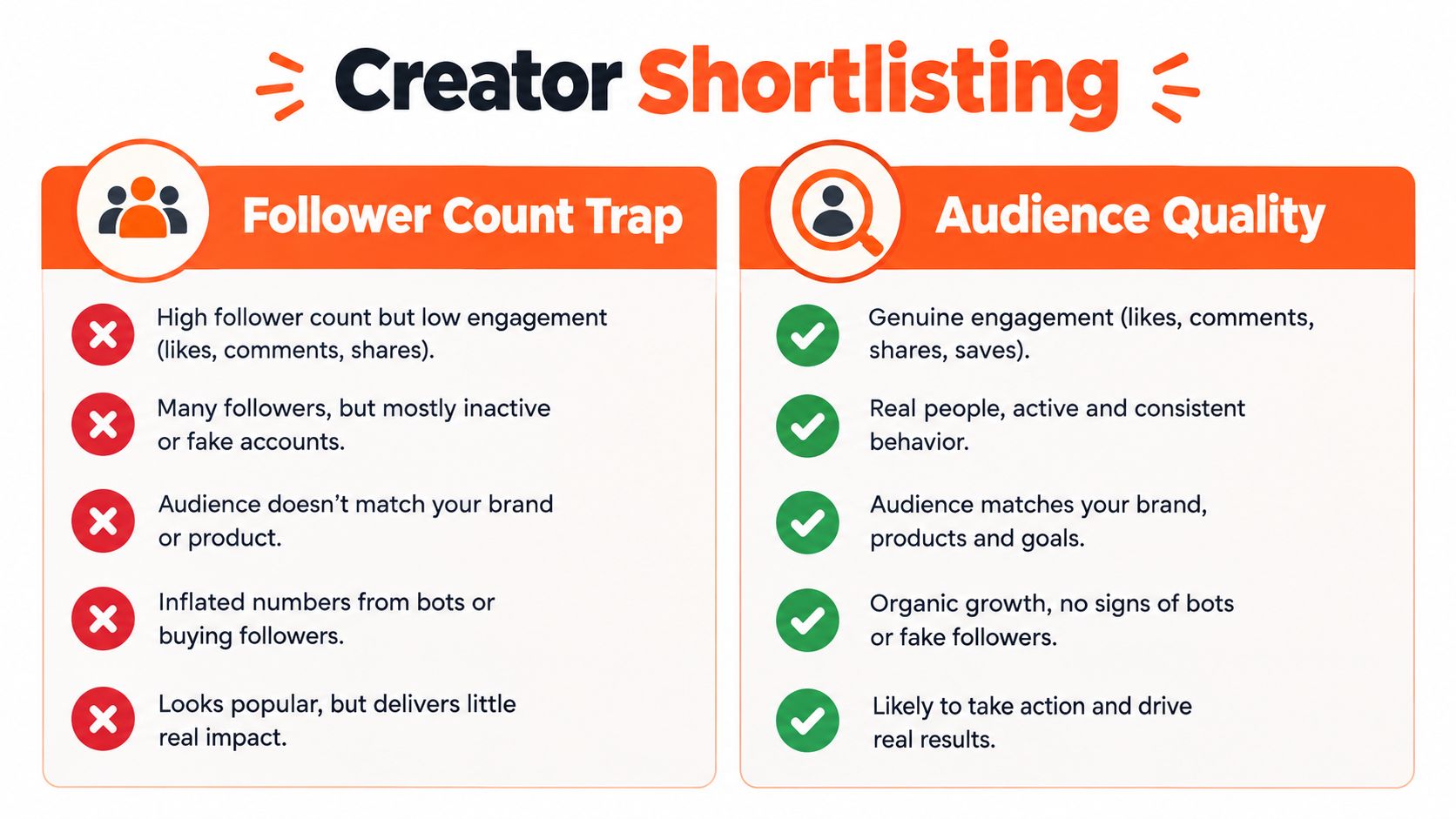
A creator with 10 times the reach rarely delivers 10 times the value. In gaming, the spread between high-view placements and high-value placements is wide, and the gap usually shows up after the click.
The hiring mistake is not just buying audience size. It is buying reach that does not match the job. A broad entertainment creator can generate a traffic spike, but if your game needs a long tutorial, high device compatibility, or a second session to monetize, that spike often collapses into poor retention and expensive installs. A smaller creator with tighter genre fit can produce fewer visits and still win on CPI, D7 retention, and payer rate.
Creator selection should map to funnel stage, not creator fame.
| Creator type | Best use in the funnel | What you gain | Trade-off |
|---|---|---|---|
| Broad variety streamer | Launch awareness, social proof, short burst traffic | Fast reach, retailer or store-page lift, visible momentum | Weak install efficiency, lower intent, fast drop-off after the stream |
| Genre specialist on YouTube | Consideration and conversion | Better audience match, stronger click intent, longer shelf life | Lower top-line reach, slower ramp |
| Mid-size Twitch creator with loyal chat | Conversion during events, updates, or live ops beats | Real-time education, stronger CTA response, immediate feedback | Performance depends heavily on offer quality and stream pacing |
| UGC-first short-form creator | Cheap testing of hooks, creatives, and angles | Fast iteration, useful paid reuse potential | Volatile quality, weaker depth, mixed attribution |
The practical question is simple. What kind of player is this creator likely to send, and what happens to that player after install?
That changes who should make the shortlist.
Vet for player fit, not just content fit
A lot of teams stop at surface alignment. The creator plays games. The game looks fun on stream. The audience leaves nice comments. None of that is enough if post-click behavior is poor.
My filter is stricter:
- Genre adjacency. Recent videos and stream archives should show overlap with your game loop, pacing, and player motivation.
- Audience geography and platform fit. A mobile title with paid UA targets needs installable markets and device reality, not just global view volume.
- Comment quality. Look for viewers asking about mechanics, builds, progression, and whether they can play. Those signals are worth more than generic hype.
- Conversion environment. Check whether the creator can hold attention long enough to explain onboarding, account creation, or event rewards.
- Sponsored behavior. Past integrations show whether the creator can sell without sounding rented.
- Usage rights. Paid reuse, whitelisting, cutdowns, and raw file access affect downstream economics.
Retention matters more than top-line views because retention hints at whether the creator can carry a gameplay explanation without losing the room. That matters for games with any onboarding friction.
Choose creators by business model
Different games need different creator mixes. This sounds obvious, but teams still hire as if every title monetizes the same way.
A hypercasual or low-consideration mobile game can tolerate broader top-of-funnel traffic because the install decision is fast and the content hook does a lot of the work. A deeper strategy, gacha, extraction, or MMO title needs creators who can explain systems, progression, and why the first hour is worth the effort. For those games, a lower-volume creator who converts players with higher LTV is usually the better buy.
The same rule applies to live streams. Burst traffic is worth paying for when your game has a reason to act now: a launch window, limited-time drop, event reward, creator code, or social proof moment that compounds because many players enter at once. Burst traffic is usually overpriced when your onboarding is slow, your servers are unstable, or your monetization depends on users who need several sessions before they see value.
A shortlist should look like an investment memo
Gut feel creates political creator picks. A scorecard keeps the conversation tied to outcomes.
Weight the shortlist against criteria that affect revenue:
- Genre and audience fit
- Expected install intent
- Historical sponsored execution
- Live or evergreen content value
- Reuse rights and paid amplification value
- Brand safety and disclosure discipline
- Estimated cost against likely payback window
Red flags are rarely subtle. Sudden audience spikes, shallow comments, weak disclosure habits, and a feed full of mismatched sponsorships usually lead to the same result: expensive traffic that does not survive the first session.
For teams that vet creators across more than one category, the evaluation logic stays consistent. Audience relevance, trust, and conversion context matter more than raw scale. This guide on how to find B2B influencers on LinkedIn is a useful parallel because the qualification standard is similar, even though the buying motion is different.
The best creator for your game is not the one who looks biggest in a deck. It is the one whose audience behaves like your future retained players.
Briefing and Creative Guidance Across Streams UGC and Shorts
Most bad creator output starts with a bad brief. The team either scripts too much and kills the creator's voice, or says “just make it authentic” and leaves out every point that affects conversion.
The fix is simple. Brief the format, not just the message.
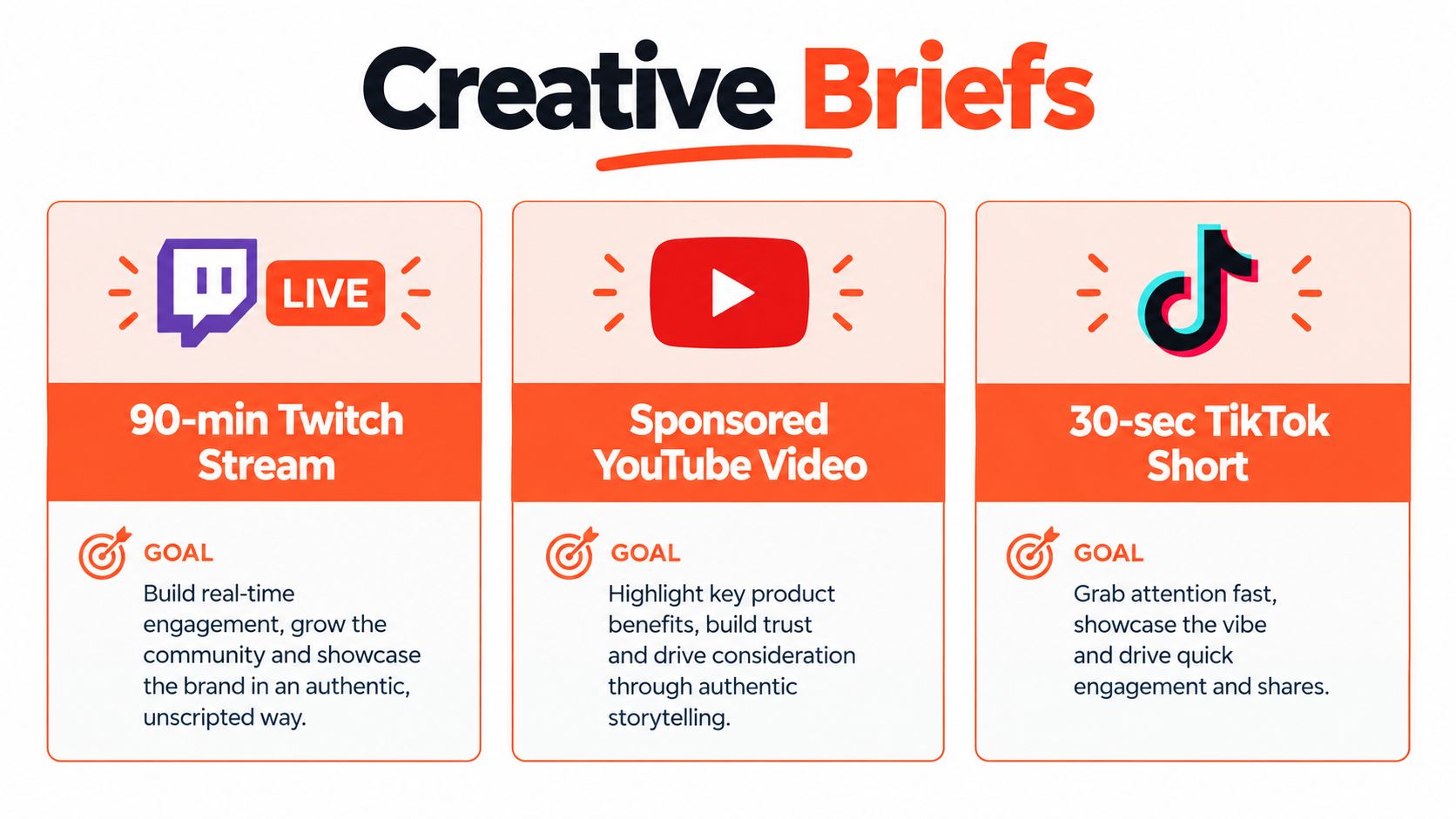
Three briefs for three very different jobs
A 90-minute Twitch stream brief needs flow, not script. It should specify the stream title, game hook, timing for the first CTA, pinned-link language, any redeem code mechanic, must-show moments, and clear disclosure requirements. It also needs contingency notes in case queue times, bugs, or matchmaking kill momentum.
A sponsored YouTube brief needs structure. The creator should know the hook, what progression or feature payoff needs to be shown, where the sponsor integration sits, which claims are approved, and what landing page or store action matters most. If you need a review, that's a different brief from a how-to or challenge video.
A 30-second TikTok or Short brief is all about the first three seconds. Give the creator one clear gameplay hook, one reason to care now, and one CTA. Anything beyond that usually turns into rushed ad copy.
What goes in the contract, not just the brief
Creative clarity without operational clarity still breaks campaigns. Your deliverable sheet should define:
- Asset format: Raw capture, edited cut, caption copy, thumbnail option, clip derivatives.
- Posting window: Exact go-live range, review timeline, and what happens if the creator slips schedule.
- Usage rights: Organic reposting, paid amplification, platform scope, market scope, and term.
- Revision rules: What counts as a factual correction versus a creative rewrite.
This is also the point where many teams realize they need a tighter process for influencer video operations overall. If you want a broader framework for briefing, asset handling, and repurposing, this guide to influencer video marketing is a solid operational reference.
Protect the creator's voice while protecting performance
A good brief controls the essentials and leaves the delivery style alone.
That means you should lock these items early:
- Must include: Game name, core hook, CTA, disclosure, approved landing path.
- Must avoid: Competitor references, unsupported claims, awkward monetization framing, anything that makes the game sound pay-to-win if that isn't the positioning.
- Tone guidance: Competitive, cozy, social, skill-based, progression-heavy, or narrative-led. Pick one.
The moment a brief reads like ad copy pasted into a doc, conversion usually drops. Players can smell it.
Tracking Attribution and Proving ROAS on Every Placement
If you can't prove what a creator placement did, you don't have a scaling channel. You have content spend.
Attribution in gaming creator campaigns should be built before outreach starts. Every creator gets a tracking stack that survives platform quirks, delayed installs, and messy user behavior. If the stack goes live late, reporting gets political because everyone starts arguing from partial data.
The minimum viable attribution stack
For most gaming campaigns, this stack is enough to defend spend:
- Unique UTM links per creator and placement. Not one link per platform. One per creator, per content unit.
- Vanity redirects or smart links. Useful when platforms shorten, strip, or mangle URLs.
- Promo codes tied to creator IDs. Best for mobile offers, starter packs, or live-stream urgency.
- MMP postbacks for installs and events. Essential if your team buys app installs seriously.
- Post-install or post-purchase surveys. They won't replace hard attribution, but they catch some assisted conversions.
Where attribution breaks most often
Teams usually blame creators when the tracking setup is the problem.
| Method | Best For | Defensibility | Common Failure Mode |
|---|---|---|---|
| UTM links | Web traffic, store page visits, direct click attribution | High for click-based paths | Broken parameters, copied links, platform stripping |
| Promo codes | Live streams, offer-driven campaigns, mobile redemption | High when code use is required | Code leakage beyond the creator audience |
| MMP event tracking | App installs, post-install quality, ROAS modeling | High if instrumentation is clean | Event delays, mismatched attribution windows |
| Post-purchase surveys | Assisted attribution, creator recall | Moderate | Self-report bias, low response volume |
One sentence I use a lot with finance teams: creator reporting is an exercise in reconciliation, not certainty. Platform click counts, MMP installs, storefront analytics, and code redemptions rarely line up perfectly. They don't need to. They need to line up enough to support a decision.
For teams building that framework from scratch, this walkthrough on how to measure influencer marketing ROI is useful because it maps the reporting logic cleanly across placements and outcomes.
Missing UTMs are annoying. Cannibalized organic traffic is expensive. Delayed event reporting is where bad decisions get made.
The fix is process discipline. QA every link before the post goes live. Lock naming conventions. Match creator IDs across contracts, tracking sheets, and dashboards. And split your reporting into direct, assisted, and unattributed buckets so nobody pretends the data is cleaner than it is.
Live Streams as a Burst Channel and How to Capture the Spike
Live stream sponsorships work. They just don't work for very long.
A recent academic summary reported that a typical live stream increased a game's concurrent players by about 3%, but the effect dropped quickly to one-tenth of its size within about seven hours. The positive effect appeared for 88% of games, with the strongest gains among small-publisher, highly rated, or niche titles (livestream lift summary).

That's the key reframing. Live streams are a burst channel. If your game can't capture intent during or immediately after the stream, you're often paying for attention that expires before your funnel does anything with it.
When streams are worth paying for
Streams are worth it when the game has a clear same-session action:
- A launch or update moment with a live reason to click now
- A redeemable code or in-game bonus that rewards immediate response
- A friction-light onboarding path where viewers can install and start fast
- A retargeting setup ready to capture visitors while they're still warm
They're weaker when the store page is confusing, the tutorial is slow, server stability is shaky, or the game's hook takes too long to reveal.
Tactics that actually capture the spike
A stream placement needs choreography. Not just sponsorship copy.
Use these moves:
- Pre-stream build-up: Countdown posts, short teaser clips, Discord reminders, and creator community posts so the audience arrives expecting the placement.
- In-stream capture: Pinned links, repeated verbal CTAs, visible redeem code overlays, and timed reminders around the strongest gameplay moments.
- Immediate follow-through: Clip top moments fast, distribute them within a day, and retarget viewers or visitors before interest decays.
For teams using Twitch heavily, this guide on influencer marketing on Twitch is worth keeping in the operating doc because stream mechanics and reporting need tighter timing than most brand teams expect.
Here's a useful example of the format pressure live placements create:
The pricing model matters too. Flat-fee streams can be fine for launches with obvious upside, but they become hard to justify if downstream conversion is soft. In those cases, cost per engaged viewer, code redemption, or tracked action is a healthier negotiation anchor than pure appearance fees.
Amplification Repurposing and a Repeatable Launch Timeline
Most gaming teams still underuse the part they already paid for. The creator post goes live, performs once, then disappears into a recap deck. That wastes creative, rights, and learning.
Repurposing is where creator campaigns start behaving like a system instead of a sequence of one-offs.
Negotiate rights before you need them
The expensive mistake is asking about paid usage after the content performs. By then the creator knows the asset is valuable and your options narrow.
Lock these terms upfront:
- Usage type: Organic repost only, paid amplification, or both.
- Term length: Short campaign window or broader reuse period.
- Platform scope: TikTok, YouTube Shorts, Instagram Reels, storefront pages, paid social.
- Market scope: Geo matters if your publishing footprint is mixed.
If the team wants to multiply derivatives after launch, it helps to think in content systems. This framework on how to multiply your content output is useful because it pushes teams to plan the derivative assets before the original goes live.
The repurposing workflow that scales
Strong repurposing usually follows a simple path.
A Twitch stream becomes clipped moments for TikTok, Shorts, and paid retargeting. A YouTube integration becomes short extracts for store-page social proof or paid social tests. UGC-style gameplay reactions become creative variants for install campaigns.
One option for managing this end to end is Social Cloud, which runs creator selection, briefing, tracking, and cross-platform amplification for performance-focused campaigns. That kind of setup is useful when the bottleneck is operational consistency rather than just creator discovery.
A repeatable five-week launch motion
This timeline is practical because it leaves enough room for contracts, approvals, and paid reuse without dragging so long that the game moment passes.
- Week 1: Finalize KPI target, shortlist creators, send briefs, negotiate rights and disclosures.
- Week 2: Approve concepts, QA links and codes, collect production milestones, prep dashboard views.
- Week 3: Stagger creator posts and streams so you can compare performance without total overlap.
- Week 4: Put paid support behind the top-performing assets, clip winners into short-form variants, suppress weak creatives quickly.
- Week 5: Reconcile tracking, assess creator-level value, and decide who gets renewed, expanded, or cut.
Good creator programs don't end with reporting. They end with a clearer list of who to rebook, what to reuse, and what not to buy again.
The operational failures are boring and predictable. Late rights requests. Missing whitelisting approval. No raw files. Sloppy asset naming. Unclear expiry on promo codes. Solve those once with a written SOP and the next launch runs much faster.
If your team wants influencer marketing for gaming to behave like a measurable acquisition channel, Social Cloud helps plan, run, and attribute creator campaigns across YouTube, TikTok, Instagram, and Twitch. They're built for growth teams that need creator-fit, tracking, and ROI clarity before budget gets scaled.