A memorable creator ad isn't the same as a profitable one. In an analysis of nearly 200 influencer-ad campaigns, Nielsen found that, on average, 80% of exposed viewers recalled the featured brand. That's a strong reason to consider creators, but it doesn't tell a founder whether the next campaign will pay back.
Influencer marketing for startups works best when you buy a useful comparison, not a famous face. Choose creators who reach plausible buyers, give them a clear job, and decide what evidence would justify another investment. You don't need perfect last-click attribution. You do need a consistent way to separate promising results from expensive attention.
Table of Contents
- Why Creator Campaigns Fit a Startup
- What a Small Budget Buys by Creator Tier
- How to Judge Creator Fit Before You Pay
- Choose One Platform for the First Test
- Measure Campaigns When Attribution Is Incomplete
- Briefs That Disclose the Deal Without Killing Trust
- Campaign Patterns Worth Copying
- Decide When to Hire an Agency
Why Creator Campaigns Fit a Startup
Creator marketing has grown into a significant budget category, which makes it worth evaluating alongside other ways to reach potential customers. Its scale, though, doesn't predict what a campaign will earn for your startup.

A meal-planning app for busy parents could advertise broadly or partner with a creator whose audience watches practical weeknight cooking demonstrations. The creator's channel is like a shop on a street your likely buyers already walk, rather than a billboard beside a highway they may never use.
That partnership can provide distribution, a familiar format, and an explanation of the product in the creator's own language. These advantages are useful only if they support a clear business goal.
Give the channel a defined job
Decide what the campaign needs to produce: purchases, activated users, qualified leads, or evidence that buyers understand a new category. A clear goal gives the team a basis for choosing creative and judging results.
- Assign an owner. Someone must approve creative, confirm tracking, and decide whether to renew.
- Protect the rest of the plan. Reserve budget for onboarding, landing pages, and customer support alongside creator spending.
- Set a decision date. Allow time for your actual buying cycle before judging a placement.
If creator work needs to fit alongside other launch priorities, SleekPost's 30/60/90-day marketing execution plan provides a scheduling framework.
A growing channel doesn't make every placement profitable. Your audience, offer, economics, and execution determine whether a campaign deserves more budget.
What a Small Budget Buys by Creator Tier
| Tier | Followers | Typical fee per short-form post | Startup use |
|---|---|---|---|
| Nano | Small, tightly focused audience | Request an organic-post quote; separate gifting from paid delivery | Seeding and raw clips, not a reach bet |
| Micro | Established niche audience | Quote a defined Reel or TikTok without bundled advertising rights | Default first paid test |
| Mid-tier | Broader category audience | Compare the full quote against demonstrated acquisition economics | Second wave after a tracked micro win |
| Macro | Large, broad audience | Evaluate concentration risk before committing | One post can consume the test |
| Mega | Mass-market or celebrity audience | Require proven economics before considering a large commitment | Skip until payback is proven |
Tier names aren't a price list. The useful budget question is what a creator will deliver, under which rights, to which audience. Without comparable terms, a cheap-looking quote and an expensive-looking quote may describe different purchases.
Use the table as a buying framework, not a set of market-rate promises. For more detail on comparing commercial terms, consult our guide to influencer marketing rates.
Make micro creators the starting shortlist
For a lean paid test, start by requesting quotes from niche creators whose audiences already discuss the problem you solve. A smaller partnership can let you compare different explanations without putting your whole experiment behind a single personality.
That isn't a claim that smaller creators always convert better. A small account with the wrong audience is still the wrong purchase.
Nano partnerships suit situations where product experience and content creation matter more than broad distribution. Be explicit about whether you're sending an unconditional gift or commissioning a deliverable. A parcel arriving doesn't mean a post is owed.
A mid-tier creator becomes easier to evaluate after you understand which audience, demonstration, and offer generate qualified demand. Macro and mega partnerships require a different tolerance for risk: your learning may depend heavily on one creative execution.
Budget beyond the post
Ask every shortlisted creator to separate these items:
- Publication. The format, platform, posting window, and time the content must remain available.
- Production. Concept development, filming, editing, revision limits, and any reshoot conditions.
- Usage rights. Where you can reuse the asset and when permission expires.
- Paid amplification. Permission to advertise through the creator's identity, separately from the advertising spend.
- Exclusivity. Named competitors, covered platforms, and the restricted period.
A dedicated YouTube video is a different production task from a short clip. Don't compare their quotes as if they were interchangeable inventory.
Reserve money for product delivery, landing-page work, measurement, and the person coordinating approvals. If every available dollar goes to publication fees, you'll have no room to fix a broken buying journey.
Budget rule: Buy enough comparable placements to learn something, without making success depend on every creator working.
Lock the tier, deliverable, and total spending ceiling before you fall in love with a name.
How to Judge Creator Fit Before You Pay
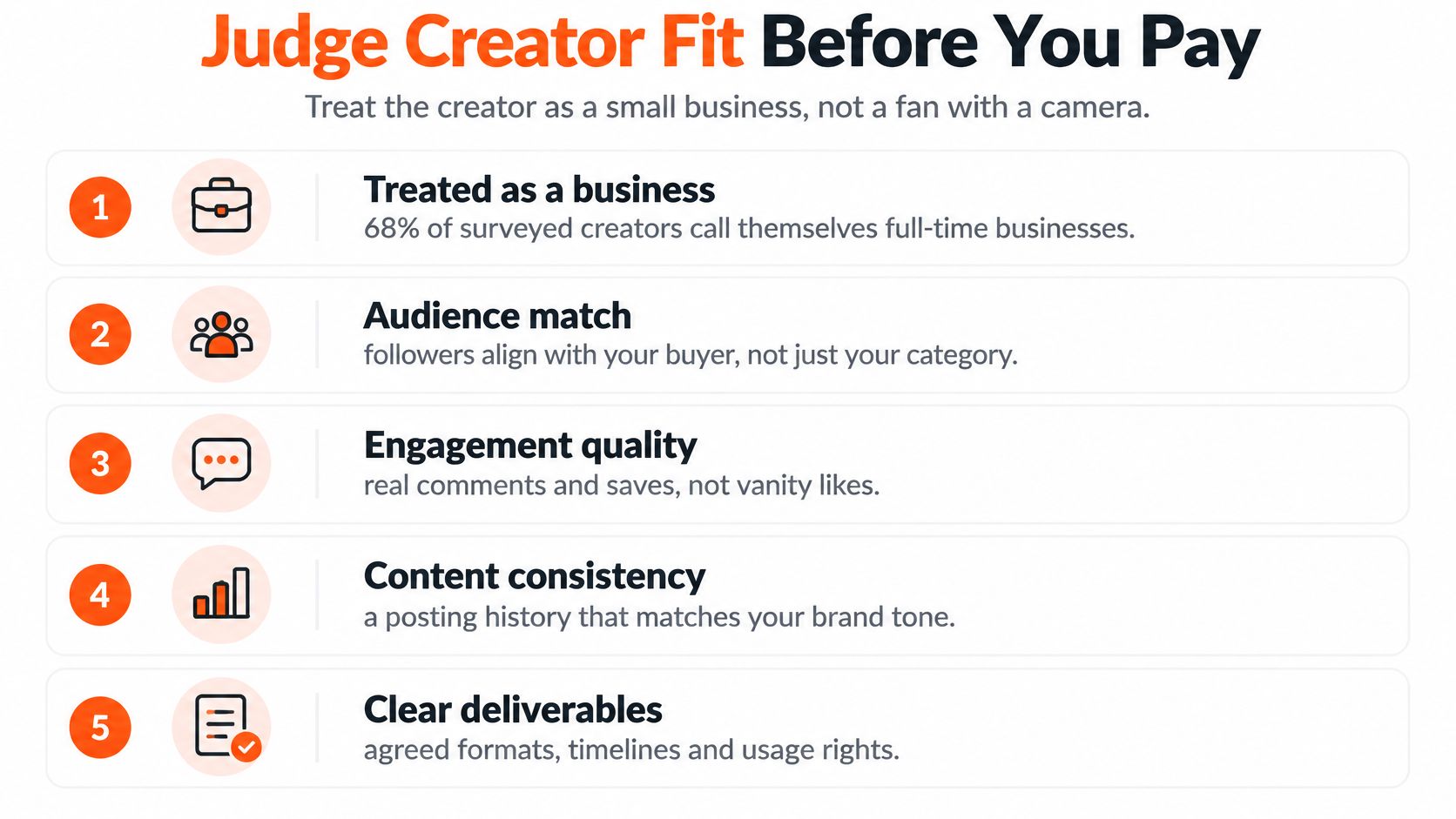
Treat creators as commercial partners. In 2025, 68% of surveyed creators considered themselves small-business owners, according to Visa's Morning Consult survey of 1,067 creators across five countries.
That calls for a vendor-style review, not an informal exchange built around enthusiasm. A friendly conversation can start the relationship, but it can't replace clear scope and evidence of fit.
Use this checklist as an operational prompt. Business ownership doesn't necessarily mean someone creates content full time.
Check the audience before the aesthetic
Start with audience geography, language, and age. Ask for platform analytics, not just the creator's description of their community.
Then read comments. Do viewers ask relevant questions, describe the problem your product solves, or discuss buying decisions? A beautiful feed won't help if most followers can't access your product.
Use our guide to calculating Instagram engagement rate to make comparisons consistent. Keep the denominator visible: engagement calculated against followers isn't the same measure as engagement calculated against reach.
Look for a believable recommendation
Review recent organic content before reviewing sponsored work. Your product should fit naturally into the subjects the creator already covers.
A fitness-comedy account might entertain people interested in exercise without being a good match for a clinical health app. Adjacent interests aren't automatically purchase intent.
Next, examine sponsored posts. Did the creator demonstrate the product, explain a genuine use case, and preserve their normal voice? If they can share historical click, code, or install results, ask what the offer and attribution method were.
- Reject geographic mismatch. Strong engagement in an unavailable market won't solve your acquisition problem.
- Investigate giveaway spikes. Prize-seeking activity shouldn't stand in for ordinary audience interest.
- Check commercial readiness. Confirm availability, invoicing, approval expectations, and willingness to follow disclosure requirements.
If you wouldn't trust this person to recommend the product to a friend who matches your buyer, don't pay them to recommend it to strangers.
Request a media kit and recent sponsored examples, then record a pass or fail with a short explanation. That written decision stops a polished pitch from replacing your selection criteria when outreach gets busy.
Choose One Platform for the First Test
Choose the platform where buyers already discover products like yours, not the network the founder enjoys using.
A constrained campaign becomes harder to interpret when you change the platform, creator type, offer, and format simultaneously. Keep the initial environment narrow enough that differences between creators remain useful.
| Platform | First-test job | Format to buy | Main limit |
|---|---|---|---|
| TikTok | Fast discovery for consumer products and apps | Native short video; amplify only a proven winner | Don't assume continued organic distribution |
| Community proof for DTC brands | Reel plus a Story with the code or link | Reach is uneven without a strong hook | |
| YouTube | Consideration and search discovery | Integrated mention, dedicated video, or a Short | Production scope and turnaround can exceed a lean test |
| Twitch | Live trust for games and community products | Stream segment plus clip rights | Narrow audience and weaker last-click trails |
Match the viewing situation to the purchase
On TikTok, commission a demonstration that makes sense in the creator's normal feed. A consumer app might show the frustrating task first, then the shortcut. Don't buy amplification because the video looks polished; wait for evidence that viewers take the intended action.
On Instagram, a Reel can establish the use case while a Story gives interested viewers an obvious next step. Make the code readable and the destination relevant to the exact offer. A generic homepage adds unnecessary work for someone arriving from a specific recommendation.
YouTube suits products that need explanation. A workflow tool, technical product, or considered purchase may benefit from seeing the setup and limitations, rather than hearing a slogan. Agree whether the integration includes a demonstration or only a mention.
Twitch makes sense when live interaction matters. A game creator can answer questions while playing, but a viewer may act later on another device. Specify how the link appears during the stream and whether you can reuse an edited segment.
Keep tools subordinate to the test
Before buying discovery software, list the functions you need: audience filtering, contact management, approval records, or placement reporting. Mojolin's sourced influencer software comparisons can help you compare those requirements without treating a large feature list as the objective.
Repurposing a successful asset into Reels, Shorts, or paid creator advertising can be useful later. Treat that as an amplification experiment, with its own rights and spending controls, rather than folding it unnoticed into the original result.
Finish the platform decision with a named format, publication window, and review date.
Measure Campaigns When Attribution Is Incomplete
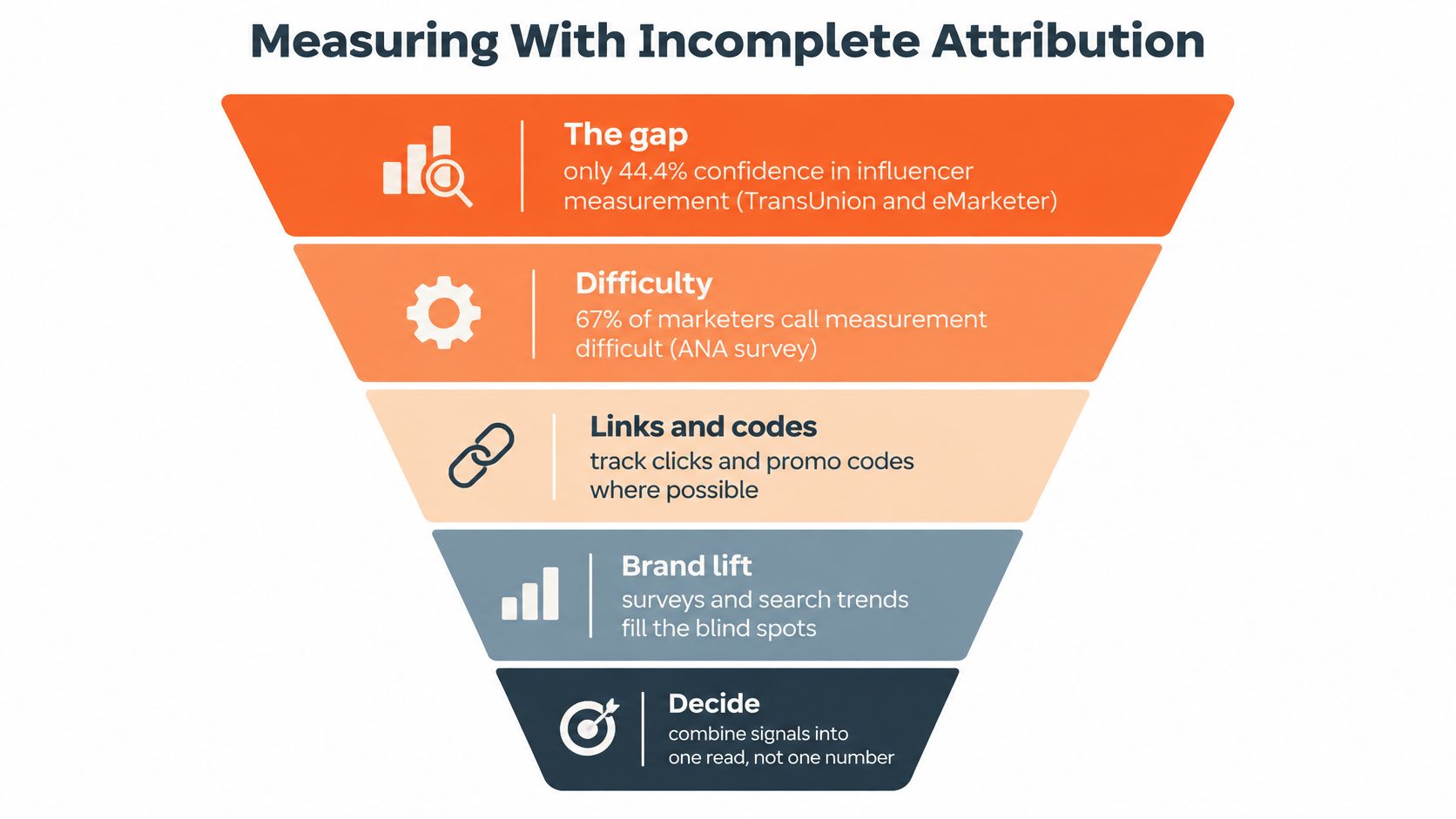
The confidence gap is real. A TransUnion and eMarketer survey gave influencer marketing a 44.4% measurement-confidence score, while an ANA survey found 67% of marketers considered influencer measurement difficult, as summarized by Influencers Time.
Links and discount codes can capture direct responses. They can't fully capture someone watching on a phone, searching later on a laptop, and buying after a friend's recommendation.
The practical response is a hierarchy of evidence, not an invented all-knowing attribution number.
Start with the outcome closest to the goal
For acquisition, assign creator-specific tracking links, codes, or app parameters. Report acquisition cost using the full relevant campaign cost, not just the publication fee.
Distinguish an install from an activated user and a first order from a retained customer. An inexpensive signup can be poor value if that cohort never uses the product.
For consideration, examine qualified visits and meaningful activation. A SaaS campaign might generate product walkthrough requests or completed onboarding rather than immediate subscriptions.
For awareness, examine branded-search movement, post-purchase survey responses, and lift measurement where available. These are evidence of discovery or changed attitudes, not permission to label every subsequent sale creator-driven.
Separate observation from causation
A tracked purchase proves that a recorded path included the creator's identifier. It doesn't automatically prove the customer wouldn't have purchased anyway.
A holdout comparison can help estimate incremental impact when you have adequate volume and a credible comparison group. When you don't, consider a staggered launch, geographic comparison, or matched creator groups.
Each has limits. Regions differ, promotions overlap, and creators don't have identical audiences. Keep changes to pricing, email campaigns, and paid media in the reporting notes so you don't attribute unrelated movement to a creator.
Evidence rule: Direct conversions are observable responses. Incrementality asks what changed because you ran the campaign. Keep those conclusions separate.
Use a creator-level sheet with spend, publication date, tracked outcomes, assisted signals, and customer quality. Add an evidence-confidence column so a plausible interpretation doesn't become a certainty when someone copies it into a presentation.
Our guide to measuring influencer marketing ROI helps turn those inputs into an economic decision.
Don't double-count a purchase captured by both a code and a tracking link. Likewise, don't add survey-reported discovery to tracked revenue as though those were necessarily different customers.
Write the primary metric, supporting evidence, attribution window, and renewal condition into the brief before spending. Incomplete attribution is manageable. Changing the definition of success after launch isn't.
Briefs That Disclose the Deal Without Killing Trust
The fear that a visible sponsorship label automatically kills performance is too simplistic. A 2025 meta-analysis covering 288 effect sizes from 37 studies and 12,721 participants found that disclosure increased persuasion knowledge and brand recall, reduced perceived credibility, and had insignificant overall effects on attitudes and behavioral responses.
That doesn't promise identical results for every campaign. It does undermine the idea that hiding the deal is necessary to preserve sales.
The compliance standard also predates today's creator workflows. On April 19, 2017, the FTC said it had sent more than 90 letters to influencers and marketers, reminding them to disclose material brand relationships clearly and conspicuously.
Make transparency part of the creative
The FTC's Disclosures 101 guide explains that material connections can include payment, free products, and employment relationships, and that disclosures should appear with the endorsement. Don't assume a platform toggle alone resolves the brand's responsibilities.
Build these controls into the brief:
- Record the relationship. Include payment, gifting, affiliate compensation, employment, and permissions for advertising through the creator's account.
- Specify visible disclosure. Require clear spoken or on-screen disclosure at the opening, with an obvious sponsorship label that isn't buried behind expanded text.
- Approve supportable claims. Review health and financial statements carefully, including claims implied by demonstrations.
- Check the live placement. Save evidence, correct missing labels, and record any interruption separately from creative performance.
Preserve the creator's explanation
Give creators truthful product boundaries, then let them explain genuine use in their own voice. A specific account of what the product helped them do is more useful than a generic script padded with enthusiasm.
An honest label lets viewers evaluate a recommendation with the relevant context. Concealing that context isn't a sustainable performance tactic.
For campaigns outside the United States, include a market-specific advertising review. Put disclosure wording, placement, approval responsibility, and correction procedures into the contract before filming begins.
Campaign Patterns Worth Copying
A food campaign offers a straightforward lesson: show the product solving a familiar problem in a setting where viewers can recognize themselves.
A cooking demonstration makes that buying situation concrete.

The repeat-purchase pattern
Our HelloFresh campaign involved 14 lifestyle and foodie creators, generating 12.2 million views, 31,800 conversions, and 4.1× ROAS. Those are campaign outcomes, not a forecast for a startup or proof that any similar food video will perform.
The transferable structure is a relevant niche, a recognizable use case, and a clear offer. A startup food brand could commission recipe-style demonstrations from creators whose viewers already ask about convenient meals.
Keep the offer and buying destination consistent while allowing creators to choose the meal, opening scene, and explanation. That preserves a useful comparison without forcing everyone to publish an identical ad.
Evaluate the resulting customers beyond the introductory purchase. A discount-driven order and a customer who returns at ordinary pricing have different implications for a repeat-purchase business.
The app-install pattern
Our Honey campaign used 20 creators, produced more than 150,000 installs, and delivered 1.7× installs per budget. That reported efficiency result isn't a universal benchmark, and it shouldn't become a promise for another app.
A startup adaptation starts with a visible product benefit: the creator shows the task, demonstrates the app, and gives viewers a direct installation route. The creative should answer why someone would install now, rather than merely announce that the app exists.
Use video review to inspect how naturally the creator introduces the product and hands viewers a next step.
For an install-led test, judge activation and retention before expanding paid distribution. A persuasive demonstration can attract users who understand the product; a vague incentive can attract people who disappear after opening it.
- For repeat purchases. Compare customer quality, contribution after discounts, and subsequent buying behavior.
- For apps. Compare onboarding completion and meaningful product use, not installation volume alone.
- For amplification. Obtain the necessary rights and evaluate the added advertising spend separately.
A first campaign should buy a decision, not imitate a large campaign's view count. Which buying behavior matters to your product: repeat purchasing, qualified demand, or an install that becomes real use?
Decide When to Hire an Agency
Stay in-house when coordination is manageable. A focused campaign can be run by someone who has time to evaluate creators, negotiate scope, review content, maintain records, and reconcile outcomes.
Give that person actual ownership. If campaign work is squeezed between unrelated urgent tasks, missed approvals and inconsistent reporting become predictable operational problems, not evidence that the channel doesn't work.
Choose help for a specific bottleneck
Agency support becomes more useful when you need forecasting, cross-market review, complicated usage rights, or coordinated production. Hire against the work you can't reliably perform, rather than assuming an agency automatically improves every campaign.
- Keep execution internal. Your team can handle the workload and needs direct learning about buyers and creative.
- Bring in support. Outreach, contracts, approvals, or reporting would prevent your team from doing its core job.
- Delay the launch. You still haven't settled the offer, product experience, or acquisition economics.
Social Cloud works with growth-stage e-commerce, apps, SaaS, and games teams that have a KPI to hit. Most campaigns start between €10,000 and €25,000, with performance fees depending on delivery; clients receive a creator strategy, forecast, and budget within 48 hours of submitting a growth target. Our free The 2026 influencer marketing report also contains CPM, CPI, and engagement benchmarks by tier.
Before adding budget, write a campaign decision sheet with the audience, creator tier, platform, primary outcome, spending ceiling, and disclosure requirement. If someone can execute it with clear accountability, run the focused test. If forecasting or operational capacity is the blocker, solve that problem before commissioning content.
Social Cloud brings creator strategy, selection, production, and attribution under one team. Visit Social Cloud with your growth target to request a creator strategy, forecast, and budget, and assess whether a managed campaign fits your next investment.