
You've got a campaign brief, a fixed budget, and three creator quotes that seem to describe the same deliverable. One creator wants $300, another asks for $2,000, and a third quotes $8,000. None of them is necessarily wrong. They may be pricing different combinations of audience access, production, rights, exclusivity, and expected performance.
That's why influencer marketing rates make more sense as a media economics problem than as a follower-count lookup. The useful question isn't “What does a creator with this many followers cost?” It's “What exactly am I buying, how many impressions might it deliver, and what can my team do with the resulting content?”
Table of Contents
Why Influencer Quotes Feel Random at First
A creator quote usually bundles several jobs into one number. The creator may be developing the concept, filming and editing the asset, publishing it to an audience, answering revisions, and allowing the brand to reuse the content. A second creator might be charging only for organic publication, while a third includes paid-media access and category exclusivity.
Those offers look comparable in an inbox because they all say “one video.” They aren't comparable in value.
The package behind the price
Platform changes the economics first. A TikTok video, Instagram Reel, YouTube integration, or Twitch segment has a different production process, audience behavior, lifespan, and distribution path. A polished YouTube placement may take more planning than a short vertical video, while a Twitch activation may involve live interaction and moderation rather than a finished asset.
Creator size adds another layer. A 2024 U.S.-market benchmark places nano creators, those with 0 to 10,000 followers, at roughly $30 to $300 for an Instagram post, $30 to $300 for an Instagram Story, and $100 to $200 for a Reel. Its estimated nano package range is $160 to $800. The same benchmark places micro creators, with 10,000 to 100,000 followers, at about $500 to $2,500 for an Instagram post or Story, $400 to $2,000 for a Reel, and roughly $1,400 to $7,000 for a combined package. The benchmark's full Instagram rate breakdown also shows a much wider range at the mid-tier level.
Practical rule: Treat a quote as a package, not a price card. Ask what asset, audience access, rights, and accountability the number includes.
Growth teams need a forecast before they commit spend. Social Cloud, for example, plans creator campaigns across YouTube, Instagram, TikTok, and Twitch by setting expected views, target CPI or CPA, and platform-level budget allocation before launch. That turns a vague quote into a testable buying decision.
The rest of the buying process follows a simple path: understand the rate gradient, choose a payment model that matches the funnel, forecast delivered media, price rights separately, then negotiate around scope and measurable outcomes.
How Creator Tiers and Platforms Shape Pricing
Creator tiers work like neighborhoods, but the neighborhood isn't the whole property. A larger audience may give a creator more distribution power, while a smaller specialist may offer stronger relevance or more dependable engagement. The format determines the building work, and usage rights determine how widely you can use what you buy.
The clearest published comparison in the available benchmark is Instagram. These figures describe typical U.S.-market ranges, not guaranteed quotes.
| Creator tier | Post range | Reel range | Package range |
|---|---|---|---|
| Nano, 0 to 10,000 followers | $30 to $300 | $100 to $200 | $160 to $800 |
| Micro, 10,000 to 100,000 followers | $500 to $2,500 | $400 to $2,000 | $1,400 to $7,000 |
| Mid-tier, 100,000 to 500,000 followers | $5,000 to $50,000 | $7,500 to $25,000 | $17,500 to $125,000 |
Source: 2024 influencer marketing cost benchmarks.
Why the format changes the quote
A static post may require a concept, product styling, a shoot, editing, caption writing, and publishing. A Reel adds motion, pacing, audio, cuts, subtitles, and often more rounds of creative review. A bundle can lower the effective production cost per asset, but it still increases the total work and the amount of distribution you're purchasing.
That's why two creators with similar audiences can price a post and a Reel very differently. The audience is only one input. The creator's time, equipment, editing skill, creative reputation, and delivery risk all sit inside the quote.
Platform comparisons require the same discipline. A follower count on Instagram doesn't translate directly to average views on TikTok, watch time on YouTube, or live reach on Twitch. Ask for platform-native evidence, such as recent average views for comparable videos, typical Story reach, or historical live attendance. Don't replace those numbers with a follower total because it is easier to read.
Put every quote on the same brief
Before comparing creators, normalize the offer:
- Deliverables: Specify the exact post, Story frames, Reel, integration, live segment, link placement, or repost.
- Distribution: Confirm the platform, account, publishing date, tag requirements, and whether the creator can cross-post.
- Production: State who supplies the product, script, footage, editing, music, and approvals.
- Rights: Separate organic publication from paid usage, whitelisting, raw files, adaptations, and duration.
- Restrictions: Define category exclusivity, territory, and the period during which competitors are excluded.
- Performance: Request expected impressions or views, but label them as forecasts unless the contract includes a guarantee.
A creator with fewer followers can be the better buy if the audience fits, the content earns stronger expected impressions, or the creator provides useful reusable assets. Conversely, a large account can be poor value if the quote includes a costly production scope but no clear distribution or usage plan.
Flat Fee CPM CPA and Hybrid Models Compared
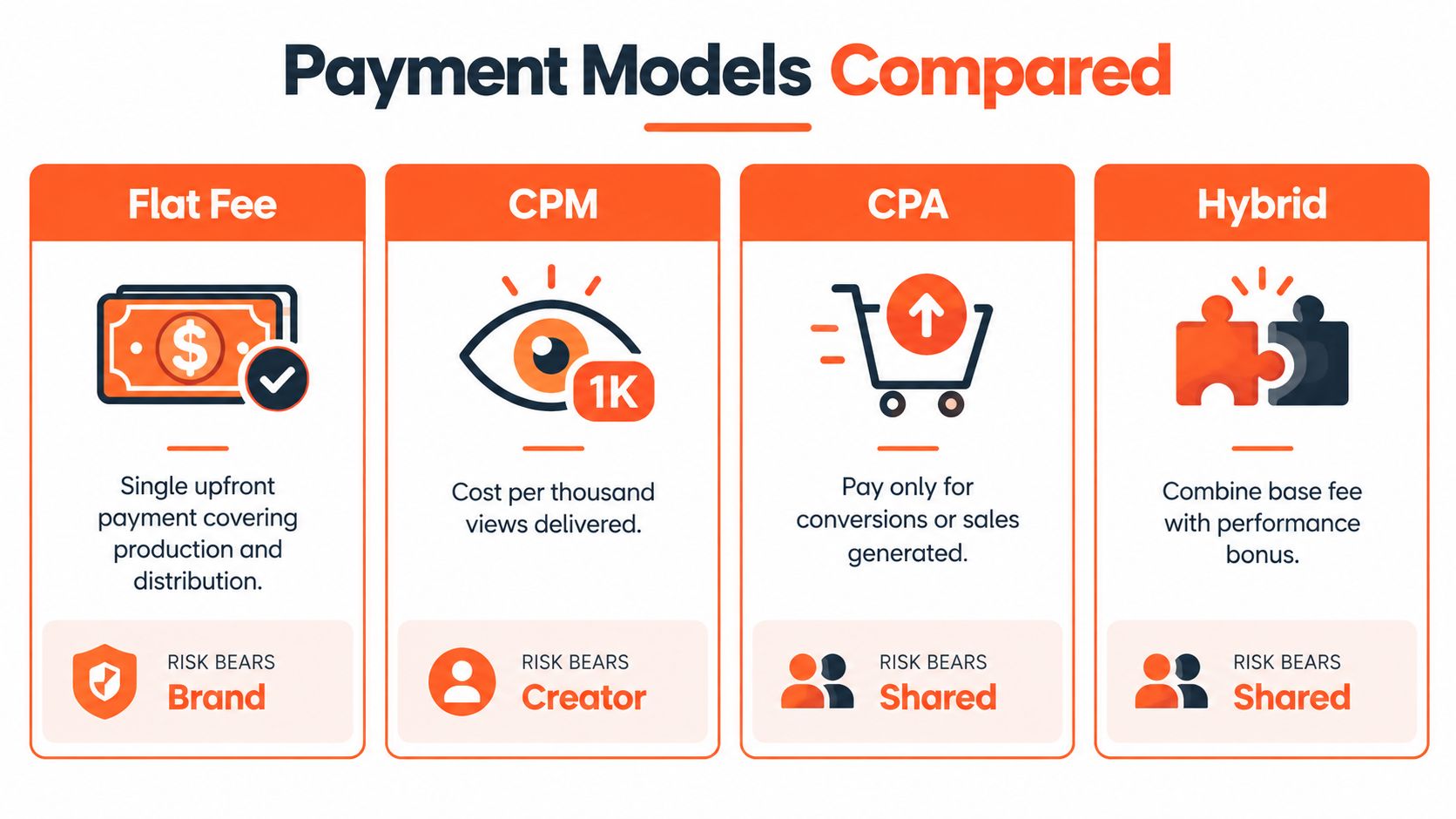
The payment model decides who carries uncertainty. A flat fee protects the creator from weak performance after delivery. A cost-per-action model protects the brand from paying for content that doesn't produce a tracked action, but it asks the creator to accept risks they may not control.
An awareness launch and an app-install campaign shouldn't use the same compensation logic. If the objective is broad exposure, buying a defined creative asset and distribution opportunity may be sensible. If the objective is measurable acquisition, a tracked action or hybrid bonus can create better alignment.
Four ways to share risk
Flat fee means one agreed payment covers defined production and distribution. It's easy to approve and forecast, especially when the campaign needs a guaranteed number of assets or a launch date. The brand carries most performance risk, so the scope and creator selection need to be precise.
CPM links compensation to delivered impressions. It can help compare creators across platforms, but the contract must define what counts as an impression, how reporting is verified, and whether the rate applies to actual or estimated delivery. CPM is more useful for reach objectives than for a long conversion journey.
CPA or CPI ties payment to a tracked conversion, sale, or install. It can suit a short path from content to action, particularly when the offer is clear and tracking links or codes work reliably. It becomes harder to assess when the purchase takes place offline, across devices, after a long consideration period, or through several retargeting channels.
Hybrid compensation combines a guaranteed production fee with a bonus for verified actions. The base protects the creator's time, while the bonus gives the brand a route to incremental accountability. Define the action, attribution window, refunds, fraud rules, view-through credit, and reporting source before publishing.
For a deeper explanation of how delivered impressions affect creator economics, see influencer marketing CPM.
The model should also reflect what the creator can control. A creator controls the quality and timing of the content, but not the landing page, product price, app-store friction, checkout experience, retargeting, or every attribution decision. That's why pure performance pay can be unfair for both sides when the conversion path is complicated.
Available 2025 research indicates that flat fees remain dominant. 31% of brands said they always use a flat fee per post or video, while another 35% said they do so very often. The same research found that 40% never use performance-based remuneration, and only 2% use it always or very often. The World Federation of Advertisers research supports a more practical conclusion: performance structures can work, but they haven't replaced fixed rates.
Forecasting Cost Against Views and ROI
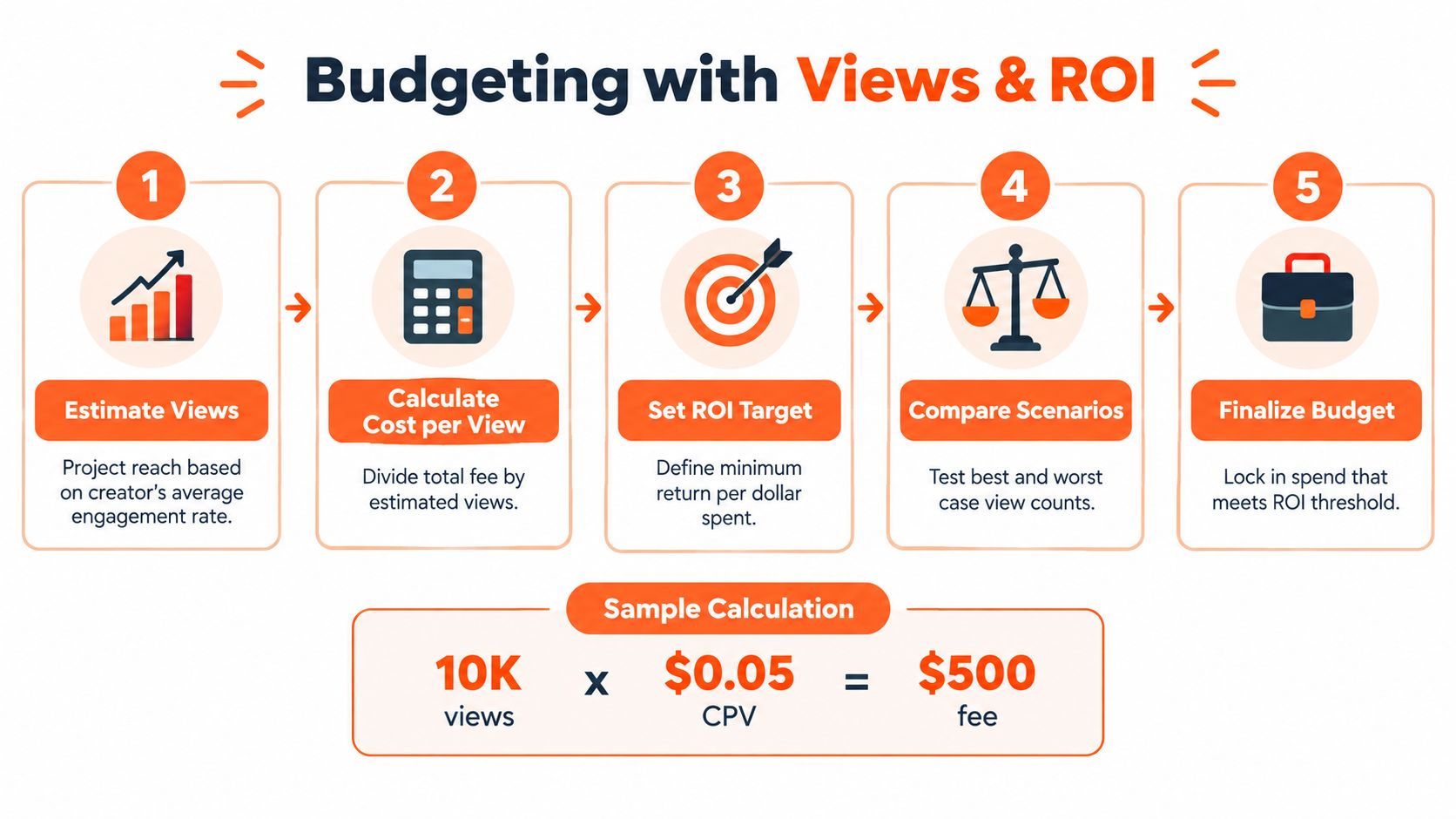
A forecast should answer three questions before money moves: how many impressions or views might the campaign deliver, what will each delivered impression cost, and what action volume would make the spend worthwhile?
Start with the simplest media equation:
Campaign CPM = creator spend ÷ delivered impressions × 1,000
Use delivered impressions after the campaign, not just the creator's follower count. Before launch, use a range of expected views and label it clearly as a forecast.
Build the forecast in layers
Estimate delivery. Request recent average views or impressions for the same format, not a total audience number. Use conservative, central, and upside scenarios when the platform's distribution is volatile.
Calculate the media cost. Divide the creator fee by the expected impressions and multiply by 1,000. If a creator costs $500 and delivers 10,000 impressions, the forecast CPM is $50. The same fee with 25,000 impressions produces a lower effective CPM.
Set an action target. For an app campaign, start with a target CPI. For ecommerce, use CPA or contribution margin. For awareness, use CPM, reach quality, view completion, or a defined engagement goal rather than pretending every campaign has immediate revenue.
Model the funnel. Estimate clicks from views, conversions from clicks, and revenue from conversions only when your historical data supports those assumptions. If you don't have reliable conversion inputs, keep the forecast qualitative rather than manufacturing precision.
Reconcile after launch. Compare each creator's quoted fee with actual tracked impressions, clicks, conversions, and revenue. Reallocate future budget toward creators who combine audience fit with efficient delivered economics.
Suppose Creator A has a smaller audience but a $500 fee and a forecast of 20,000 impressions. Creator B charges $2,000 and forecasts 40,000 impressions. Creator A produces a forecast CPM of $25, while Creator B produces $50. Creator B may still be valuable if the audience converts better or the content has stronger paid-media reuse, but follower count alone doesn't justify paying four times as much.
The useful comparison is not “small creator versus big creator.” It's “what did each creator deliver for the total rights-adjusted cost?”
Include every cost in the denominator or the comparison will mislead you. A fee may look efficient until paid usage, exclusivity, revisions, shipping, management, or production expenses are added. For teams building repeatable planning systems, forecasting models and metrics can help organize scenarios before the campaign starts.
Track every placement with a unique link, promo code, or post-purchase survey. Then use how to measure influencer marketing ROI to connect delivery with business outcomes instead of stopping at published content.
Usage Rights Exclusivity and Hidden Cost Drivers
A creator's organic post and a brand's reusable advertising asset are different products. Buying the first gives you a publication on the creator's channel. Buying the second may give you the right to place that content in paid social, on a landing page, in email, across territories, or in new edits.

Much like music, paying a band to perform at a private event is not the same as licensing the recording for a national commercial. The performance and the commercial use may involve the same song, but the commercial license expands the buyer's control and potential value.
Separate the line items
Recent collaboration data shows that adding usage rights raised average pricing from $221 to $307, a 39% increase. The supporting report on usage rights and creator pricing also highlights why a single "post price" can hide the true campaign cost.
Ask for separate prices or clearly defined inclusions for:
- Organic publication: The creator posts on their own channel.
- Paid usage: Your brand can run the content as an ad.
- Whitelisting or Spark Ads: Your team receives access to promote through the creator's identity or account permissions.
- Raw assets: You receive unedited footage for new cuts and placements.
- Adaptations: The creator or brand produces Shorts, Reels, cutdowns, stills, or cross-platform versions.
- Duration and territory: Rights apply for a defined period and geography, not an accidental perpetual worldwide license.
- Exclusivity: The creator avoids named competitors for an agreed window.
- Revisions: The contract states how many review rounds and reshoots are included.
Exclusivity has an opportunity cost for the creator. If your contract prevents work with an entire category, the creator loses potential income during that period. A narrow competitor list and a limited window are usually fairer than broad category language.
Production complexity can also be easy to underestimate. If the project requires scripted scenes, studio work, motion graphics, or multiple versions, compare the scope with a specialist commercial video production workflow rather than treating the extra labor as a minor edit.
The lowest upfront quote isn't always the cheapest campaign. A slightly higher production fee may be more efficient if it includes reusable assets you can test in paid media. Conversely, paying for broad rights you won't use wastes budget and may weaken the creator relationship.
Negotiating Fair Rates Without Burning Goodwill
Good negotiation changes the package before it attacks the person. Creators know the value of their time and audience, while growth teams know the limits of their acquisition model. Both sides get a better deal when the conversation moves from “Can you do it cheaper?” to “Which inputs matter most for this campaign?”
Start with the forecast. Ask for the creator's recent average views or impressions for comparable sponsored content, then calculate the expected CPM or CPE against the proposed fee. Don't present the metric as a universal rate ceiling. Use it as a shared basis for comparing offers.
Trade scope, not respect
If the quote is above budget, offer a specific exchange:
- Shorten usage: Buy organic publication first, then add paid rights only for winning assets.
- Narrow exclusivity: Name direct competitors instead of blocking an entire category.
- Reduce revisions: Provide a clear brief and one consolidated approval round.
- Adjust the format: Remove a higher-production asset or replace it with a simpler deliverable.
- Bundle assets: Combine a hero video with supporting Stories, Shorts, or Reels when the creator can adapt one production session.
- Extend the relationship: Offer a defined series of campaigns in return for planning certainty, without promising volume you can't fund.
- Shift some risk: Keep a guaranteed production fee and add a bonus for verified clicks, installs, sales, or qualified leads.
The negotiation email should be concrete: “We can keep the proposed Reel and organic publication, but we need paid usage limited to a defined period. If you can include one revision round and provide the raw cut, we can approve the package at the available budget.” That message gives the creator choices rather than demanding an unexplained discount.
Protect measurement and trust
Use unique tracking links, creator-specific promo codes, and post-purchase questions where appropriate. Confirm the attribution window and reporting source before launch. For performance pay, document how refunds, fraudulent actions, duplicate users, delayed conversions, and cross-device behavior will be handled.
Keep disclosure and brand-safety requirements clear. Creators need to know the required claims, prohibited claims, approval process, and publishing rules before filming. Growth teams also need to respect creator voice, because over-scripted content can weaken the very trust they're buying.
Finally, request a line-item quote. A transparent proposal separates production, distribution, usage, exclusivity, rush work, and management. That makes it easier to reduce cost without asking a creator to absorb work that still needs to happen.
Structuring Outcome Linked Fees With an Agency
An agency fee should create accountability without pretending an agency controls every part of the funnel. The strongest structure combines a lean base for strategy, creator management, production coordination, and reporting with a performance component tied to verified installs, conversions, or ROAS.
That arrangement works when the rules are written before launch. The team should define the KPI, attribution source, conversion window, fraud treatment, reporting cadence, and the difference between creator budget and agency compensation. Creator payments should remain visible rather than disappearing inside an unexplained blended total.
Social Cloud is one example of this approach. It plans campaigns across major creator platforms, uses tracking links, promo codes, and surveys for placement-level attribution, and combines a base fee with performance-linked compensation. Its influencer marketing agency pricing should be evaluated through that scope, not through the agency fee alone.
Buy accountability as a system: forecasting, rights management, verified attribution, weekly learning, and budget reallocation should connect from the first brief to the final report.
Ask prospective partners how quickly they can produce a forecast, how they vet audiences, what the contract says about rights, and how they decide which creators receive more budget after launch. A useful partner should make influencer rates easier to compare, not add another opaque layer.
The decision becomes straightforward: define the asset, price the rights, forecast delivered media, choose a payment model that matches the funnel, and pay bonuses only against outcomes the measurement setup can verify.
Social Cloud helps growth teams plan, run, and measure creator campaigns across YouTube, Instagram, TikTok, and Twitch, with creator selection, rights management, tracking, and reporting in one workflow. If you want to turn influencer marketing rates into a rights-adjusted forecast with outcome-linked fees, visit Social Cloud and bring your next campaign brief.