A creator posts a product demo that feels effortless, and the audience responds immediately. Comments pile up, viewers share it, and people ask where they can buy. Meanwhile, your paid team is preparing another polished In-Feed Ad that has already been through production, approvals, and several rounds of revisions.
The obvious question is simple: can you put paid budget behind the exact post that people already like without stripping away the creator's voice? That's the job TikTok Spark Ads are designed to do. The difficult part isn't understanding the phrase “boost an organic post.” It's managing authorization, preserving engagement, and choosing Spark Ads instead of a dark post when the operational trade-offs matter.
Table of Contents
- The Moment a Creator Post Outperforms Your Best Ad
- How the viewer experiences the ad
- Spark Ads and standard In-Feed Ads
The Moment a Creator Post Outperforms Your Best Ad
You're reviewing organic content with a growth lead when one creator post keeps outperforming the polished ads in the folder. The lighting is casual, the opening sounds conversational, and the creator explains the product in the same language the audience uses in the comments.
The team's first instinct may be to download the video, request a new cut, or rebuild the idea as a brand ad. Each option can create distance from the original. A re-cut may lose the timing that held attention. A screenshot of the comments cannot carry the post's live social proof. A fresh upload starts with a different identity and no engagement history.
Practical rule: When the audience has already validated the post, preserve the post before you try to improve it.
That choice became possible at scale when TikTok launched Spark Ads globally in July 2021. The format lets advertisers put paid distribution behind an existing organic post while keeping its native context and engagement signals, as described in TikTok's Spark Ads guidance.
The operational question is whether the winning post can move into paid media without being rebuilt. The creator still owns the original publishing context, while the brand must obtain permission to use the post and connect it correctly in Ads Manager. Those steps determine whether the team can promote the actual post or must create a separate ad.
That distinction matters because a Spark Ad is closer to extending a live conversation than placing the same script on a blank billboard. The creator's account identity, caption, comments, and existing reactions remain part of the asset viewers encounter. Rebuilding the content may preserve the message, but it changes the object that earned attention.
A practical review should therefore ask three questions before budget is assigned:
- Has the post earned meaningful audience response without paid support?
- Will the creator authorize its use for advertising?
- Does preserving the original post offer more value than producing a new dark post?
The first answer identifies a candidate. The second makes that candidate usable. The third connects creative performance with the media team's operating constraints. Spark Ads are valuable when that connection is stronger than the case for starting over.
What TikTok Spark Ads Actually Are
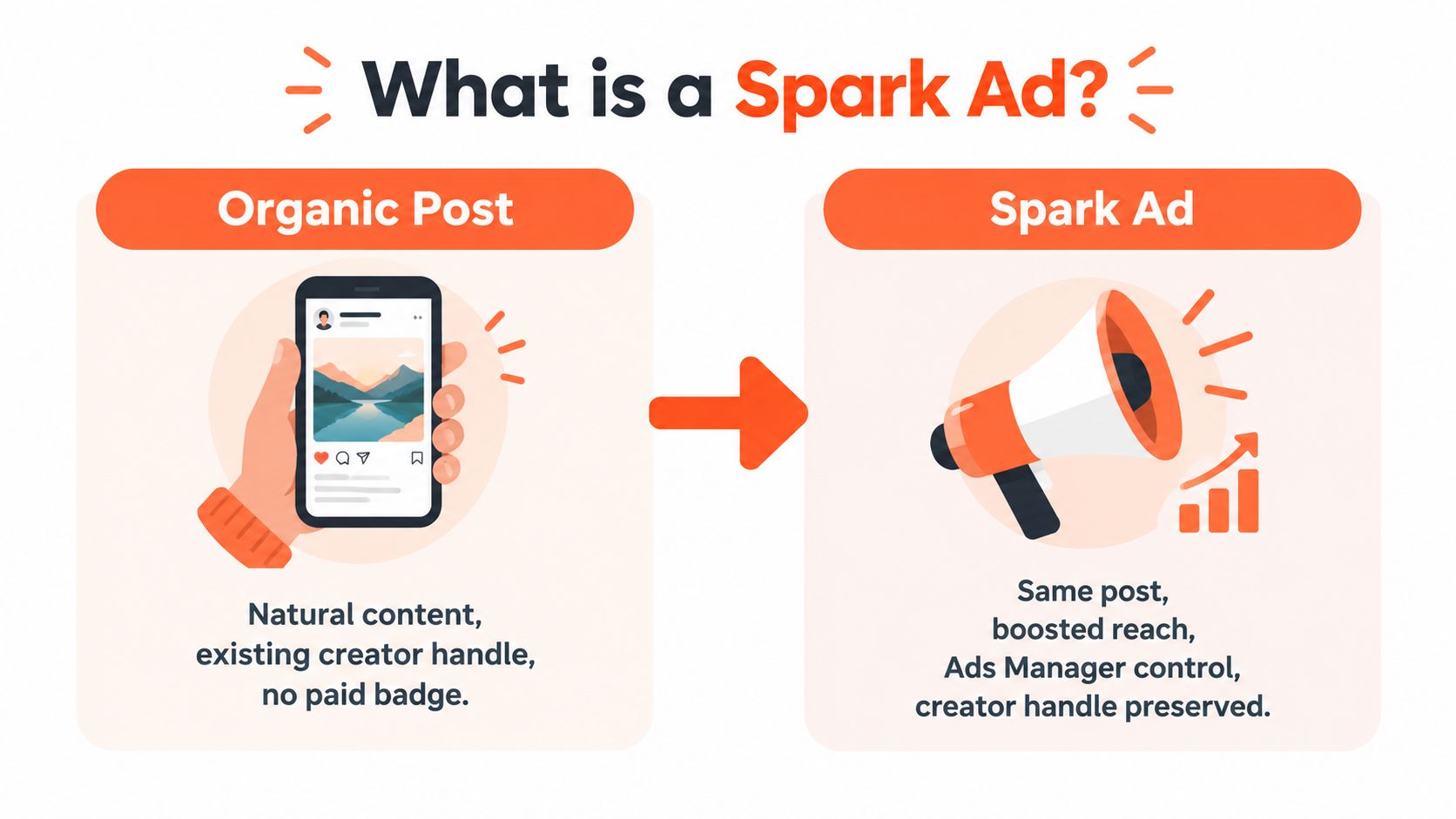
A TikTok Spark Ad is a paid promotion built from an existing organic TikTok post. The post can belong to the brand or to a creator, provided the advertiser has the necessary authorization. In Ads Manager, the advertiser selects that post instead of uploading a separate video as a new ad asset.
The simplest analogy is the difference between resharing a real conversation and renting a blank billboard. A blank billboard gives you space to place a message, but it has no history. A Spark Ad amplifies a post that already exists, with its account identity, caption, sound, and visible engagement attached.
That native structure is the important part. TikTok describes Spark Ads as a format that boosts organic posts while preserving post-level engagement signals. Views, comments, shares, likes, and follows generated during promotion are attributed back to the original organic post, so paid distribution doesn't split the interaction history across a second creative.
How the viewer experiences the ad
The viewer still sees the content in TikTok's in-feed environment. The post is connected to the account that published it, and the user can interact with the post rather than encountering a completely separate ad object with no organic home.
That doesn't mean Spark Ads are invisible advertising. Paid placements carry TikTok's advertising treatment, including a sponsored indication. The point is not to disguise paid media. The point is to preserve the context that made the content feel native in the first place.
Spark Ads and standard In-Feed Ads
A standard In-Feed Ad can be uploaded as fresh creative through Ads Manager. The brand controls the video asset and can create a version that isn't published organically on its profile. That approach is useful when the team needs tight control over scripts, variations, landing-page language, or campaign-specific messaging.
A Spark Ad starts with a TikTok post and keeps the post's account identity. It can use a creator's post or a brand's own organic post. In both cases, the advertising layer is added to an existing TikTok asset rather than replacing it with a separate upload.
Spark Ads therefore don't replace organic content or standard paid creative. They connect the two. Organic publishing supplies the post and its audience response. Paid media supplies additional distribution, targeting, and performance measurement.
Why Engagement Inheritance Changes the Math
Engagement inheritance matters because the post doesn't start its paid life as an empty creative. Existing likes, comments, shares, and follows remain connected to the original post when the brand promotes it. New interactions generated during the campaign also flow back to that same post, according to TikTok's Spark Ads documentation.
That creates two practical effects. First, viewers encounter a post with visible social context rather than an asset that appears to have no audience response. Second, the brand and creator continue building interaction on one public post instead of dividing it among multiple versions.
Consider three ways to use the same underlying footage:
| Format | Engagement inherited | Creator handle shown | Organic post required |
|---|---|---|---|
| Spark Ad | Yes, from the authorized post, with new engagement added to the same post | Yes, the post's account identity remains attached | Yes |
| Re-uploaded In-Feed Ad | No, the new upload begins without the original post's engagement history | No, unless the brand's uploaded ad identity is used | No |
| Dark post | No public organic engagement history | Brand advertising identity or configured ad identity | No |
The footage may be identical, but the audience receives a different signal. A Spark Ad says, in effect, “this is a real post from this account, and people have already interacted with it.” A re-upload says, “this is a new ad asset.” A dark post keeps the asset inside paid distribution without requiring a public organic post.
Why the original post can be more useful than the edit
Teams often treat likes and comments as vanity metrics. In this context, they're also part of the creative environment. A creator's wording, profile identity, visible reactions, and comment thread can help viewers interpret the video quickly, especially when the first impression has to feel native to TikTok.
That doesn't guarantee better performance. Engagement inheritance can't rescue a weak hook, an unclear offer, or a poor landing page. It does give the paid campaign a different starting context from a re-uploaded asset.
The timing of the decision matters too. If the creator post is gaining meaningful organic attention, the brand should decide whether to authorize it before changing the caption, removing the post, or letting the campaign window become disconnected from the original audience response. Treat the selected post as a strategic asset, not as a file to be copied into Ads Manager later.
How Post Authorization and Ads Manager Access Work
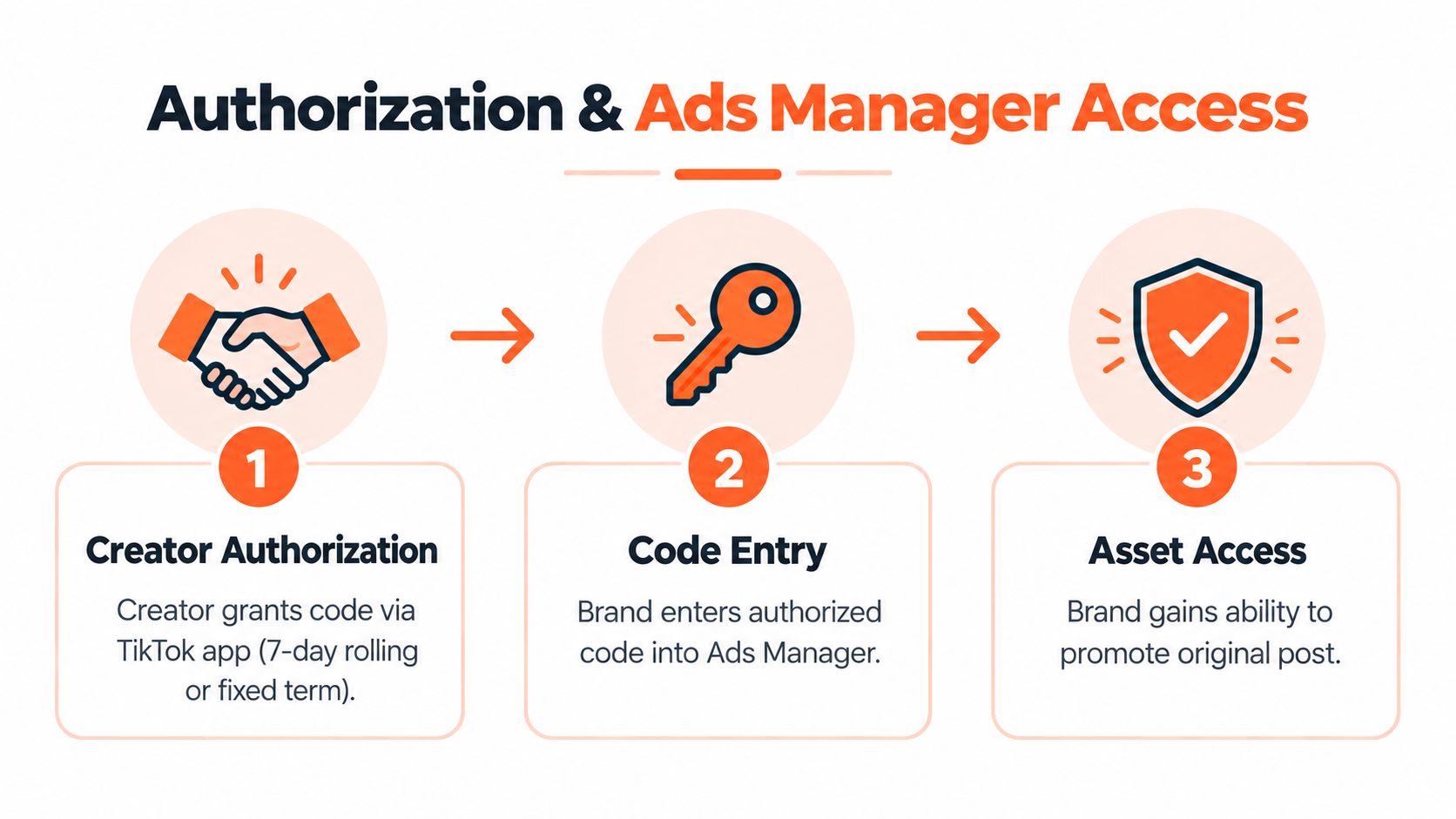
Authorization is the operational gatekeeper for creator Spark Ads. A brand can't just find any public TikTok video and turn it into paid media. The post owner must grant permission through TikTok's supported authorization process.
TikTok supports several routes. A creator can generate a post code from the app's advertising settings and send it to the brand. A business can also connect to authorized posts through the relevant business access workflow. For teams using the API, TikTok provides authorization operations that include enabling ad authorization, applying codes, and extending or deleting authorization periods, as described in the Spark Ads creation guide.
The code workflow
The creator opens the relevant post, enters the post's ad settings, enables authorization, and generates a code. The brand then enters that code in Ads Manager, where the authorized post becomes available for selection in the Spark Ads workflow.
TikTok says advertisers can batch authorize up to 20 video codes at a time. That limit matters when creator operations move beyond occasional partnerships. A spreadsheet or campaign tracker should record the creator, post URL, code status, authorization window, campaign, and person responsible for renewal or removal.
The alternative business-access route can be more suitable when a brand expects repeated collaboration with the same creator or needs a more structured account relationship. Whichever route you choose, permission should be agreed during contracting rather than treated as a launch-day request.
Authorization as governance
Authorization gives brands control over which posts they can promote and for how long. It also gives creators control over where their content is used. A code can be limited to an approved post and a defined validity period, and the creator can revoke or remove access according to the platform's controls.
That creates a useful approval checkpoint:
- Before posting: confirm disclosure, usage rights, landing-page claims, and the intended paid objective.
- After posting: verify the exact post, account identity, caption, and comments before requesting authorization.
- Before launch: check that the code works, the post is selectable, and the campaign dates fit the authorization period.
- During delivery: monitor whether the post remains available and whether authorization needs attention.
A reliable operating model keeps creator operations, legal review, and paid media aligned. If the creator believes the post will only support organic distribution while the brand plans paid amplification, the disagreement will appear at the worst possible moment, after the creative has already been produced.
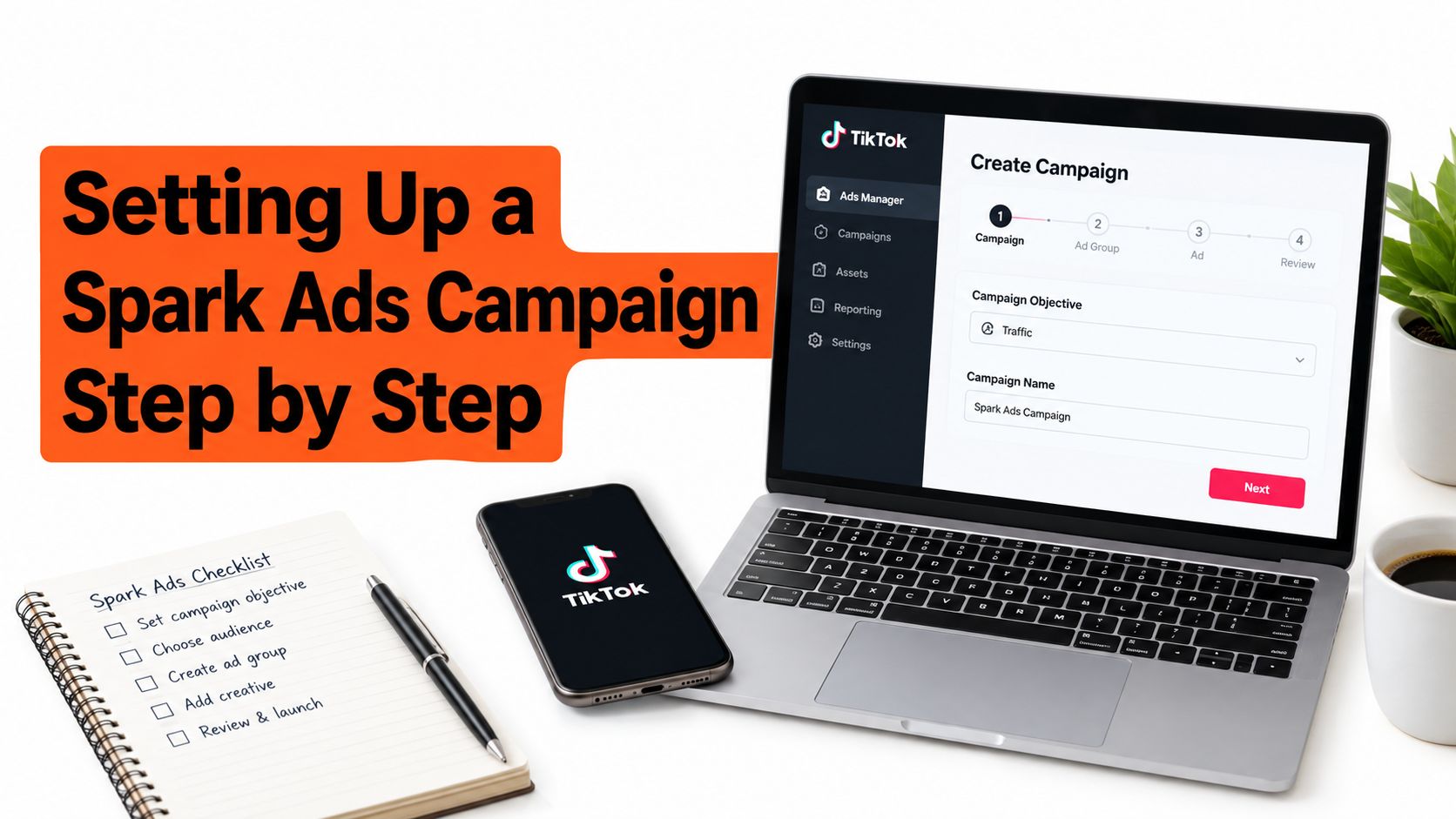
Setting Up a Spark Ads Campaign Step by Step
Start with the brief, not Ads Manager. The creator needs to know that the post may become paid media, which means the hook, product claims, disclosure, caption, and intended usage should be reviewed before publication.
Once the post is live, the creator either sends an authorization code or grants the required business access. The brand then imports the post through the Spark Ads workflow and selects the existing post identity. The advertiser isn't replacing the creator's post with a new upload. The goal is to keep the original post connected to its account and engagement history.
A practical launch sequence
- Approve the organic concept. Confirm the creator's opening, product demonstration, disclosure, caption, sound, and destination before the post goes live.
- Publish and observe. Give the post an opportunity to generate organic audience response. Look beyond views. Read the comments, check whether viewers understand the offer, and watch for brand-safety issues.
- Secure authorization. Collect the code or complete the business-access workflow. Record the validity window in the campaign tracker.
- Import the post. In Ads Manager, choose the Spark Ads option and select the authorized post identity. Confirm that the account name and post preview are correct.
- Choose the objective. Spark Ads support objectives such as video views and conversions, according to TikTok's official materials. Select the objective that matches the business question rather than treating every Spark Ad as a reach campaign.
- Add the destination and tracking. Check that the landing page reflects the creator's promise. Add consistent UTM parameters so paid traffic can be evaluated outside TikTok.
- Review before launch. Check the authorization status, post identity, caption, CTA, destination, disclosure, and campaign dates.
For broader guidance on launching paid activity, see how to start TikTok ads. The exact interface can change, so use the current labels shown in your Ads Manager account.
What to read after launch
Don't scale solely because the first delivery numbers look encouraging. Review how long viewers stay, whether comments show genuine product interest, and whether clicks reach the promised page. Compare the Spark Ad with your normal paid creative using the same measurement definitions and attribution window.
The post identity is part of the asset. If the creator changes availability or authorization, the ad may no longer be usable. Your launch checklist should therefore include a named owner for creator communication, not just a media buyer responsible for budget.
When Spark Ads Beat Standard In-Feed Ads
A creator post earns strong watch time and useful comments before the media budget arrives. The brand then faces a practical choice: promote that post through Spark Ads, or build a separate standard In-Feed Ad. The better option depends on what the campaign needs from the creative, not just on which format is newer.
Spark Ads usually fit when the post already feels native to TikTok. The creator's delivery makes sense to the audience, the product appears in a believable context, and the reactions support the message rather than distracting from it. Paid distribution can extend that working asset instead of asking a new ad to establish credibility from zero.
TikTok reports a 134% higher completion rate and a 157% higher six-second view-through rate for Spark Ads compared with standard In-Feed Ads in TikTok's official Spark Ads materials. The same materials report a 69% higher conversion rate and 37% lower CPA for an updated Spark Ads profile landing page interface. These figures describe TikTok's comparisons, not a guaranteed result for every creator, audience, or offer.
Use Spark Ads when these conditions fit
The post has a clear commercial signal. Comments ask about the product, viewers respond to the demonstration, or the creator explains a problem the offer actually solves. High views alone are not enough. A viral joke or trend can attract attention without giving a paid campaign a useful reason to continue.
The creator's public identity helps the message. Spark Ads keep the post connected to its publishing account. That can make the ad feel like a continuation of the creator's content. It also means the team must accept the post's existing caption, presentation, and public context.
Authorization is available for the planned run. Treat the authorization code or business-access approval as campaign infrastructure, not a last-minute permission. Confirm who owns the account, how long access lasts, and who will renew it if the campaign continues.
The team can work with the original asset. Spark Ads suit campaigns that want to amplify an existing post. Standard In-Feed Ads are better when the brand needs several hooks, frequent edits, strict copy control, or a promotional frame that should never appear on the creator's profile. That separate upload is a dark post, so it can be built for paid delivery without becoming a public creator post.
Measurement can separate creative fit from media performance. Compare Spark and standard In-Feed Ads using the same attribution window, conversion event, and landing page wherever possible. Track approval status and post availability alongside CPA and conversion rate. A strong result is less useful if the asset cannot remain authorized.
For a broader assessment of whether TikTok ads are worth it, apply the same test to Spark and non-Spark creative: audience response, access, message control, and measurable business value.
Deciding If Spark Ads Belong in Your Next Brief
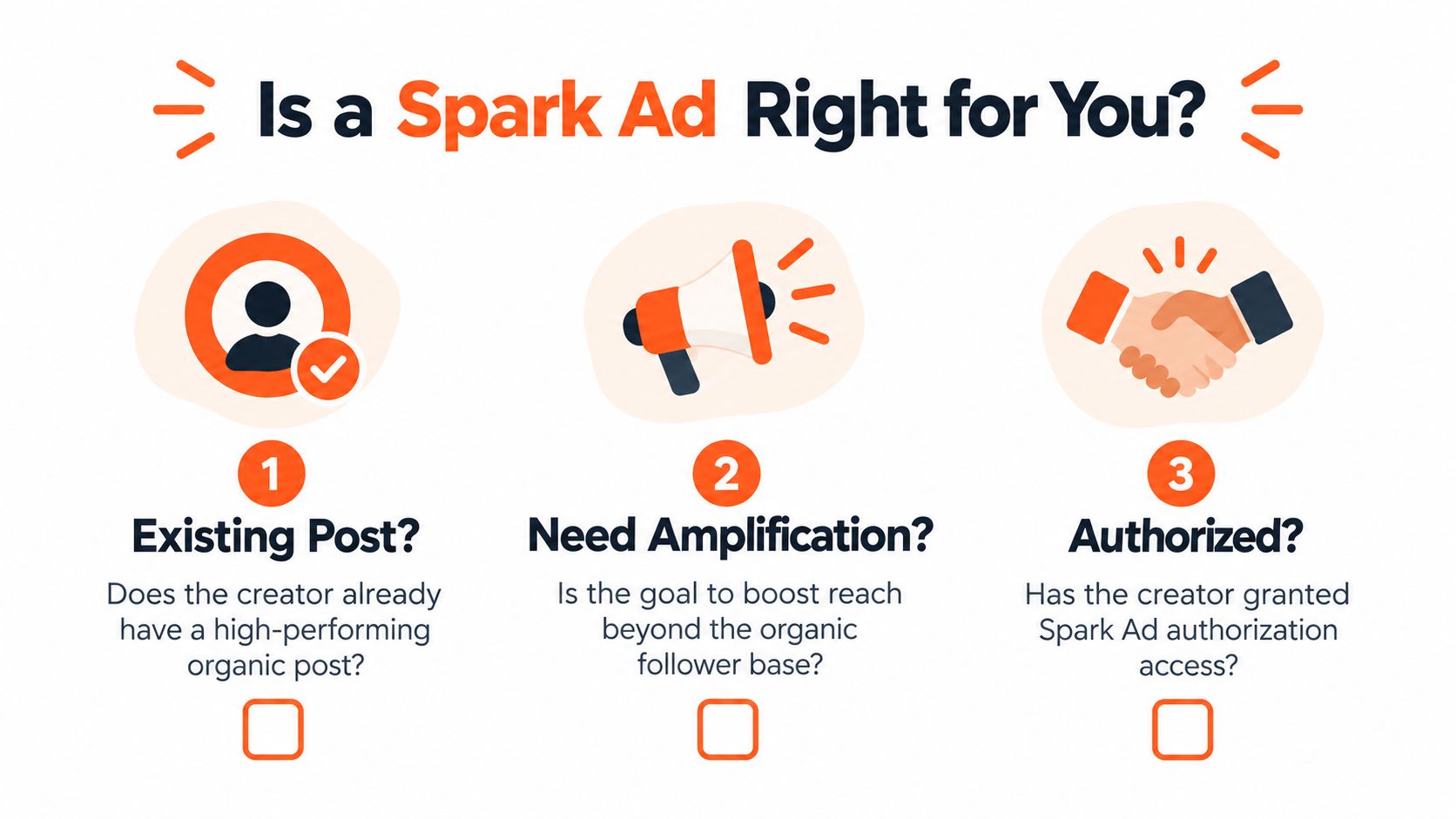
A Spark Ad belongs in the media plan when three conditions line up: the post is already showing audience response, the creator can authorize it cleanly, and the campaign objective benefits from native engagement rather than maximum creative control.
Use this decision check before you promise paid amplification.
Check the post
Look for a post that has more than passive reach. Read the comments, inspect the shares and likes, and decide whether viewers are responding to the actual product message. A post can attract attention for a reason that has nothing to do with purchase intent, so don't confuse popularity with suitability.
Check access
Ask whether the brand can secure authorization from the correct account owner. The code or business-access request should be part of the creator workflow, with a recorded validity period and a clear owner for renewal. If the post owner can't approve paid usage, the creative isn't ready for a Spark campaign.
Check the objective
Spark Ads make sense when the team wants to amplify a native post while preserving its engagement context. They're less suitable when the campaign requires extensive editing, tightly controlled copy, or a series of assets that should remain separate from the creator's profile.
Two disqualifiers deserve an early discussion. A creator's tone may conflict with brand-safety requirements, or the product category may have restrictions that prevent creator amplification. Resolve those issues before production, not after the post has become the obvious paid winner.
For planning context, see TikTok Spark Ads cost considerations, but keep the decision anchored to the asset and workflow rather than a generic benchmark. The useful takeaway is straightforward: choose the post for its audience signal, secure authorization before launch, and use Spark Ads when preserving creator context matters more than rebuilding the creative from scratch.
Social Cloud plans, runs, and measures creator campaigns across TikTok and other platforms, including creator selection, authorization and usage-rights support, Spark Ads amplification, and outcome-focused reporting. If you want help turning organic creator posts into trackable paid campaigns, visit Social Cloud and discuss your next brief with the team.