You can have a creator post that looks great in the dashboard and still wonder why the pipeline didn't move. The views are there. The comments look healthy. Revenue, though, stays stubbornly flat, and your team ends up debating whether the issue was the creator, the brief, the offer, or the tracking.
That's the core problem with a lot of key opinion leader marketing advice. It stops at visibility, when growth teams need a system that connects expert voices to CPA, ROAS, installs, and revenue. The channel has also become too big to treat casually, with one widely cited estimate putting the influencer marketing market at about $17.4 billion in 2022 and projecting it to reach roughly $32.55 billion in 2025 (Statista). For teams under pressure to prove efficiency, that scale matters because creator-led persuasion is now a mainstream budget line, not a side experiment.
Table of Contents
- Introduction to Key Opinion Leader Marketing for Growth Teams
- Expertise changes the conversion path
- KOLs, not just loud voices
- Get the forecast before you talk to creators
- Build the shortlist, then contract cleanly
- Launch, then amplify what works
- Build attribution into every placement
- Treat compliance as part of performance
- Report on business metrics, not just content metrics
Introduction to Key Opinion Leader Marketing for Growth Teams
A growth team can launch creator content, watch the post perform, and still face the same question in the next meeting, “Did it drive anything?” If the answer is based on vibes, the channel is being treated like expensive attention instead of a revenue tool.
Key opinion leader marketing works better as a performance system. Select the right expert voice, brief it with a clear job, price it against the outcome you want, then measure what comes back through the funnel. Brands are already spending with that mindset, and Statista reports that many maintained or increased influencer budgets in 2025, with a sizable share raising spend by 11% or more. That shift makes sense, because buyers often trust a credible voice more than polished ad copy.
For growth teams, the useful question is simple. Which creator can influence the next step in the journey, lower CPA, or lift ROAS? A creator brief should answer that before a post ever goes live, the same way a media plan defines audience, offer, and conversion event before spend starts.
This guide follows that operating logic. It starts with what a KOL is, then compares KOLs with general influencers, then moves into selection, briefing, pricing, launch, and attribution. If you work in UA, demand gen, or growth, the goal is not to admire content. It is to build a repeatable system that can defend budget with business results.
Practical rule: if you cannot explain why a creator should lower your CPA or improve your ROAS, the role is not defined well enough.
What Key Opinion Leader Marketing Really Means
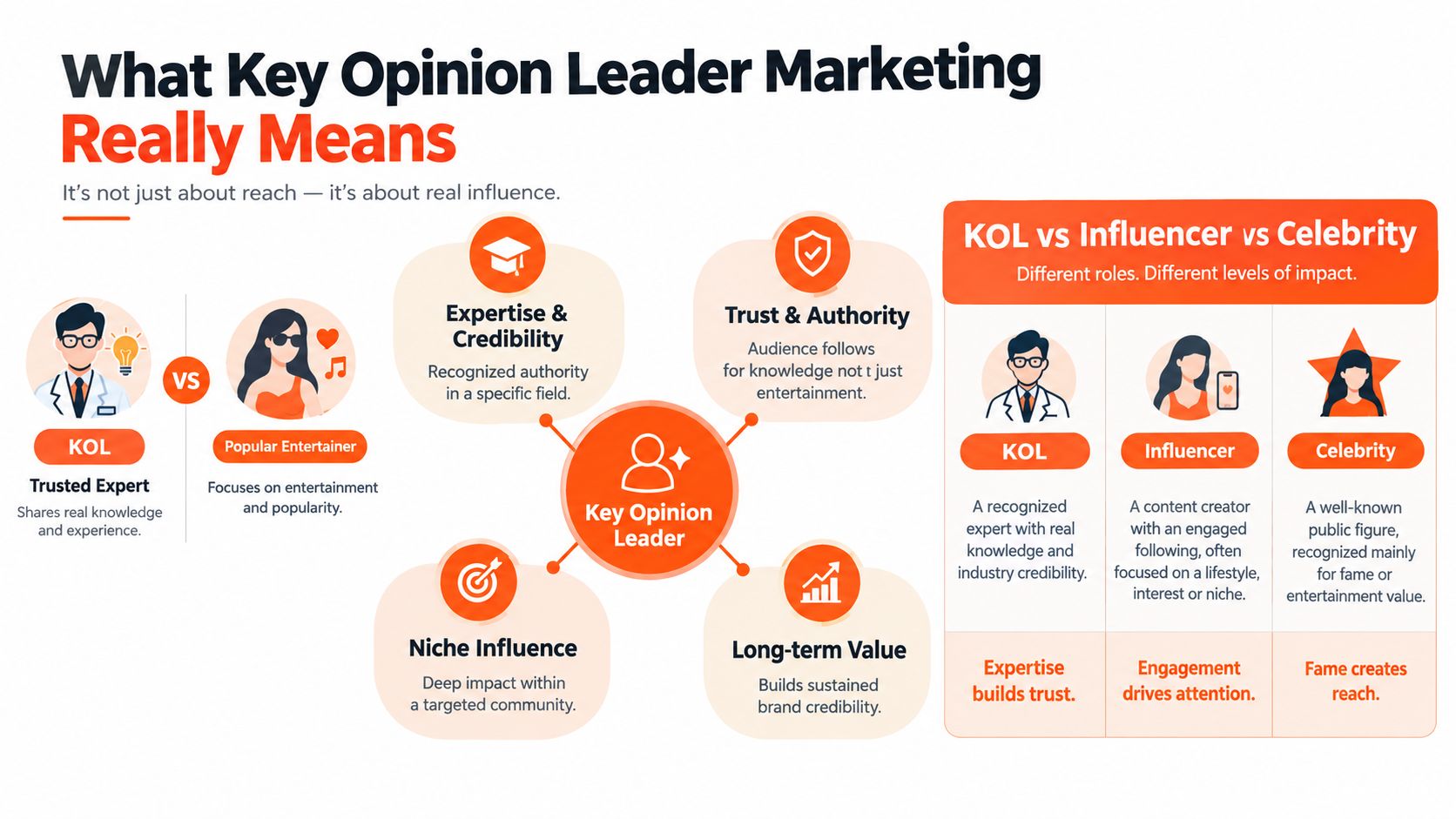
A key opinion leader is not just someone with an audience. It's someone people trust because they've built authority in a specific field, and that changes how their recommendation lands. It's the difference between a popular entertainer and a specialist you'd ask for advice before making a decision.
Expertise changes the conversion path
In practice, KOL influence usually comes from expertise, credibility, and contextual authority. Academic work on KOL effectiveness shows that trustworthiness and expertise are the most influential drivers of consumer trust and purchase intention, with familiarity also contributing positively (INFEB article). That's why a KOL isn't just another creator with strong content. They're a credible source in a niche where the audience wants guidance, not just entertainment.
That distinction matters across channels. On YouTube, a detailed product breakdown can build consideration. On TikTok or Instagram, a trusted expert can make a skeptical viewer stop, listen, and act. On Twitch, a creator with deep authority in a game or category can shape what the audience considers worth trying. The channel format changes, but the mechanism stays the same, people listen because they trust the person, not just the production.
KOLs, not just loud voices
The easiest way to remember the difference is this, a loud voice gets attention, a trusted voice changes decisions. KOL marketing works best when the audience is already thinking about a problem, comparing options, or worried about risk. That's why it's so common in categories where confidence matters and where a bad choice feels expensive.
If you're trying to build a KOL roster or use creator support as part of a broader growth motion, it helps to think of the KOL as a specialist partner, not a media asset. A useful reference point for how teams structure that relationship is the way a creator marketing agency coordinates sourcing, briefing, and reporting around a creator program. The point isn't to copy a branding playbook. It's to keep expertise, fit, and accountability in the same system.
Key Opinion Leader Marketing Versus Influencer Marketing
A growth team can spend on creators and still miss the business goal if it treats every creator like the same kind of asset. The difference starts with the job each one is hired to do. Influencer marketing usually drives reach, momentum, and audience response. KOL marketing is built for credibility, decision support, and trust inside a specific niche.
Here's the simplest way to separate them.
| Dimension | Key Opinion Leader | General Influencer |
|---|---|---|
| Audience intent | People want guidance, validation, or expertise | People want entertainment, inspiration, or trend awareness |
| Main trust driver | Professional knowledge, authority, and relevance | Personality, style, and social proof |
| Content style | Educational, analytical, specific | Lifestyle, aspirational, broad appeal |
| Pricing logic | Often tied to expertise, scarcity, and campaign depth | Often tied to reach, format, and audience size |
| Measurement need | Attribution, incrementality, conversions, downstream revenue | Reach, engagement, and content performance |
When a KOL wins
A KOL fits best when buyers are careful, technical, or already close to a purchase decision. That is common in SaaS, fintech, health, gaming, and other categories where proof matters before the click. A specialist recommendation works like a product demo from someone the audience already trusts, it reduces hesitation instead of just adding noise. Recent industry data shows 73% of brands preferred micro and mid-tier creators in 2025 because of the stronger engagement-to-cost ratio, which aligns with the KOL focus on depth over raw scale (PR Newswire).
When a general influencer wins
General influencers make more sense when the goal is broader social proof, fast awareness, or more creative output. That does not make them weaker. It means they are solving a different problem. If a consumer launch needs broad top-of-funnel attention, a wider creator mix can do more useful work than a narrow expert roster.
The mistake is treating all creators like interchangeable inventory. They are not. A creator can produce strong content and still be the wrong performance partner if the audience, offer, and buying moment do not line up.
For the content side, the planning habits used in actionable creative marketing tips still apply, but the bar is different here. The creative has to support measurement, not just look polished.
Practical rule: use KOLs when trust has to do the heavy lifting, and use broader influencers when distribution is the main job.
How to Design a High Performing KOL Campaign Framework
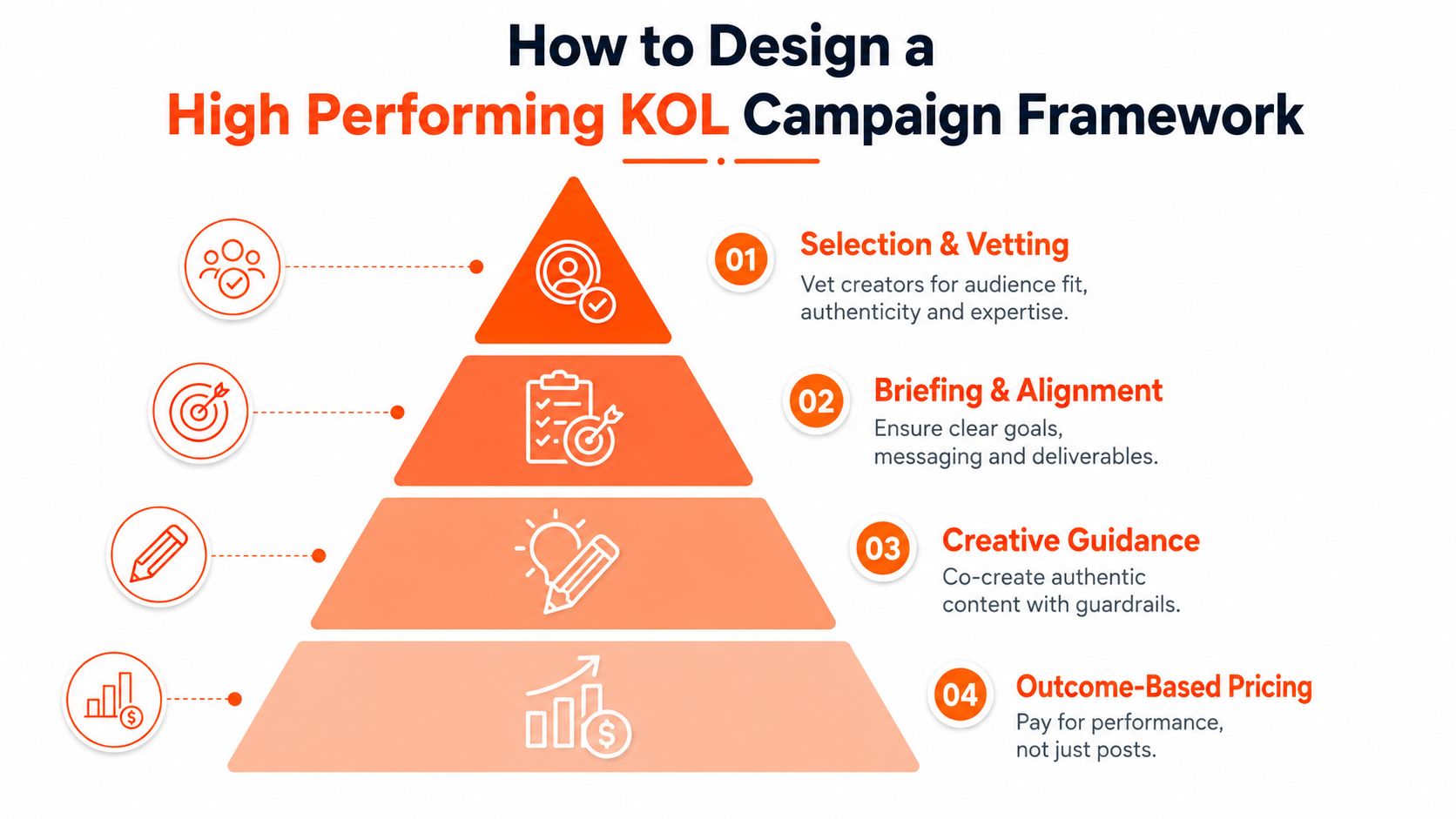
A strong KOL campaign starts before you pick a creator. If you choose first and define the job later, you usually pay for a voice that sounds right but fails where it matters, in the funnel. The better model treats the campaign like a sequence of choices, each one cutting waste and improving the odds of CPA and ROAS.
Start with selection and fit
Selection should look past follower count. Analysts in the SCITEPRESS paper found that choosing the most popular KOLs in a short-video market could reduce revenue even with a large budget, while better results came from matching creator traits such as unique style, positive audience rating, and activity level. That fits what performance teams already see, the strongest creator is not always the largest one.
A useful shortcut is to ask one question first, will this person help the audience trust the offer, or just add reach? If the answer is only reach, the fit is probably wrong for a revenue campaign.
Brief for outcomes, not vibes
Once the shortlist is set, the brief should protect the message and the creator's voice. If you script every line, you remove the part of the content that made the creator credible. If you under-brief, you get content that looks good but does not move a buyer.
A practical brief covers the problem, the offer, the proof points, the action you want, and the boundaries the creator must respect. Then the creator turns that into their own format and tone. The audience follows them for judgment, not for brand copy.
Price to the business result
The strongest KOL programs do not price only by post. They set a base fee, then align it with a performance component where possible, so the creator is tied to the business result rather than the appearance of activity. Industry reporting from PR Newswire also showed that many brands were investing heavily in creator work, while many influencers charged in a wide per-post range. That split is the point, content cost and business value are not the same thing.
Price the creator against the outcome you expect, not the post itself. Define the result, match creator attributes to that result, forecast the economics, then choose the mix that gives you the best expected conversion efficiency.
Putting Your KOL Plan Into Action Step by Step
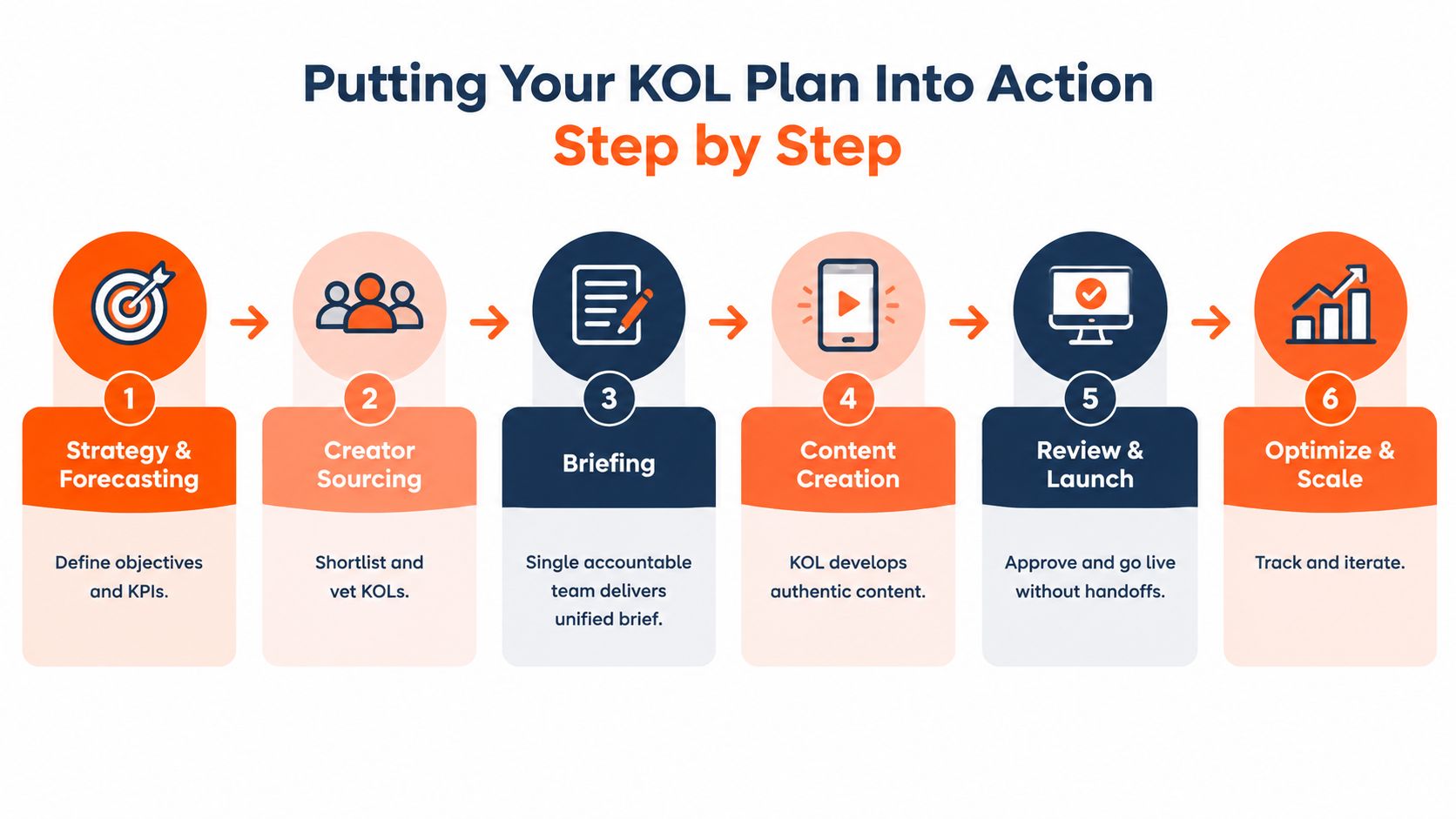
Speed matters, but speed without sequence just creates rework. Growth teams usually waste time when creative, legal, and reporting all operate like separate departments instead of one campaign flow. A single accountable owner fixes more than people think.
Get the forecast before you talk to creators
The first move is strategy and forecasting. You want the objective, the KPI, the expected economics, and the platform mix locked before outreach starts. Social Cloud, for example, structures this around strategy and forecasting with target CPI or CPA, expected views, and platform-level budget allocation before spend. That kind of preparation keeps the campaign anchored in a number the business cares about.
Build the shortlist, then contract cleanly
Once the direction is clear, source creators from a vetted network, then handle contracting, disclosure, and usage rights before anything goes live. That part sounds boring, but it's where a lot of campaigns fall apart. If usage rights aren't settled, you can't confidently repurpose the content later. If disclosure is unclear, you create compliance risk before you've even measured performance.
Launch, then amplify what works
After briefing and QA, launch on the channel where the audience already expects that creator type to show up. For some campaigns that's YouTube, for others it's TikTok, Instagram, or Twitch. Then look at whether the content deserves amplification through formats like Spark Ads or Shorts and Reels variants, because creator content often performs differently once it's reused in paid media.
Practical rule: keep one team responsible from forecast to reporting. Handoffs look efficient on org charts and expensive in real life.
For a more operational version of how creator workflows get built, the internal playbook at how influencer marketing works is a useful companion, especially if you're trying to map a clean chain from brief to launch.
Measuring Attribution Compliance and Performance the Right Way
Most KOL programs don't fail because the content is bad. They fail because the team measures the wrong thing. In the 2025 measurement research, 94% of brands still used views, reach, or impressions as primary KPIs and 89% used engagement, while a smaller share emphasized conversions or sales (WFA PDF). That's the trap. Those metrics tell you people saw the content. They don't tell you whether the content changed business outcomes.
Build attribution into every placement
A proper setup ties each creator placement to its own tracking link, promo code, or post-purchase survey. That gives you a way to see whether traffic, conversions, or revenue followed the exposure. It also lets you separate creators who generate curiosity from creators who generate action.
Measurement becomes a decision engine. If one creator drives attention but no downstream movement, you can lower that budget. If another creator converts efficiently, you can increase spend, reuse the content, or clone the format across similar audiences. That's much more useful than a generic engagement report.
Treat compliance as part of performance
Compliance isn't a legal afterthought, it's part of campaign quality. Disclosure, brand safety, and claim review all affect whether the campaign can scale safely across markets. When the category is regulated or the claim is sensitive, the creator's credibility can help the message land, but only if the team has reviewed what can be said and how it's framed.
Report on business metrics, not just content metrics
Weekly reporting should tell you what got seen, what got clicked, what converted, and what it cost to get there. The important question is not whether a post was liked. It's whether the creator helped produce an outcome that the finance or growth team would fund again.
If you need a clean way to structure ROI review, the operational guidance in how to measure influencer marketing ROI is a useful reference because it keeps the conversation on outcomes instead of vanity metrics.
Real Playbooks and Results to Guide Your Next Move
A strong KOL program looks different by vertical because the path to revenue is different. In e-commerce, creator content often needs to become reusable creative that helps conversion. In apps, the main question is whether the creator drives installs that keep performing after the click. In SaaS, the creator may need to build trust in a claim or category before someone is ready to request a demo.
What changes by vertical
Gaming depends on authenticity. Players want to see real gameplay and a creator who sounds like someone they would watch, not a polished brand script. Fintech and health raise the bar in a different way, because credibility and compliance shape whether people trust the message at all. Expert-led key opinion leader marketing can help a complicated offer feel safer to explore.
Social Cloud fits this operating model because it brings creator selection, briefing, attribution, and reporting together across YouTube, Instagram, TikTok, and Twitch. It also supports creator gifting and seeding, which helps a team gather organic UGC before it moves into paid amplification.
What strong execution looks like
The playbook is straightforward. Select creators for audience quality and relevance, not just size. Set the economics before launch. Track each placement. Then shift spend toward the creators that drive outcomes and cut the rest without hesitation.
One app case shows why that matters. A team moved 30% of budget from two macro creators to five mid-tier KOLs and used promo-code attribution to follow the result. CPA fell from $4.20 to $2.85 in three weeks. The lesson was simple, smaller creators with better fit and cleaner tracking can beat bigger names when the goal is efficient acquisition.
Common mistakes still show up. Teams pay for broad reach, under-brief the creator, wait too long to think about rights, or call the campaign a win because engagement looks healthy. None of that helps a growth leader defend budget.
Build a roster instead of a one-off campaign. Once you know which creators can produce credible influence in a specific niche, you can reuse that learning across markets, offers, and channels. That is how key opinion leader marketing becomes part of the growth system instead of a single test.