
You're running the usual playbook. A creator posts a polished product video, the traffic lands on a product page, and your team waits for analytics to tell you whether attention turned into revenue. Meanwhile, a competitor is hosting a live session where a creator demonstrates the product, answers objections, pins the exact SKU, and gives viewers a reason to buy before the stream ends.
That difference matters. Live stream shopping isn't video with a buy button attached. It's a commerce event where discovery, trust, urgency, social proof, and checkout happen in the same session. The format can convert at a very different rate from ordinary ecommerce, but only when the platform mechanics and measurement model match the product.
Table of Contents
- Urgency gives the viewer a reason to act
- Scarcity makes the offer concrete
- Trust transfers through the host
- Social proof arrives in real time
What Live Stream Shopping Actually Feels Like
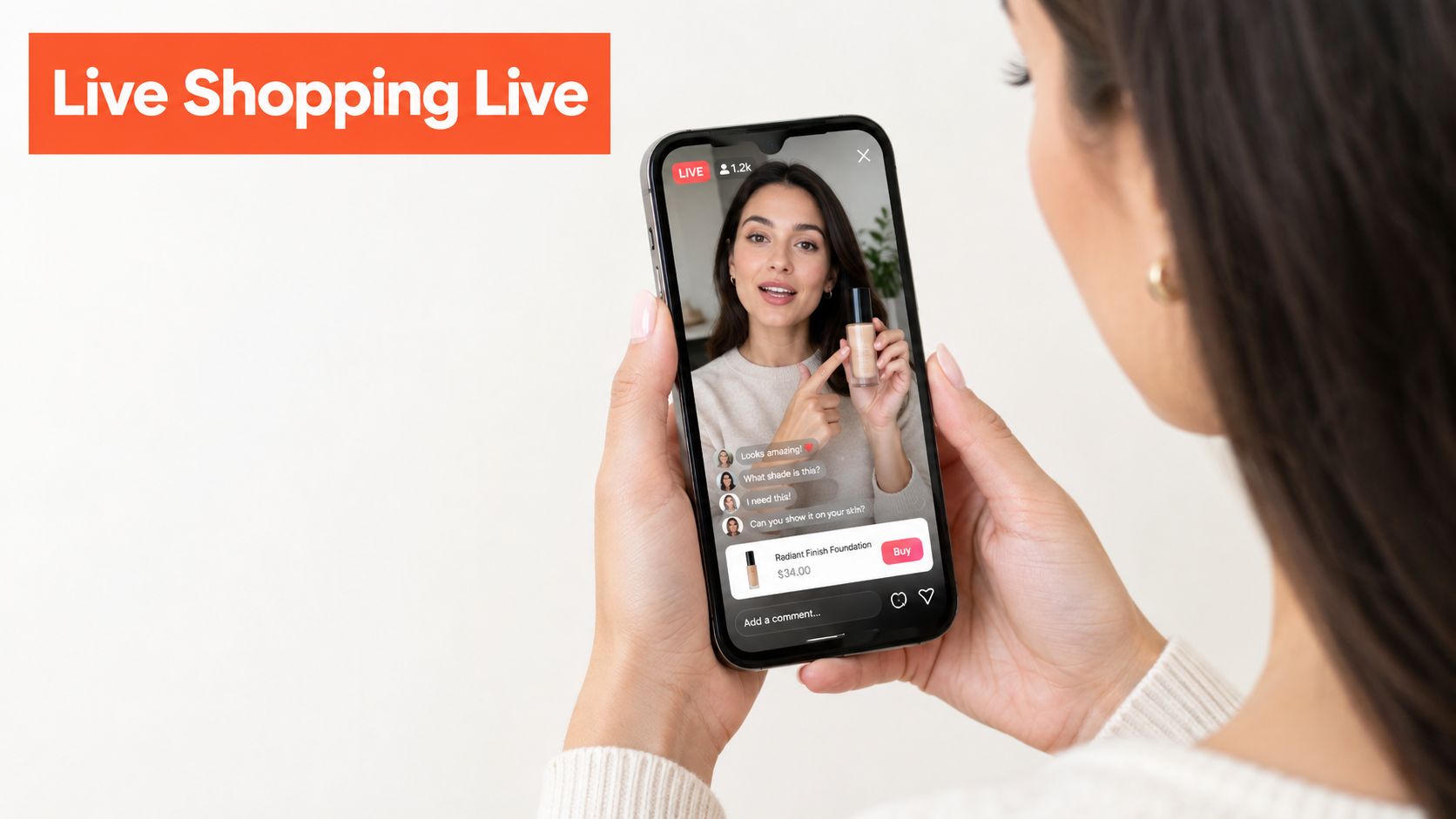
You join halfway through a beauty creator's stream. She's holding a foundation bottle close to the camera, turning her face toward a ring light so viewers can see how the shade looks under changing angles. The chat is moving quickly. Someone asks whether the finish works for dry skin, another viewer wants the shade match, and the host answers both without breaking the demonstration.
A product tile appears beneath the video. The host taps it, reveals a limited bundle, and pins the SKU so late arrivals can find it without scrolling through the catalog. A comment thread fills with screenshots of carts and questions about shipping. The viewer taps the shopping sticker, reaches checkout with the promotion already applied, and sees a countdown attached to the offer window.
That experience feels less like watching a television infomercial and more like joining a group checkout line that moves at the speed of conversation. The host keeps selling, but the audience also sells the product to one another through questions, reactions, recommendations, and visible purchase confirmations.
The session is part demonstration, part storefront
The strongest moments are concrete. A SKU gets revealed. A texture gets shown on camera. A host compares two options, handles an objection, or explains why the bundle is better value for the people watching now. The product surface stays available while the conversation continues, so the viewer doesn't have to remember a product name or leave the stream to search for it.
After purchase, the interaction often continues. The host acknowledges a buyer by name, answers a follow-up question, or celebrates the first wave of orders. That acknowledgment gives the transaction a social setting, which is one reason live stream shopping can feel more immediate than a standard product page.
The format doesn't guarantee a sale. Poor audio, a distracted host, unclear product links, or an offer that feels artificial can make the session feel like an interrupted advertisement. The useful distinction is that live shopping creates a measurable conversion environment, not merely another content placement.
The Core Mechanics of a Live Shopping Format
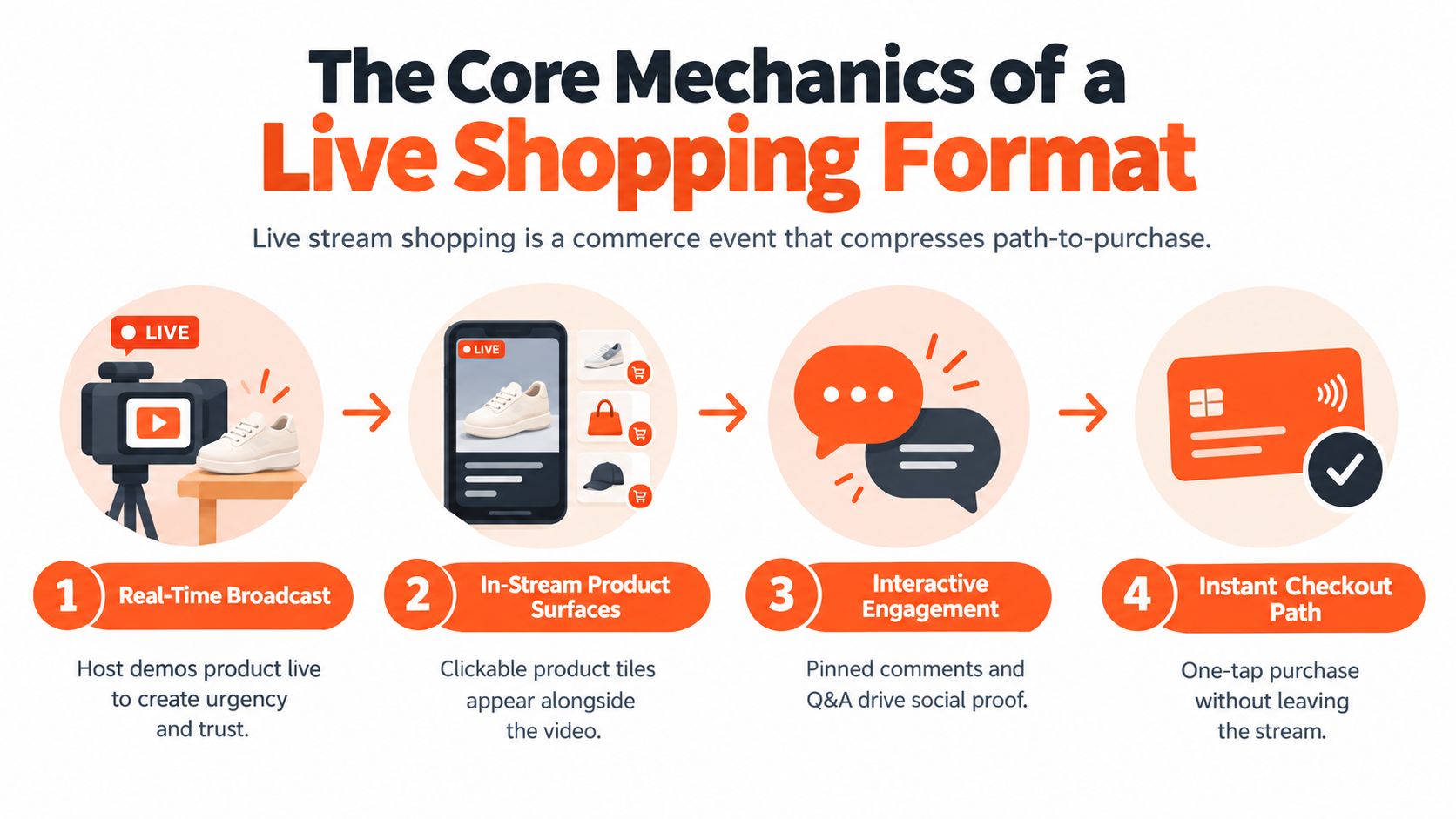
A live stream shopping event is a real-time broadcast connected to product discovery and checkout. Think of a QVC-style department store compressed into one mobile screen, with the salesperson, product shelf, customer questions, and payment path sharing the same interface.
The broadcast supplies attention. The product surface supplies access. The chat supplies objections and social proof. Checkout removes the delay between wanting the item and acting on that intent.
Four levers shape the buying experience
Real-time presentation: The host demonstrates the product while viewers can ask questions. A useful presenter behaves like a merchandiser, not a voice-over artist. They decide which feature deserves attention, which objection needs an answer, and when to move from explanation to offer.
Persistent product surfaces: Product tiles, pinned SKUs, and clickable overlays keep the item discoverable throughout the session. If a viewer joins late, they should still understand what's being sold and how to buy it.
Interactive social proof: Chat messages, reactions, viewer questions, and buyer confirmations help people evaluate the product in public. The audience sees not only what the host claims, but also what other shoppers want to know.
Compressed checkout: The best flows preserve the viewer's selected product and promotion as they move toward payment. Every extra page, account requirement, or broken link creates an opportunity for the purchase to disappear.
Practical rule: Treat every stream as a system you can optimize lever by lever. Improve the product pinning, then the offer timing, then the host's objection handling, rather than calling the entire format a success or failure.
Creators may also earn a commission on each sale, which changes the host's role. The creator isn't just supplying reach. They're participating in merchandising, explaining why the product fits the audience, and making the offer feel relevant to the people currently watching. That incentive works best when the product matches the creator's content and audience.
The commercial advantage comes from combining scarcity loops, trust transfer, and friction collapse. A time-bound offer gives the viewer a reason to act now. A credible host reduces uncertainty. An integrated checkout eliminates the need to restart the shopping journey somewhere else.
How YouTube, TikTok, and Twitch Compare for Live Shopping
The three platforms support very different shopping behaviors. TikTok is built for discovery and impulse. YouTube is better suited to research and consideration. Twitch depends heavily on a tight creator community and a product that belongs inside that community.
TikTok Shop turns live shopping into a shoppable feed. The viewer may arrive without a specific product in mind, discover the item through the creator's stream, and check out inside the platform. That makes TikTok the clearest starting point for low-priced, visually demonstrable products that benefit from rapid decision-making.
YouTube Live supports a more deliberate viewing session. Product cards and merchandising surfaces work well when the audience wants an explanation before buying, such as a technology demonstration, beauty tutorial, or product comparison. YouTube can also support streams that continue to generate value after the broadcast because the content remains searchable and watchable.
Twitch is narrower. Its product surfaces often depend on extensions, affiliate tools, or external commerce paths rather than a universally native shopping flow. That can still work for gaming hardware, collectibles, limited drops, and community-led launches, but the creator relationship has to carry more of the commercial weight. Teams evaluating the platform should also review the practical differences covered in this guide to influencer marketing on Twitch.
| Platform | Checkout Mechanism | Audience Intent | Best Fit SKUs |
|---|---|---|---|
| TikTok | Native social commerce checkout where available | Discovery and impulse | Accessible beauty, fashion, accessories, and other fast-decision products |
| YouTube | Product cards and platform-linked shopping surfaces | Research and consideration | Electronics, beauty routines, education-led products, and considered purchases |
| Twitch | Affiliate extensions or external tools | Community-driven intent | Gaming hardware, collectibles, limited drops, and enthusiast products |
Match the platform to the decision
TikTok makes the most sense when the product can be understood quickly and the offer benefits from momentum. YouTube earns the investment when the buyer needs a detailed demonstration or comparison. Twitch can outperform broader channels when the creator's audience already treats the stream as a trusted community rather than a storefront.
Creative still matters across all three. If you're adapting a live session into short-form promotional assets, use a production checklist that includes the perfect Reel dimensions for e-commerce, because poor cropping can weaken the follow-up content even when the live event itself worked.
The candid answer is that a platform can host a stream without creating meaningful commerce. Measure the product surface, checkout completion, and creator-driven sales, not just concurrent viewers.
Why Live Stream Shopping Converts Differently
Standard ecommerce commonly converts at about 2% to 3%, while documented live stream shopping conversion rates sit around 10% to 30%, according to the live commerce conversion optimization framework. That comparison doesn't mean every stream will reach the upper end. It shows why the format deserves to be evaluated as a conversion channel rather than only as a traffic source.
The difference comes from several mechanisms operating at once.
Urgency gives the viewer a reason to act
A limited-time promotion changes the decision from “Should I research this later?” to “Do I want this offer before it expires?” A flash code, countdown overlay, or timed bundle can create that pressure, but the offer has to be clear. If viewers can't tell when the discount ends or which SKU qualifies, urgency becomes confusion.
Scarcity makes the offer concrete
Stock messaging, bundle thresholds, and limited drops make demand visible. The host can explain what remains, why the quantity is limited, and what happens when the offer closes. Artificial scarcity is easy to spot, so the constraint should reflect a real inventory or promotion rule.
Trust transfers through the host
A creator's reputation can reduce the uncertainty that static product pages leave unresolved. The host demonstrates the product, answers difficult questions, and explains who should not buy it. That last behavior often matters more than exaggerated enthusiasm because it gives the audience a reason to believe the recommendation.
Social proof arrives in real time
The audience sees questions being answered, reactions accumulating, and buyers confirming their choices. Adobe reports that 80% of livestream shoppers discover new brands or products through live shopping, while 68% are more likely to buy when chat participants recommend the product in its state of live shopping report. Those figures point to discovery and peer validation as important parts of the session, not merely side effects of the sale.
| Format | Typical Conversion Range | Primary Driver |
|---|---|---|
| Standard ecommerce | About 2% to 3% | Static product evaluation and delayed checkout |
| Standard live shopping | About 10% to 15% | Demonstration, host trust, and integrated purchase path |
| Interactive live shopping | About 15% to 20% | Q&A, chat participation, and visible social proof |
| Live shopping with strong scarcity triggers | About 20% to 30% or more | Flash sales, countdowns, and tightly framed offers |
Use a running viewer count, a pinned comment with the correct product path, and a clearly announced offer window. Then test the levers independently. A stream with strong chat activity but weak checkout completion probably has a friction problem, not an audience problem.
Measuring and Attributing Live Shopping Performance
Attribution is where many live shopping programs lose credibility. A platform may report sales, but that figure can overlook creator influence, post-stream purchases, and viewers who saw the session without clicking the native product surface.
Start with identifiers that survive a privacy-conscious measurement setup. Give each creator a unique UTM link and a unique discount code. Add a creator identifier to Shopify order tags, record the code redemption, and pass the UTM into GA4 events so the team can connect the session to downstream behavior.
Build the measurement stack in layers
Creator-specific links and codes establish the baseline. They won't capture every assisted conversion, but they create a defensible direct-response layer and let you compare creators without relying on platform reporting alone.
Post-purchase surveys recover part of the missing picture. Ask buyers how they heard about the product and include the live stream or creator as an option. A sample of orders can provide useful directional evidence for view-through influence, especially when a buyer saw the stream but completed checkout later.
Platform dashboards remain useful for pacing. TikTok Shop GMV reporting and YouTube merch-shelf conversion data can show whether a campaign is moving, but don't treat either dashboard as a complete incrementality model. Platform-native reporting tends to favor the platform's own surfaces and may miss halo effects created by the creator.
Measurement discipline: Separate direct attributed revenue from creator-influenced revenue. Combining both into one ROAS number makes a stream look cleaner, but it makes the next budget decision harder.
Track the KPIs that defend the next spend
A performance lead should be able to answer four questions:
- Attributed ROAS: Did tracked revenue justify creator fees, production, discounts, and media support?
- Customer acquisition cost: What did it cost to acquire a new customer through the stream?
- Repeat purchase rate: Did livestream customers buy again within the chosen retention window?
- Creator-influenced new customer rate: How many first-time buyers reported or demonstrated creator influence?
For teams building a broader framework to optimize every marketing dollar, live shopping should sit inside the same attribution discipline as paid social, affiliate, and email. The practical guide to measuring influencer marketing ROI is also useful when the creator appears across multiple placements.
Finally, run an incrementality check where possible. A geographic holdout or audience split can show whether the stream generated new demand or redirected buyers who were already likely to purchase.
A Brand and Creator Playbook That Actually Converts
A limited creator budget needs focus more than spectacle. Start with one product that has proven margin, a visible demonstration, and a simple reason to buy now. Don't use the first live event to explain an entire catalog or place your highest operational risk on camera.
Choose the commercial ingredients before the script
Select a creator using audience insights, content fit, and prior sponsored performance, not follower count alone. The audience should resemble the intended customer, and the creator should be comfortable answering unscripted questions without turning every response into a sales line.
Agree on the offer architecture before writing talking points. That might include an exclusive live code, a bundle threshold, and an accessible anchor item. The exact offer depends on margin and fulfillment, but the viewer should understand the value in one sentence.
A practical run of show can include:
- Opening demonstration: Show the product in use before delivering a long introduction.
- First offer drop: Pin the SKU and explain the promotion while attention is high.
- Objection block: Address fit, ingredients, setup, compatibility, or shipping questions.
- Second demonstration: Use a different angle, use case, or comparison.
- Final Q&A and close: Restate the offer, inventory condition, and checkout path.
Keep the production simple enough to repeat. Good lighting, clean audio, reliable product links, and a prepared moderator matter more than elaborate staging. Teams working with marketplace sellers can also review practical guidance on creative production for Etsy sellers when adapting product visuals for commerce content.
Instrument the event before it begins. Use a unique link, a unique code, Shopify creator tags, and a post-purchase survey. Within two days, compare direct revenue and assisted signals against your ordinary ecommerce baseline, then document whether urgency, scarcity, trust, or checkout friction shaped the result.
Repeat with one meaningful variable changed. Change the offer, host, product angle, or platform, but don't change everything at once. The influencer marketing for ecommerce framework is useful for keeping creator strategy connected to commercial outcomes rather than vanity metrics.
The Adoption Gap Most Articles Ignore
China remains the clearest historical reference point for national-scale live commerce. By 2023, China's live-streaming commerce market had reached nearly five trillion yuan, described as roughly a twelvefold increase from the period before the health crisis, and about six in ten Chinese online shoppers were using live commerce that year, according to Statista's livestream commerce overview. Forecasts in the same source pointed to more than 430 million users by 2026, making the market useful as a reference point, not a template to copy.
The U.S. picture is more mixed. MRI-Simmons reports that live stream shopping reaches more than 90 million U.S. adults, while its reported buyer share rose from 25% in 2024 to 31% in 2025 and 34% today. At the same time, eMarketer-linked reporting in the MRI-Simmons analysis says 21.7% of U.S. digital buyers made a livestream purchase in 2025, and 43% of U.S. adults were not interested.
| Market Indicator | United States | China |
|---|---|---|
| Current behavior | Broad reach, but adoption remains uneven | Mainstream behavior at national scale |
| Commerce role | Stronger in selected categories and creator communities | A major transaction layer inside digital retail |
| Strategic implication | Pilot by category and unit economics | Study the mature mechanics, but don't assume identical behavior |
The gap changes the recommendation. Beauty, fashion, and collectibles have a natural fit because entertainment and product utility reinforce each other. Grocery and large appliances face more friction because the live format may not add enough value to overcome routine purchasing habits or logistical concerns.
Treat cross-border examples carefully. Payment flows, creator incentives, platform discovery, and shopper expectations differ by market. For Western brands, the sensible question isn't whether every shopper will adopt live shopping. It's whether one category can produce margin-positive sessions with a repeatable creator and measurement model.
Choosing Your Next Live Shopping Move
Start with the objective. If you need incremental GMV, prioritize native checkout and offer mechanics. If you need awareness, measure qualified reach and assisted discovery. If you want to deepen a creator relationship, evaluate content quality, audience response, and repeat collaboration potential alongside sales.
Then run a focused pilot. Use one platform, one creator, and one product line over a defined testing period. Model production cost, creator fee, discount impact, fulfillment, and expected contribution margin before the broadcast goes live.
Instrument the loop from the first session. Attach UTM links, issue unique promo codes, tag orders by creator, and ask buyers how they discovered the stream. Start on TikTok for impulse-priced products under $50, YouTube for considered purchases over $100, and Twitch for niche communities where the creator has already earned trust. These recommendations are operating heuristics, not universal laws, so validate them against your own unit economics.
Live stream shopping should be managed as a measurable funnel, not treated as an untracked content experiment.
Social Cloud can help you plan creator-led live shopping across YouTube, TikTok, Instagram, and Twitch, from audience-based creator selection through tracking links, promo codes, post-purchase surveys, and performance reporting. Visit Social Cloud to build a measurable creator campaign that connects live attention to revenue.


