
The most popular advice about macro influencer marketing is also the most expensive shortcut: find a bigger creator, negotiate a post, and expect bigger results. Follower count isn't a business case. If a macro creator reaches people you'd have acquired more cheaply through paid social or smaller creators, you've bought expensive duplication.
Treat macros as an incremental-reach investment, not your default performance channel. Buy the audience access, creative credibility, or demand you can't get efficiently elsewhere. Then test whether that advantage survives contact with your acquisition economics.
Table of Contents
What Macro Influencer Marketing Actually Means
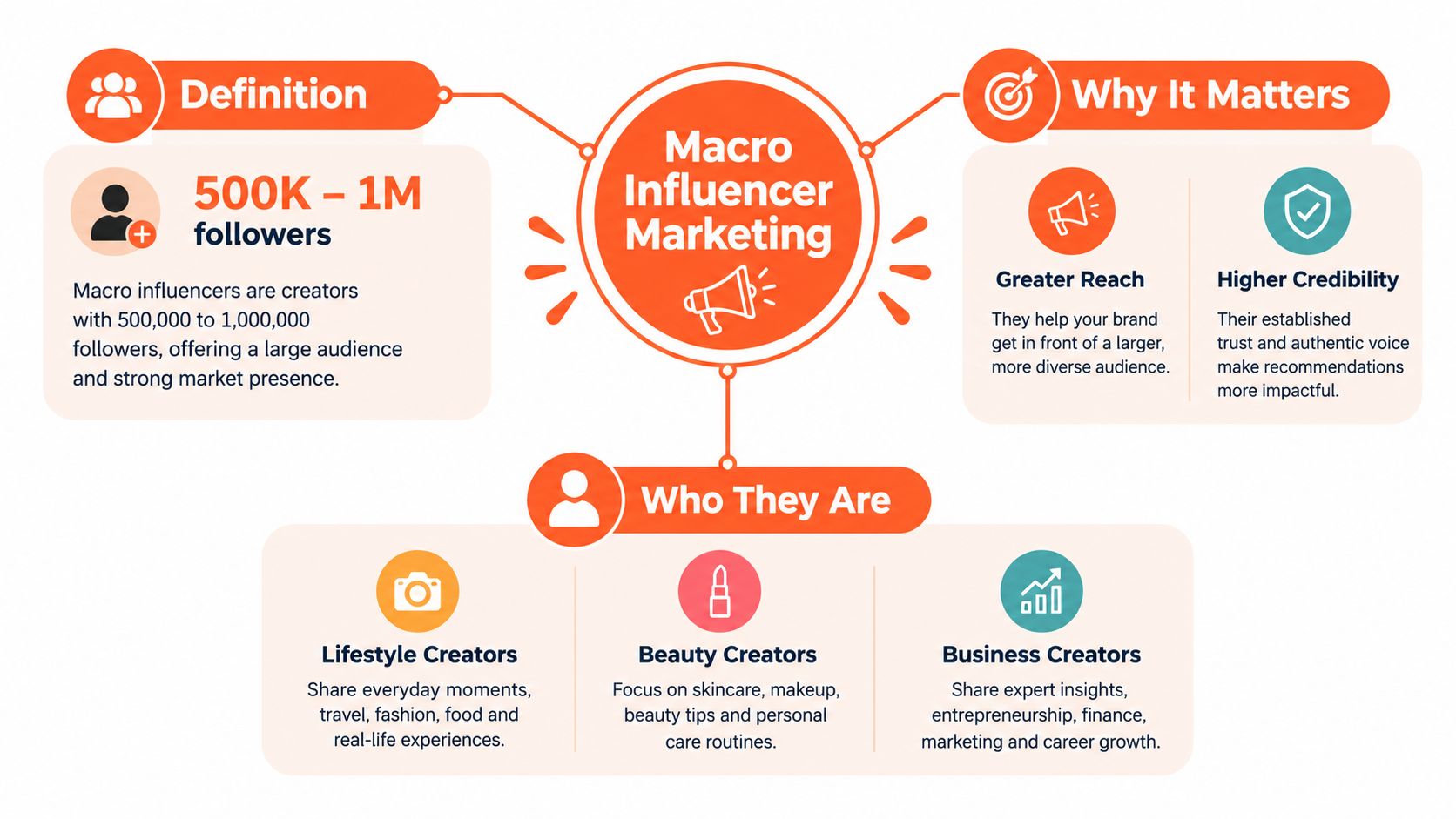
Macro influencer marketing means partnering with established creators to access a substantial audience through their content and reputation. A useful working definition is roughly 500,000 to 1 million followers, although tier boundaries vary, as reflected in this influencer marketing market overview.
That band helps organize a shortlist. It doesn't tell you whether someone can sell your product. A beauty educator, business commentator, and lifestyle creator might occupy the same tier while offering completely different audience relevance and commercial value.
Think of the relationship between reach, credibility, and creator identity this way:
Buy a reason to listen
My working distinction is simple: a celebrity placement buys association with a widely recognized person. A macro partnership should buy access to someone whose audience knows why they follow them.
For a software creator, that reason might be practical workflow advice. For a fitness creator, it might be training instruction. Your product needs a credible role inside that relationship, not just room in the caption.
Use these questions before requesting a proposal:
- Audience relevance: Would these viewers plausibly need the product, in the markets you serve?
- Creator authority: Does the creator have a believable reason to discuss this problem?
- Sponsored-content fit: Can they explain the offer without abandoning the content viewers came for?
- Commercial purpose: Are you buying category education, launch awareness, consideration, or acquisition?
Separate scale from suitability
Compared with a mid-tier creator, a macro candidate should offer enough additional relevant distribution to justify a larger commitment. Compared with a celebrity-scale account, you should still be able to identify a specific editorial identity that fits the campaign.
Don't assume trust transfers automatically. Ask to see previous sponsored work, audience geography, and performance on comparable formats.
Reach plus credibility is the opportunity, not the guarantee. A large audience with no persuasive connection to your offer is still the wrong audience.
Macro vs Micro vs Nano and Where Each One Wins
Choose the job before choosing the tier. If your brief starts with “we need a macro,” you've selected the supplier before defining the problem.
For acquisition testing, I'd usually start with smaller, tightly matched creators. For a concentrated launch or a category-defining explanation, I'd consider a macro. Mid-tier creators belong in the comparison whenever you need more distribution without making a large commitment to an individual partner.
Influencer Tier Comparison at a Glance
The available benchmark reports micro engagement rates of 3–8% and cost per engagement of $0.20, versus 1–3% and $0.33 for macros, in this discussion of influencer measurement and creator-tier economics.
| Tier | Followers | Engagement Rate | Cost per Engagement | Best For |
|---|---|---|---|---|
| Nano | Smallest audience tier | Evaluate individually | Evaluate individually | Testing narrow communities and product affinity |
| Micro | Smaller, niche-focused audiences | See benchmark above | See benchmark above | Testing efficient engagement and acquisition |
| Mid-tier | Between micro and macro | Evaluate individually | Evaluate individually | Balancing distribution with specialist relevance |
| Macro | Large, established audiences | See benchmark above | See benchmark above | Broad launches, category education, and credibility |
Exact follower cutoffs aren't necessary for the smaller tiers here. A consistent internal classification is more useful than pretending every supplier uses identical definitions.
Match the tier to the constraint
Nano creators are worth considering when community specificity matters more than distribution. Product affinity should lead selection, especially for seeding. Don't assume a small account is automatically authentic or commercially useful.
Micro creators are a sensible starting point when you need to test messages across distinct customer interests. The engagement benchmark supports investigating their efficiency, but cheaper engagement doesn't prove cheaper customers.
Mid-tier creators deserve consideration when a niche specialist can explain the product well and reach enough qualified viewers. Don't skip them because your planning spreadsheet only compares small accounts with famous names.
Macros make sense when concentrated attention has a clear strategic purpose. That might mean introducing an unfamiliar category or giving a launch a recognizable editorial voice.
Decision rule: Start with smaller creators for conversion learning. Consider macros when broader qualified attention is the actual bottleneck.
Then compare both against paid social. Creator tiers are purchasing options, not a ranking of marketing quality.
When Macro Influencers Are Worth the Premium
A macro creator earns the premium when the partnership adds something your existing channels don't deliver efficiently. That could be access to an underreached audience, stronger product understanding, or additional demand that persists beyond the sponsored post.
“More views” isn't sufficient. You need a clear hypothesis about what changes because you hired this creator.
Define the counterfactual
Before approving the placement, write down what you'd do with the same budget otherwise. Compare against a realistic paid-social campaign or smaller-creator portfolio, not an intentionally weak alternative.
A credible comparison should account for:
- Audience overlap: How much of the creator's relevant audience might already encounter your advertising?
- Comparable economics: Include production, management, amplification, and rights costs on both sides.
- A primary outcome: Choose incremental customers, qualified demand, or brand lift according to the campaign's job.
- A decision threshold: Agree on what result would justify another booking.
Use this checklist to organize the test:
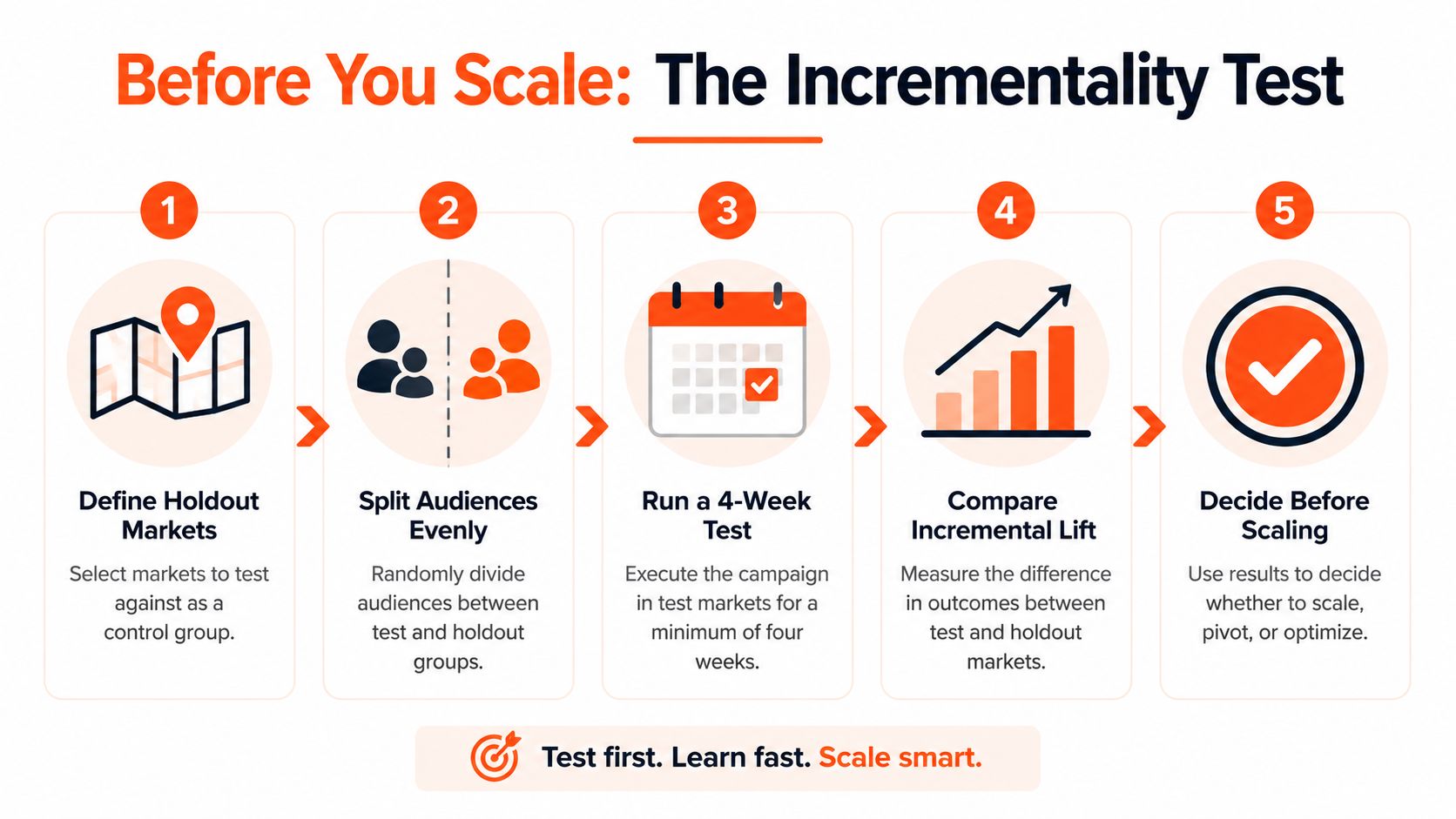
Choose the testing window around your purchase cycle and expected exposure, rather than treating a fixed duration as universally valid.
Make the test defensible
For geographically concentrated audiences, consider matched markets with comparable baseline demand. Keep other marketing activity as consistent as practical, document promotional changes, and check whether the creator's audience maps to the proposed test regions.
Organic creator distribution won't neatly respect geographic boundaries. If substantial exposure reaches the holdout, acknowledge that contamination rather than reporting a clean causal estimate.
Where geography won't work, investigate audience-level lift testing where available. Compare deduplicated reach, branded-search movement, assisted conversions, and commercial outcomes with the alternative investment.
Greenlight the macro when the advantage is identifiable and testable. If you can't explain what would make the placement incremental, you're not ready to scale it.
Budgeting and Forecasting Macro Campaigns
Don't begin with a generic price-per-post list. Begin with the outcome your business can afford, then work backward to a creator package.
A quote only becomes meaningful when you know what it includes. Separate the creator's publishing fee from production, exclusivity, content licensing, paid amplification, product costs, and campaign operations. Use an influencer marketing rates guide to structure negotiations, not to substitute for a forecast.
Build an auditable worksheet
Your forecast should expose assumptions rather than hide them inside a confident-looking revenue total.
| Forecast input | What to use | What to challenge |
|---|---|---|
| Expected views | Comparable recent sponsored content | Reliance on viral organic posts |
| Qualified audience | Target-market and customer-fit evidence | Treating every viewer as a prospect |
| Response rate | Relevant historical campaign results | Borrowed assumptions from unrelated verticals |
| Purchase or activation rate | Your own funnel performance | An untested landing page or onboarding flow |
| Total investment | Complete campaign cost | Excluded rights, management, or media spend |
| Customer value | Revenue or contribution assumptions | Optimistic retention without supporting history |
Model a downside, planning, and upside scenario. Change the assumptions that drive uncertainty, particularly qualified views, response, and downstream conversion.
Use the right commercial denominator
CPM helps compare distribution costs, but it doesn't distinguish useful exposure from irrelevant views. CPI is more appropriate for install campaigns, provided you also inspect activation quality. CPA should reference the actual acquisition event your growth team reports.
For revenue forecasting, multiply expected conversions by expected order value. Divide forecast revenue by total campaign spend to estimate campaign-level ROAS, and label that forecast clearly.
Don't force a macro campaign to match a retargeting campaign's economics. Compare it with the relevant prospecting alternative, using consistent attribution rules and customer-quality expectations.
Allocate platform budgets according to audience fit and the role of each format. Avoid an equal split made solely to give every platform a presence.
Budget discipline: Reserve enough money to measure and activate the partnership. A creator fee that consumes the entire budget leaves no room to learn or improve.
Designing a Macro Campaign That Performs
Give the creator a clear commercial problem, not a script disguised as a brief. Define the audience, product truth, required disclosure, prohibited claims, and desired action. Let the creator develop the opening and demonstration in their own voice.
Keep production grounded in a format the creator can deliver naturally:

Brief the persuasion, not every sentence
Ask the creator to show the problem, demonstrate the product, address a meaningful objection, and offer a logical next step. Review for accuracy and clarity without replacing their delivery with brand copy.
Use gifting to explore genuine product affinity, not as a substitute for a contracted publishing commitment. When timing, messaging, and deliverables are mandatory, negotiate a paid agreement.
Plan destinations alongside creative. For teams coordinating multiple offers and platforms, RedirHub's resource on campaign link infrastructure for marketing teams provides useful operational context. Assign ownership for destination checks, naming conventions, and redirects before publishing.
Match the format to the buying question
- YouTube: Consider a demonstration or integration when buyers need explanation and objection handling.
- Instagram: Brief Reels for the main creative idea and Stories for supporting context and a direct next step.
- TikTok: Develop a platform-native concept, with Spark Ads permissions negotiated if paid amplification is planned.
- Twitch: Consider live demonstrations or audience interaction when seeing the product in use matters.
Shorts and Reels variants should have their own openings and edits. Don't treat cropping a longer video as a finished cross-platform strategy.
Use the video below as a discussion prompt when reviewing execution ideas with your team:
Negotiate usage rights before production. Specify channels, editing permissions, paid-media access, duration, and whether the creator must approve adaptations.
Keep the creator responsible for content they can control. Your team remains responsible for stock availability, landing-page quality, checkout, and onboarding.
Measurement and Attribution That Actually Closes the Loop
Observed conversions and incremental conversions aren't interchangeable. A tracked order tells you which measurable touchpoint preceded a purchase under your attribution rules. It doesn't prove the purchase wouldn't have happened otherwise.
Research examining influencer marketing value and ROI measurement identifies the difficulty of evaluating value distributed across firms, creators, followers, and platforms. Your reporting should reflect that complexity without becoming an excuse for unaccountable spending.
Build complementary evidence
Use the measurement methods together rather than asking any individual tool to explain the entire campaign:
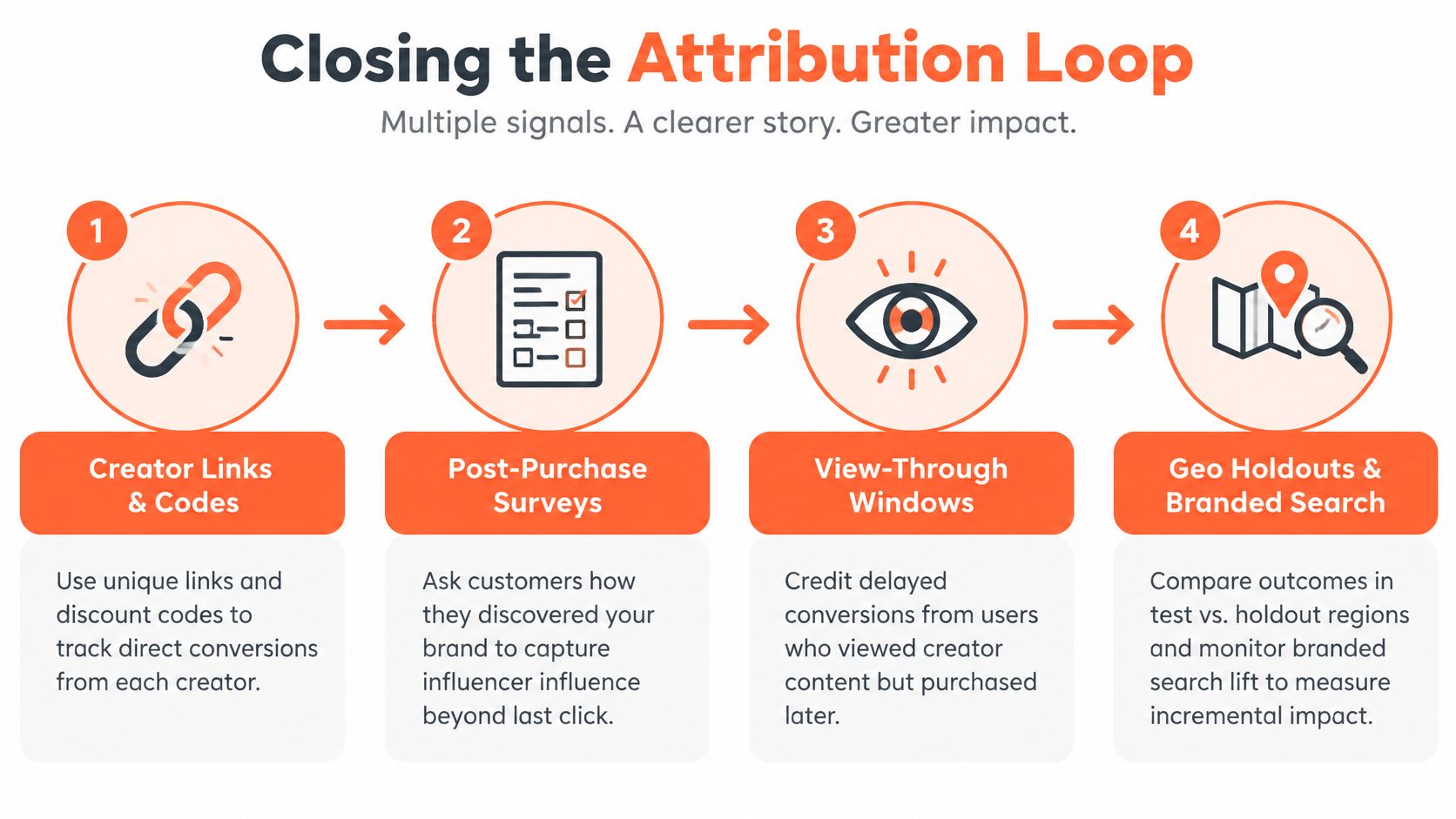
- Creator links and codes: Identify attributable actions, but flag code leakage and discount-driven purchases from existing customers.
- Post-purchase surveys: Ask buyers how they discovered you. Keep reported discovery separate from transaction-based attribution.
- View-through reporting: Set exposure windows before launch and distinguish platform-reported results from independently reconciled orders.
- Lift evidence: Apply the test design described earlier, then inspect branded search and direct traffic as supporting signals rather than standalone proof.
Cross-device journeys, delayed decisions, private sharing, and exposure without a click can leave gaps in click-based reporting. Conversely, a code can capture someone who already intended to buy.
Don't respond by adding every system's conversions together. A buyer may appear in creator reporting, paid-social reporting, and a customer survey.
Reconcile before you report
Create a consistent order or customer-level reconciliation process where your systems allow it. Separate new customers from existing buyers, remove cancellations and refunds according to an agreed policy, and identify overlapping claims across channels.
For leadership, maintain distinct views of attributed performance, assisted evidence, and estimated incremental impact. A practical guide to measuring influencer marketing ROI can help organize the commercial reporting.
Performance-linked payouts also need explicit rules. Specify which data system governs payment, how disputed conversions are handled, and when results become final.
A measurement gap is a reason to qualify your conclusion, not a reason to claim every sale or ignore every assist.
The useful outcome isn't a dashboard with the largest revenue total. It's a defensible decision about whether to renew, revise, or stop the partnership.
Macro Campaigns Across E-commerce Apps SaaS Gaming Fintech and Health
The following are illustrative campaign designs, not reported client results. Each gives the creator a different job because the buying decision changes by category.
E-commerce and apps
For an e-commerce launch, I'd brief a relevant macro creator to demonstrate the hero product in a recognizable use case. Measure new-customer purchases and contribution after discounts, then inspect returns before calling the partnership successful. The planning lesson is to fund the complete buying experience, including inventory and a product page that matches the demonstration.
An app feature launch needs more than a download instruction. Have the creator show the action that makes the app useful, then connect install reporting to activation and subsequent customer quality. Don't optimize compensation around installs if the business needs retained users.
SaaS and gaming
For SaaS, use a specialist macro to explain a workflow or buying problem. Match the destination to purchase readiness, whether that's a product trial, technical walkthrough, or demo request. Judge the campaign through qualified pipeline and downstream progression rather than treating every lead as equally valuable.
A gaming launch could pair a creator's edited introduction with a Twitch live session. Track relevant store or install activity while examining whether players return after the sponsored moment. The lesson is to select for player fit and credible gameplay, not just broad entertainment reach.
Fintech and health
For fintech and health, I'd raise the approval threshold before increasing distribution. Choose creators who can explain limitations clearly, and involve qualified reviewers in claims, disclosures, audience suitability, and the destination experience.
The conversion event might be an eligible application, an approved account, or an appropriate product purchase, depending on the offer. Don't reward raw lead volume when eligibility or suitability determines commercial value.
Across these designs, ask a different question from “Which creator is biggest?”
- Product fit: Can this person demonstrate the actual customer benefit?
- Funnel fit: Does the requested action match the audience's readiness?
- Operational fit: Can your team handle the demand responsibly?
A macro placement shouldn't compensate for an unclear proposition or an unfinished funnel.
Compliance Contracting and Your Next Steps
A campaign isn't launch-ready because the creator likes the concept. It's ready when the team has agreed on deliverables, legal review, permissions, measurement ownership, and what happens if execution goes wrong.
Don't copy disclosure language across markets without review. Have qualified counsel or compliance reviewers confirm the applicable requirements for the audience, product, and platform.
Put the operating agreement in writing
Use an influencer contract template as a starting point, then adapt it to the actual partnership. The agreement should distinguish creative review from control over opinions, and commercial expectations from guaranteed business outcomes.
- Deliverables and approvals: Specify formats, publishing responsibilities, revision boundaries, and procedures for corrections.
- Disclosures and claims: Document the review process, required disclosures, substantiation, and prohibited statements.
- Rights and access: Define usage licenses, account permissions, amplification access, and revocation procedures.
- Brand safety: Review relevant content history, competing sponsorships, and escalation responsibilities.
- Fees and remedies: Clarify the base payment, performance component, data authority, cancellation terms, and missed-deliverable remedies.
Don't leave performance payments dependent on an undefined “successful campaign.” Both parties should know what qualifies before production starts.
Turn the plan into a launch decision
For your next planning meeting, bring a shortlisted creator, the alternative investment, a scenario forecast, and a draft measurement plan. Assign an owner to each unresolved dependency, especially landing pages, permissions, compliance review, and reporting access.
Approve the booking only when the team can answer what it's buying, how it will judge the result, and what evidence would support renewal. If the forecast works only under optimistic assumptions, renegotiate the package or choose a smaller test.
The discipline is simple: define attribution and incrementality rules before contracting. Your tracking setup should support the commercial agreement, not become a rescue project after the content goes live.
Social Cloud offers creator selection, campaign planning, execution, and performance attribution across YouTube, Instagram, TikTok, and Twitch. Visit Social Cloud with your target CPA or CPI, audience, and campaign objective to discuss whether a macro placement or a smaller-creator mix deserves your next test budget.