
Influencer marketing spending was projected to reach $32.55 billion in 2025, with gaming creator budgets distributed across YouTube, Twitch, TikTok, and Instagram rather than confined to one channel, according to a 2025 gaming influencer marketing benchmark. That figure changes the job. Marketing for video games isn't just about making a launch look popular. It's about proving that attention can become installs, sales, retained players, and eventually profitable revenue.
The practical question for a gaming growth team is simple: what did this dollar buy, and would the outcome have happened without it? Brand awareness still matters, especially for premium launches and live-service games, but awareness without a measurement plan is an expense category, not a strategy. The playbook below treats creators, paid media, community, and launch content as parts of one performance funnel.
Table of Contents
- Weeks 1 to 3 build evidence
- Weeks 4 to 7 turn learning into demand
- Weeks 8 and 9 concentrate the event
- Weeks 10 to 14 protect efficiency
Why Marketing for Video Games Now Sits Inside a Performance Funnel
A YouTube integration, a Twitch stream, or a TikTok clip may look like brand activity on the surface. The UA team still has to forecast its likely acquisition cost, define the event that counts as success, and decide whether the placement deserves another dollar.
The scale of the creator market makes that discipline unavoidable. The benchmark cited above places YouTube at 30% of gaming influencer marketing share, Twitch at 25%, TikTok at 20%, and Instagram at 10%. That mix signals a cross-platform creator economy where discovery, consideration, and conversion happen across different formats rather than inside one advertising account.
A peer-reviewed study from the University of Rochester adds a useful performance reference. It found that a YouTube post by a top influencer increased game usage by 0.7% and sales by 1.6% on the posting date, as reported in the University of Rochester summary of the video game influencer research. The result isn't a universal forecast for every creator or title. It's a reminder that creator exposure can be measured against commercial behavior.
What the UA lead has to defend
A serious weekly review should answer four questions:
- Pacing: Is each channel spending according to the forecast, or is one platform consuming budget without comparable downstream value?
- Acquisition cost: What CPI, CPA, or blended cost does each creator and format produce?
- Quality: Do referred players reach the events that matter, such as tutorial completion, early retention, purchases, or subscription starts?
- Incrementality: Did the creator generate additional demand, or did the campaign capture users who would have arrived through another channel?
| Channel Bucket | Mid-Core Mobile | Console / PC |
|---|---|---|
| Creator video | Gameplay explanation, reviews, build guides, tracked installs | Long-form discovery, launch reviews, wishlist and sale influence |
| Live streaming | Community participation, co-streams, event moments | Watch-along attention, demos, live launch coverage |
| Short-form video | Fast hooks, challenge formats, UGC testing | Discovery, clips, event amplification |
| Paid amplification | Scale winning creator edits and audience signals | Extend high-performing launch assets and retarget interest |
Practical rule: If a creator deal has no stated acquisition hypothesis, it belongs in a brand plan, not a performance forecast.
This doesn't mean every placement needs immediate last-click credit. It means the team should define what evidence would justify the spend before the content ships. Marketing for video games works best when brand storytelling and UA share the same reporting language, even when their time horizons differ.
Vetting Creators for Real Audience Quality
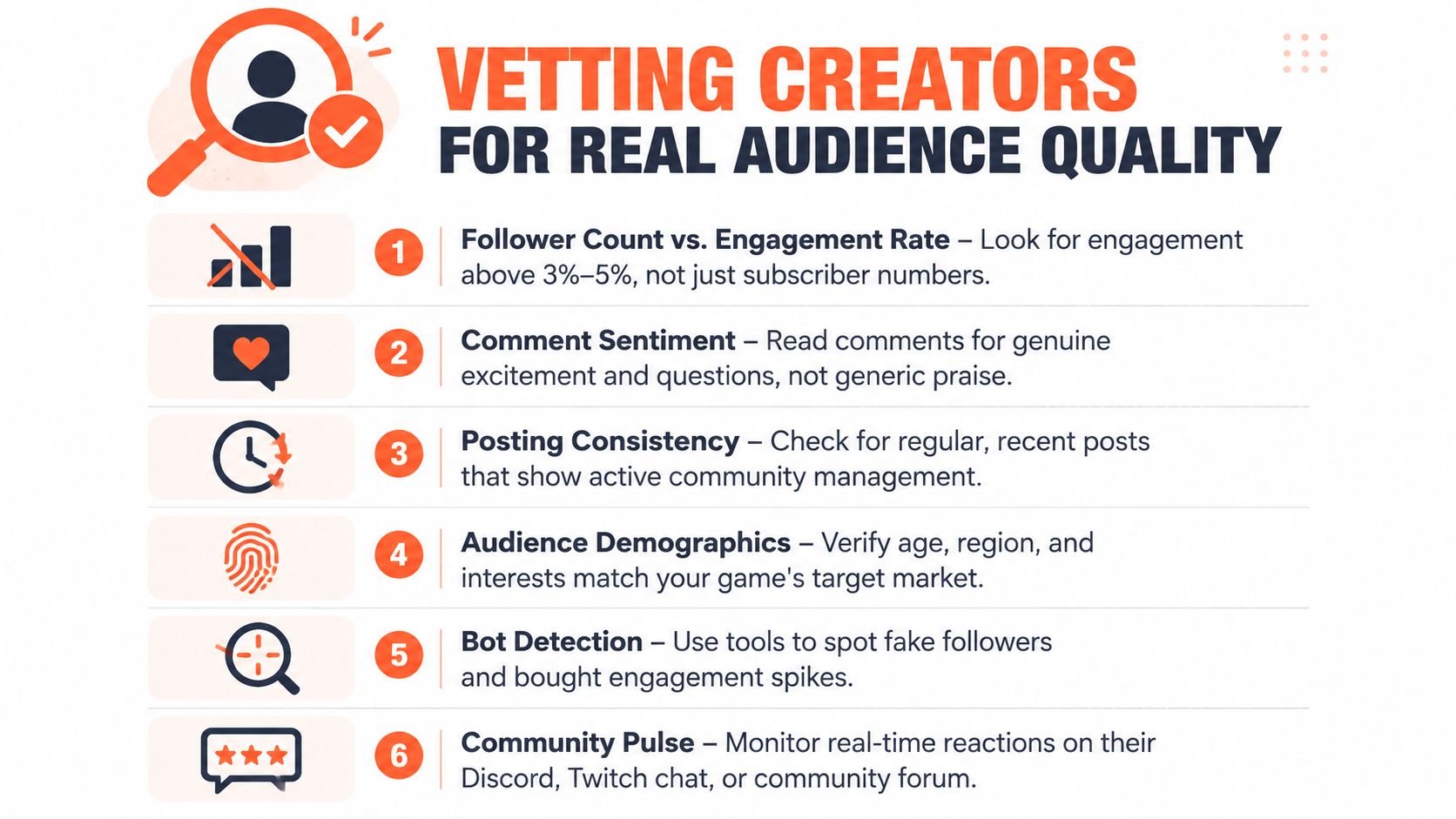
Follower count is one of the fastest ways to make a bad buying decision. It tells you how many accounts subscribed, followed, or liked at some point. It doesn't tell you whether the right players are watching now, whether they trust the creator, or whether they'll act after a sponsorship.
Start with the audience you need. A strategy game publisher may want viewers who watch long-form analysis and discuss mechanics. A competitive mobile title may need active players in specific regions. A casual game may benefit from creators who can demonstrate the core loop in a few seconds. The creator's claimed audience is only a starting hypothesis.
Read the audience, not the media kit
Comments reveal whether viewers understand and care about the content. Generic praise, repeated phrases, or a comment section that ignores the actual game can signal weak audience involvement. Specific questions about builds, characters, updates, or tactics are more useful qualitative evidence.
Retention graphs matter because a creator can generate a large opening spike and still lose most viewers before the sponsored segment. Ask for audience retention by format, then compare the point where the game appears with the average viewing curve. A creator with fewer followers but stronger sustained attention may give you a better test.
Past sponsored performance should be checked at the event level. Request clicks, installs, conversion events, and the tracking window used. Cross-check creator-supplied figures against public content performance and platform analytics. Social Blade can help identify unusual growth patterns, while a media kit gives context that public pages often omit. Neither replaces first-party campaign data.
Red flags deserve a stop sign
Look for sudden audience growth without a corresponding change in content quality, weak interaction relative to the channel's normal pattern, and view counts that don't make sense against recent uploads. Audience overlap can also waste budget. Two creators may appear complementary while reaching the same core viewers.
Don't demand a single engagement threshold as proof of quality. Platform norms vary, and raw engagement can be manufactured. Instead, compare creators within the same platform, genre, format, and audience market.
Vet against the audience you want, not the audience the creator claims.
A useful test is to ask what you'd do if the creator's follower number were hidden. Would the comments, retention, demographics, and historical conversion data still support the purchase? If not, the partnership is being priced on vanity rather than evidence.
Where YouTube, Twitch, TikTok, and Instagram Each Fit
Each platform solves a different acquisition problem. Treating them as interchangeable creates mismatched briefs, weak creative, and misleading comparisons.
The latest gaming creator-spend benchmark gives the mix a clear shape, with YouTube holding 30%, Twitch 25%, TikTok 20%, and Instagram 10% of the reported gaming influencer share. The figures are directional rather than a budget prescription, but they show why video platforms deserve a central role in gaming discovery planning. The YouTube influencer marketing guide is useful background for teams planning long-form integrations and creator-led discovery.
| Platform | Primary Role | Best-Fit Genre |
|---|---|---|
| YouTube | Evergreen discovery, reviews, explainers, gameplay integrations | Premium, mid-core, strategy, RPG, simulation |
| Twitch | Live attention, community interaction, co-streamed events | Competitive, multiplayer, live-service, esports-adjacent |
| TikTok | Rapid discovery, hook testing, short-form UGC | Casual, hybrid-casual, social, visually immediate games |
| Reels, Stories, community signaling, retargeting support | Lifestyle-friendly mobile games and established franchises |
Assign the job before buying the placement
YouTube is strongest when the game needs explanation. A creator can show the loop, compare systems, answer objections, and keep the video discoverable after launch. That depth can support higher-consideration titles, but the creative takes longer to produce and the audience may need more time before installing or buying.
Twitch is a different environment. The value comes from live trust, chat reaction, and shared participation. It fits a soft launch, event, update, or community moment better than a static awareness burst. Measurement also needs care because a stream may influence a viewer long before the eventual install.
TikTok is a testing engine as much as a reach channel. Teams can learn which visual hook, mechanic, fail state, or social prompt earns attention, then adapt the strongest concepts into paid creative. The trade-off is fatigue. A clip can spread quickly and stop working just as quickly.
Instagram usually works as a supporting layer. Reels can extend short-form concepts, while Stories can reinforce a launch or remind an existing community about an update. It's rarely the first channel I'd use to prove performance for an unfamiliar game unless the audience fit is unusually strong.
A mature team sequences these platforms. Test hooks in short-form content, use deeper YouTube or Twitch integrations to build intent, then amplify proven assets and retarget engaged audiences. Running all four in parallel without distinct roles produces a dashboard full of activity and very little learning.
A Real Launch Timeline From Soft-Launch to Sustain
Consider a fictional mid-core mobile title preparing for a global release. The team has a good game, limited certainty about its retention curve, and no reason to buy maximum reach before understanding where players drop out.
Weeks 1 to 3 build evidence
The soft launch starts with five to ten mid-tier creators, closed beta keys, and a Discord ambassador program. The purpose isn't to manufacture hype. It's to expose unclear onboarding, weak tutorial moments, and retention cliffs while the product team can still respond.
Each creator receives a different brief angle, such as beginner progression, combat depth, or social play. The UA team tags every link and records the content format, audience response, and downstream events. The review cadence is twice weekly, with product, community, and marketing in the same meeting.
The team shouldn't scale because one video looks exciting. It should push harder when referred players show acceptable quality and the creative produces a repeatable acquisition signal. It should pull spend when the content attracts curiosity but the product fails to convert that curiosity into meaningful play.
Weeks 4 to 7 turn learning into demand
Pre-launch awareness adds YouTube integrations, Twitch sponsored segments, and a TikTok brief built around three hook formats. One hook demonstrates the fantasy, another shows the decision-making, and the third creates a clear challenge viewers can understand without a long explanation.
The deliverables include approved talking points, gameplay capture, disclosure requirements, tracked links, a creator FAQ, and usage-rights language for paid amplification. The team reviews early performance at the format level, not only by creator. If one hook works across several audiences, it becomes a candidate for paid social testing.
Weeks 8 and 9 concentrate the event
Launch week gets the largest coordinated push. Co-streamed premieres, creator reminders, store-page updates, and platform-feature alignment should land close enough together to make the release feel timely without forcing creators into identical content.
The launch review happens daily. The team watches acquisition cost, conversion quality, technical issues, and sentiment. A campaign can generate installs and still need a pause if server problems, onboarding friction, or an unplanned offer distorts the result. For broader examples of gaming campaign execution, review the Epic Games influencer campaign case.
Weeks 10 to 14 protect efficiency
Sustain mode rotates briefs rather than repeating the launch script. Organic creator clips become UGC ad candidates, new updates supply fresh reasons to return, and paid social stays active only while CPI remains inside the approved target band.
The decision rule is clear: scale formats that retain acceptable economics after the launch spike, rotate content that has lost attention, and cut placements that cannot justify their cost after the agreed measurement window. A launch calendar is useful only when it tells the team when to stop.
Unit Economics That Actually Guide Spend
CPI is a screening metric, not a business case. A low acquisition cost can hide poor retention, weak monetization, or users who never reach the game's core value. A higher CPI can work when the title has stronger LTV and a credible path to payback.
There's a useful benchmark for mobile gaming influencer programs that places CPI at $1 to $5 for casual titles and $3 to $12 for mid-core titles, while noting that $3 to $8 can be acceptable when 30-day LTV exceeds $10 to $15 in the relevant campaign model. See the mobile app influencer CPI benchmark for those ranges and the surrounding assumptions.
Those figures shouldn't be pasted into every forecast. Genre, geography, platform, creative quality, attribution method, and monetization model all change the answer. Your own historical cohorts should set the ceiling wherever possible.
Build the table from observed cohorts
| Genre | CPI Range (USD) | D7 LTV | D30 LTV | Target Payback Window |
|---|---|---|---|---|
| Casual mobile | Lower than mid-core in many tests | Validate against early retention and payer behavior | Use observed cohort revenue | Short enough to support controlled scaling |
| Mid-core mobile | Often higher than casual | Focus on progression and early purchase signals | Model spend, retention, and payer conversion together | Longer, with finance-approved recovery assumptions |
| Competitive mobile | Can carry higher acquisition costs | Check whether referred users enter repeat play | Separate durable value from launch incentives | Based on stable engagement and monetization |
| Console and PC | Storefront and attribution constraints complicate CPI | Use demos, wishlists, purchases, and survey evidence | Model revenue over the title's longer commercial life | Aligned to launch and post-launch sales cycles |
The table is deliberately qualitative where the supplied evidence doesn't establish genre-specific LTV amounts. Don't invent D7 or D30 values to make a spreadsheet look complete. Pull them from matched cohorts, then document the confidence level.
Payback changes creative decisions
If finance approves a longer payback window, creators can be evaluated on more than immediate install volume. If cash recovery must happen quickly, the brief needs a direct hook, a clear store transition, and an offer that doesn't undermine later monetization.
LTV models often fail because teams extrapolate from a distorted first week. A launch offer can lift early ARPU without representing normal behavior. Platform mix can also skew retention curves, especially when one creator reaches experienced players and another reaches casual browsers. Separate cohorts by creator, platform, market, placement, and offer before comparing them.
A creator budget is scalable only when the team can explain both the cost of acquisition and the quality of the acquired player.
ROAS should be read with the same caution. Early attributed revenue may look strong because of existing demand, retargeting, or last-click bias. Hold enough budget for validation, and make the scale decision after the cohort has matured to the payback horizon that the business uses.
Measuring What Each Creator and Format Really Returned
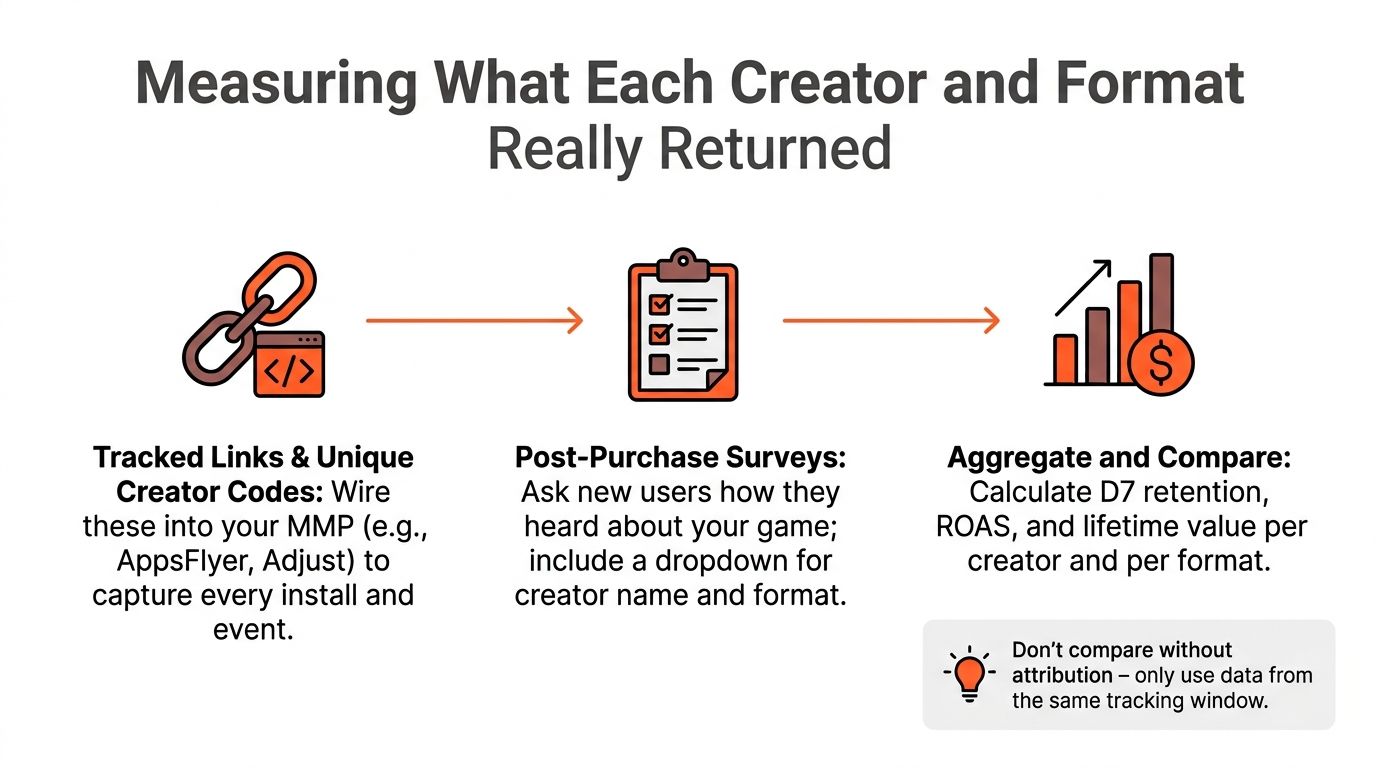
The measurement stack should be designed before the sponsorship is signed. Start with a unique tracked link for every creator and placement, then add a creator-specific code where the purchase or install journey supports it. Wire those identifiers into the MMP, such as AppsFlyer or Adjust, and map the events that matter beyond the install.
A clean event structure might include tutorial completion, account creation, first match, purchase, subscription, or another title-specific milestone. PC and console teams may need server-to-server postbacks and storefront reporting rather than relying on mobile-style device attribution. The technical setup differs, but the principle is the same, connect exposure to an observable action.
Add evidence outside the click path
Last-click attribution is useful for operational reporting, but it can misread creator influence. Someone may watch a Twitch stream, discuss the game in a community, and install later through a store search. A click-only model may credit the final touchpoint while missing the creator's role.
Post-purchase surveys provide a second view. Ask new users how they heard about the game and include creator names or formats where the list is manageable. Keep the wording consistent, capture the survey response alongside user and revenue events, and report survey-attributed share separately from tracked conversions.
The influencer marketing ROI measurement guide can help teams structure this combination of links, codes, surveys, and outcome reporting.
The video below provides a visual reference for connecting campaign activity to measurable return.
Test incrementality instead of assuming it
For a top creator, create a holdout where a defined portion of eligible impressions is withheld from the test audience. The exposed and withheld groups should be comparable, and the team should monitor installs, quality events, revenue, and timing across the same window.
A holdout doesn't make every result perfectly causal. Audience spillover, organic sharing, and platform delivery can complicate interpretation. It does, however, give the team a stronger answer than comparing a creator's attributed installs with a target.
Run a weekly creator scorecard with CPI or CPA, ROAS, quality-event rates, survey evidence, and incrementality findings. Renew creators who produce efficient, incremental value. Rotate creators who produce useful learning but weak economics. Cut placements that fail the agreed threshold after a fair tracking window, rather than allowing relationships to extend beyond their return.
Putting the Performance Playbook Together
The operating model is straightforward, but it demands consistency. Every creator deal needs a hypothesis, every placement needs a tracking method, and every campaign phase needs a decision rule. Soft-launch seeding should reveal product and audience signals. Launch amplification should convert attention while intent is high. Sustain activity should earn its place through repeatable economics.
The broader market pressure reinforces this approach. AppsFlyer and Newzoo's 2026 gaming marketing report analyzed 25 billion installs across more than 9,600 games and reported that paid install share rose 10% year over year while ad impressions rose 20%. The same verified brief cites independent coverage placing global gaming UA spend at US$25 billion in 2025, with nearly half in the United States. Those figures appear in the AppsFlyer gaming app marketing report, and they frame the operational problem clearly: scale is harder when competition and attention costs rise together.
Run the week with discipline
On Monday, review CPI, CPA, quality events, and ROAS by channel and creator cohort. On Wednesday, retire placements that have missed their agreed threshold, provided the tracking window is mature enough to support the decision. By Friday, brief new hooks, formats, or gameplay angles and lock the next sprint's allocation against a payback window finance has approved.
Creative velocity matters because a winning concept decays. Don't confuse the need for fresh creative with a requirement to produce random variations. Keep the audience promise stable, then change the opening, proof point, gameplay moment, creator framing, or call to action so the team learns which component drives response.
Social Cloud is one operational option for teams that want creator selection, briefing, contracting, tracked links, promo codes, post-purchase surveys, and weekly reporting across YouTube, Instagram, TikTok, and Twitch through one campaign workflow.
Print the short version
- Set the CPI ceiling early: Define the maximum acquisition cost before launch, then connect it to the title's observed LTV and payback assumptions.
- Instrument every placement: Create unique links and codes before content ships, not after the campaign starts.
- Cut weak economics promptly: Don't let an influencer relationship continue when the cohort can't support the agreed return.
- Recycle useful creative: Turn strong organic clips into paid variants only after rights, disclosure, and performance conditions are clear.
- Test incrementality: Separate correlation from additional demand before committing a large recurring budget.
The recurring failures are predictable. Teams over-invest in awareness while LTV modeling lags, treat TikTok virality as a strategy instead of a channel, and keep influencer partnerships alive because the relationship feels valuable. Marketing for video games earns durable budget when it behaves like performance, with brand building treated as a compounding benefit of efficient, incremental acquisition.
If your gaming team needs creator selection tied to CPI or ROAS, tracked installs across every placement, and weekly reporting that shows what to scale or cut, visit Social Cloud. Bring your launch timeline, target market, and payback assumptions, then use the campaign plan to turn creator attention into measurable player growth.