
The most popular advice about SaaS influencer marketing is to find niche creators, give them a tracking link, and scale whoever brings in the cheapest signups. That's a useful way to buy registrations. It's a poor way to decide who helps sell software. Start with the buyer's job, define what a valuable account does after signup, and judge creators against that outcome rather than their follower count.
Table of Contents
What SaaS Influencer Marketing Is and Why It Differs
SaaS influencer marketing means paying creators whose audiences are software buyers, practitioners, or operators to teach, demonstrate, or recommend a product, then tracking what happens to trials, pipeline, and revenue.
Think of the difference between a flyer through every neighbor's letterbox and a colleague recommending a tool during a team conversation. The flyer needs broad appeal. The colleague needs enough credibility to make someone investigate, try the workflow, and bring it to the people who approve purchases.
This isn't limited to consumer marketing anymore. A 2024 summary of TopRank Marketing research reported that 85% of B2B marketers used influencers, compared with 34% in 2020. Treat those figures as directional adoption benchmarks, not evidence that any particular creator campaign will convert.
Compare the buying jobs
Consumer, mobile app, and SaaS creator campaigns compared
These are useful planning distinctions, not universal rules. A self-serve utility and an enterprise security platform shouldn't inherit the same campaign design just because both sell subscriptions.
| Dimension | Consumer DTC | Mobile app | SaaS |
|---|---|---|---|
| Buying decision | Often an individual, impulse purchase | Often a quick install decision | Can involve a committee and extended evaluation |
| Main success metric | Sales and return on ad spend | Installs and cost per install | Trials, pipeline, and revenue per account |
| Creator fit signal | Lifestyle relevance | Affinity with the app's user type | Job role and workflow expertise |
| Content that works | Haul, unboxing, try-on | Gameplay or quick app demo | Tutorial, comparison, setup walkthrough |
| Compliance pressure | Endorsement disclosure and product claims | Disclosure, claims, and applicable platform rules | Added scrutiny around security, AI, or financial claims |
A software creator needs room to explain what happens after the attractive demo. Can someone connect their data? Does the workflow require administrator access? What changes for the person doing the work?
That's the kind of content to commission.

Start with your sales motion
For self-serve software, prioritize the path from content to signup to a useful product action. For sales-led software, commission content that helps buyers evaluate the problem, understand implementation, or justify a shortlist. A hybrid product needs both paths, with separate reporting.
Practical rule: Don't ask a creator to close a committee purchase with content designed for an impulse click.
For committee-led purchases, the creator's job is often to shape the shortlist, not finish the sale. Your first move is to label the product self-serve, sales-led, or hybrid, then choose the buying behavior you want to influence.
Picking Creators Who Sway Each Buying-Committee Role
Choose the buyer role before choosing the creator. A finance lead needs a different reason to believe than an engineer checking whether an integration will survive production use.
Buyer roles, the trust they need, and the creators who earn it
| Buyer role | What they need to believe | Creator profile that earns trust | Best funnel stage |
|---|---|---|---|
| Finance lead | ROI and cost savings are credible | Operators who publish documented spend math and before-and-after analysis | Consideration |
| Engineering or technical owner | The API, documentation, and setup hold up | Practitioners who build with the tool on camera | Evaluation |
| Security or compliance reviewer | Claims and certifications are accurate | Analysts who explain limits and cite evidence | Evaluation and procurement |
| Marketing or ops champion | The tool fits the existing stack and workflow | Growth operators demonstrating actual workflows | Awareness and comparison |
| Procurement | Vendor information and contract terms withstand review | Experienced sourcing practitioners who explain vendor diligence | Late-stage review |
Not every purchase includes every role. Map your actual deals using sales notes, customer interviews, and implementation conversations rather than treating this table as an org chart.
Build a candidate list around demonstrated expertise
Start with LinkedIn practitioner posts, specialist newsletters, community forums, and people your customers already follow. Ask customers who publish about their workflows whether they'd consider a paid collaboration. A knowledgeable customer can be a candidate without becoming a polished presenter overnight.
The industry discussion of role-specific B2B creator influence makes the important distinction between broad attention and credibility inside a buying committee. Use that distinction when reviewing candidates, rather than assuming professional-looking content equals purchasing influence.
Check the evidence behind the audience:
- Job titles and seniority: Request audience breakdowns and inspect whether engaged followers resemble your users, champions, or approvers.
- Geography: Confirm that viewers work in markets where you can sell and support the product.
- Comment quality: Look for implementation questions, thoughtful disagreements, and people describing their own workflows.
- Competitor overlap: Identify competing sponsorships and whether the creator can explain meaningful differences.
- Sponsored-content history: Ask for relevant results with context, including the offer, destination, and definition of conversion.
Preserve the reason people trust them
Consider a hypothetical choice between a smaller creator publishing careful software-spend analysis and a general business personality with a much larger audience. For a finance-focused campaign, I'd investigate the operator first. That's a selection hypothesis to test, not a guarantee that smaller audiences win.
Heavy scripting can also undermine the reason you hired an expert. Specify the outcome, approved claims, required disclosure, and boundaries, then let the creator explain the workflow in their own language.
Write a primary buyer role and a primary funnel stage into each brief. A creator may reach other people, but your campaign still needs a clear job.
Measuring Creator Impact Beyond Last-Click Conversions
Last-click reporting answers who supplied the final tracked visit. It doesn't necessarily answer who helped someone decide to buy.
The measurement gap is substantial: WFA research reported that 25% of members could confidently attribute sales to influencer campaigns in 2025, down from 36% in 2021. That finding supports caution about attribution, not permission to credit creators for every later purchase.
Use a funnel view to separate attention, account quality, and commercial outcomes.

Build a scorecard that follows the account
SaaS creator KPI scorecard by funnel stage
The windows below are planning guidance. Adjust them to your product's activation path and observed sales cycle.
| Funnel stage | KPI | What it proves | Typical read window |
|---|---|---|---|
| Awareness | Share of identifiable reach inside target accounts | Whether observed reach includes the intended audience | Early campaign review |
| Consideration | Branded search and direct-visit lift | A research signal, not proof of creator causation | Campaign and follow-up period |
| Pipeline | Accounts influenced and opportunities created | Documented contact with potential buying committees | Length of the sales cycle |
| Activation | Trial-to-activated rate by creator cohort | Whether referred accounts reach product value | After the normal activation period |
| Revenue | Win rate and revenue per qualified account | Commercial quality of the acquired cohort | Full sales cycle |
| Retention | Retention and expansion by cohort | Whether accounts remain valuable after acquisition | Renewal and expansion checkpoints |
A B2B buyer study reported that 83% of buyers complete research before contacting sales and 73% of decision-makers trust peer recommendations. That's a reason to measure influenced pipeline, while keeping influence separate from proven incremental revenue.
Connect the tracking before launch
- Creator-specific destinations: Assign unique UTM parameters and landing pages.
- Persistent identifiers: Store the creator ID in marketing automation and CRM records, including account-level records where appropriate.
- Self-serve codes: Use a dedicated promo code when it fits the offer, without treating code use as complete attribution.
- Declared discovery: Add a post-demo or post-purchase discovery question, with creator options and free text.
- Parallel attribution: Report first-touch and multi-touch influence side by side rather than adding their credited revenue together.
Use the guide to measuring influencer marketing ROI to connect those records to costs and business outcomes.
Dark social needs restraint. A forwarded tutorial or later branded search can support an assisted-influence label when a survey or account record connects it to the creator. Without that evidence, leave it unattributed.
Define view-through eligibility before launch, and report it separately from clicks. Compare cohorts at the same age so a recent campaign isn't judged against accounts that have already completed procurement.
Attribution describes an observed path. A holdout or staggered launch helps test whether the campaign changed the outcome.
Review clicks and trial starts weekly for delivery problems. Judge account quality and pipeline after the relevant activation and sales-cycle windows, not when the reporting month ends.
Pricing Models and Budgets for SaaS Creator Deals
Choose the commercial model around what you can measure fairly. Don't offer an opportunity-based bonus if your team hasn't agreed on what qualifies as an opportunity.
SaaS creator pricing models compared
| Pricing model | How it works | Best fit | Main risk |
|---|---|---|---|
| Flat fee per placement | Fixed price per video or post | Awareness launches and defined creative deliverables | Payment doesn't depend on outcomes |
| Base plus performance | Base fee plus a bonus for agreed actions or qualified pipeline | Products with reliable tracking and qualification | Disputes over eligibility |
| Cost per trial or install | Payment per tracked action | Self-serve trials with strong onboarding | Incentives can favor low-intent signups |
| Revenue share or affiliate | Agreed share of eligible contract revenue | Traceable purchases and clearly defined commissions | Long sales cycles delay payouts |
| Monthly retainer | Recurring fee for agreed ongoing work | Sustained education and repeat collaboration | Unclear output or scope creep |
Budgeting has become more formal: Cherry Lane Media's summary reported that 81% of B2B companies allocated a dedicated influencer budget in 2024, and more than half planned to increase it in 2025. Those were reported plans, not confirmation that the later increases occurred.
Work backward from account economics
Start with your acceptable cost per activated account or cost per qualified opportunity. Use your own historical conversion rates to estimate what an eligible visit or trial is worth. If you don't have those rates, label the forecast as an assumption and make validating it part of the pilot.
Include creator compensation, internal production time, agency fees, rights, and amplification in the cost model. The influencer marketing rates guide is useful for structuring the pricing conversation, but a quoted placement fee isn't the full acquisition cost.
For commission-based arrangements, Sprints & Sneakers' resource on scaling revenue through affiliate partnerships provides related context for evaluating an affiliate approach alongside sponsorships.
Negotiate the expensive ambiguities
- Deliverables and timing: Specify formats, revisions, publishing windows, and cancellation terms.
- Reuse and amplification: Price organic reuse, paid distribution, and creator-account advertising separately.
- Exclusivity: Define the competitor category and duration narrowly.
- Performance eligibility: Agree on qualification, duplicates, refunds, attribution, payout timing, and data access.
- Failure handling: Include make-good terms, kill fees, and creator review rights when claims change.
Performance-only deals transfer risk to creators. They can also encourage signup volume rather than customer fit, so consider a base payment with an activation or qualification gate.
Finally, ask whether creator fees pass through at cost or include an agency markup. You should be able to distinguish creator compensation from management fees without reverse-engineering an invoice.
Compliance and Usage Rights to Lock In Before Launch
Approval should happen before production, not after a creator has recorded an unsupported promise. Use a launch checklist that separates disclosure, factual accuracy, reuse permissions, and privacy review.
The checklist below is a practical starting point for the people signing off the campaign.

Check what viewers will see
- Visible disclosure: Require a clear sponsorship label at the beginning of the post or video, with placement and wording reviewed for the target market.
- Platform labeling: Enable the paid-partnership tag where available, without assuming it replaces other disclosure.
- Market-specific review: Have counsel check applicable endorsement standards, including the FTC framework for US campaigns and ASA requirements for UK campaigns.
- Evidence-backed claims: Maintain a claims sheet containing approved security certifications, performance statements, ROI examples, and AI capabilities, with supporting evidence attached.
- Restricted language: Flag terms such as “guaranteed” and “fully compliant” unless their scope and evidence have been approved.
- Fair comparisons: Reject competitor claims the team can't substantiate under the conditions shown.
Treat the claims sheet as a production asset, like the product login or demo data. Give the creator an escalation contact so uncertainty doesn't turn into improvised copy.
Define what the brand can reuse
- Channels and territory: Specify permission for organic posts, paid ads, website embeds, onboarding emails, and sales materials.
- Term and expiry: Record when permission starts, when it ends, and which assets must be removed or renewed.
- Account access: Define permissions for creator-account amplification without casually sharing login credentials.
- Editing rights: Clarify whether you can crop, subtitle, translate, or combine footage, and when the creator must approve changes.
- Privacy handling: Ask the privacy owner to review tracking, consent, data retention, and reporting. Prefer aggregate creator reports over unnecessary personal data.
- Additional legal scrutiny: Build specialist review into the schedule for sensitive fintech, health, security, or AI claims.
Use an influencer contract template to organize the agreement, then adapt it with counsel rather than treating a template as legal approval.
Assign named owners and deadlines for the brief, script where applicable, final cut, and publishing check. Give legal reviewers enough time to respond before the creator's production slot. This is general operational information, not legal advice.
Running the Awareness to Activation Playbook
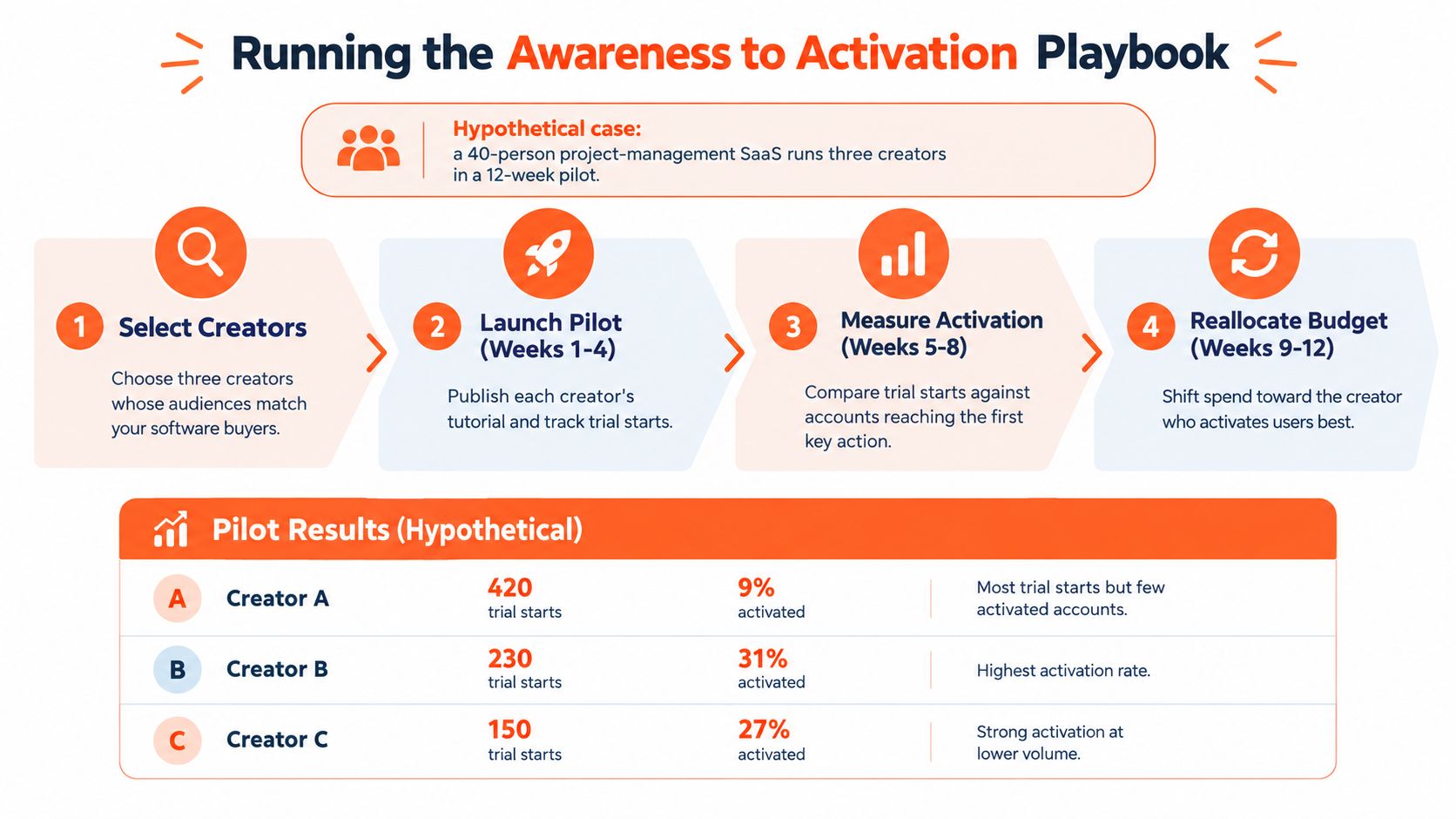
Consider a hypothetical project-management SaaS testing several creators. The creator generating the most trials sends people who rarely complete the core workflow, while a smaller source brings accounts that reach useful product value. The team should investigate the latter's account quality instead of automatically buying more of the largest signup source.
The following illustration is a hypothetical planning example, not evidence of campaign performance.
Give each creator a clear assignment
Define the audience. Write the ideal customer profile and primary buying role into the brief. Describe the problem that person owns, not just their job title.
Assign the content's job. Use education-led creators to explain why a workflow needs changing, and tutorial creators to demonstrate how someone succeeds with the product. Don't require every placement to perform both jobs equally.
Brief the workflow, not the feature inventory. Explain the starting problem, the task to complete, and the outcome viewers should understand. Pull required claims from the approved sheet rather than adding new promises during editing.
Provide a usable environment. Give the creator a sandbox or suitable trial with realistic sample data. Build an audience onboarding path that matches the demonstration, including permissions and integrations.
Test the complete handoff. Verify that destinations, identifiers, codes, and CRM capture work using a test account. Check the experience on mobile as well as desktop.
Schedule around dependencies. Confirm product access, production, legal review, revisions, and publication before announcing a launch date. Ask an agency for its assumptions rather than accepting a turnaround estimate without dependencies.
Read activation after accounts have had time to act. Investigate where each cohort stops, including failed setup, missing data, and unclear onboarding. Reallocate only after considering cohort maturity and whether the audience received comparable offers.
Continue the customer journey. Route activated accounts into relevant onboarding and send sales-assisted accounts to the appropriate owner. Someone who watched a useful tutorial shouldn't land in a generic sequence unrelated to it.
Make activation meaningful
Define activation as evidence of product value, not merely logging in. For a project-management product, a candidate event might involve creating a real project and collaborating with a teammate. Validate that definition against your own customer behavior before using it to pay performance bonuses.
Don't penalize an awareness creator for failing a tutorial creator's scorecard. Use the funnel assignments and measurement rules established earlier to distinguish an ineffective placement from a placement doing a different job.
For an additional viewing resource, use the video below alongside your working brief.
Leave the planning meeting with a brief containing the audience, workflow, approved claims, deliverables, and success criteria. Pair it with a tracking sheet containing creator IDs, asset destinations, costs, cohort dates, account outcomes, and unresolved measurement issues.
Keeping Creator Content Working in Retention
Creator content can support customers after acquisition, but reuse needs a specific purpose. Dropping the same promotional clip into every onboarding email isn't a retention strategy.
A setup tutorial can become a help-center article with screenshots, prerequisites, and troubleshooting notes. Treat reduced support demand as a hypothesis to measure, not an automatic benefit of embedding a video.
Match the asset to the customer's next problem
A customer-story video can help new accounts understand what implementation really involves. Keep the limitations and setup work in the edit. Removing those details may make the story more flattering while making it less useful for someone deciding what to do next.
An advanced-workflow demonstration serves a different audience. Show active customers how to solve an adjacent problem using capabilities they already have before steering them toward an upgrade.
Reuse the expertise, not just the footage.
The industry measurement framework for SaaS creator programs is consistent with evaluating business outcomes beyond initial engagement. For your own program, test whether educational reuse changes customer behavior rather than assuming that more viewing means better retention.
Build a maintenance routine
- Repurpose selectively: Put the strongest relevant tutorials into onboarding emails and in-app destinations, within the rights you purchased.
- Recruit customer advocates: Invite knowledgeable customers to make useful content, with appropriate compensation and disclosure.
- Time advanced education: Trigger workflow content after customers complete the prerequisite actions rather than sending it indiscriminately.
- Compare suitable cohorts: Examine retention and expansion against accounts with similar plan, size, acquisition period, and activation status.
- Review audience overlap: Refresh the roster when reach becomes repetitive or creators no longer match the product's direction.
- Retire stale instructions: Check content when interfaces, integrations, pricing, or approved claims change.
Consider a hypothetical data-pipeline tool whose creator-sourced customers stay longer but postpone expansion until their internal rollout is complete. An acquisition-only report would miss that pattern. A later cohort review could identify it, although the team would still need to investigate whether customer mix, onboarding, or creator education explains the difference.
Don't make the acquisition manager the accidental owner of a permanent content library. Assign someone to review accuracy, rights expiry, renewal permissions, and customer usefulness on a recurring calendar.
Confirm a Pilot Before You Scale Spend
Run a bounded pilot before committing scale budget. You're testing audience fit, content usefulness, and measurement reliability, not just whether someone can generate traffic.
Choose a small roster with distinct buying-role and funnel assignments. Fund enough repeat placements to evaluate the approach, and allow referred accounts to complete the relevant activation or sales process before declaring a winner.
Set the decision rules in advance
- Define a quality floor: Use your existing comparable acquisition cohorts to set an activation benchmark.
- Set a commercial target: Establish an acceptable cost and pipeline outcome per qualified account, using your own economics.
- Test incrementality where feasible: Use the holdout or staggered-launch approach described earlier.
- Write the scale rule: Expand creators who meet their assigned quality and commercial criteria. Fix identifiable execution problems before concluding that an audience doesn't fit.
Avoid changing the definition of success after the results arrive. A creator shouldn't become an “awareness investment” only because the trials didn't activate.
Decision check: If the team can't explain what would make it stop spending, the pilot isn't ready.
Assign a tracking owner, a claims approver, and a reporting owner, even if someone holds multiple responsibilities. Keep assumptions and unresolved data gaps visible in the weekly review.
You can run the program internally or evaluate an agency for creator operations and attribution support. Before signing, ask for forecast assumptions, measurement boundaries, fee triggers, and access to the underlying results.
This week, write the brief and build the tracking sheet. Don't book a placement until the buyer role, intended product action, approval owner, and pass-or-fail criteria are clear.
Social Cloud offers creator selection, campaign management, and attribution support for SaaS influencer programs, with outcome-linked fees agreed upfront. Visit Social Cloud to discuss a pilot built around your buying roles, activation goals, and pipeline measurement needs.