
You open Instagram between meetings and a creator you like is holding a product, calling it a new favorite. Half the comments want the link. The other half want to know who paid. That split is the job. You're borrowing someone's trust, and the report you send later depends on whether that trust holds and whether you can see what happened after the view.
Table of Contents
- What Sponsorship on Social Media Means
- Sponsorship Formats and Platform Fit
- How to Choose Creators Who Actually Fit
- Disclosure, Trust and Compliance Basics
- Measuring Whether Sponsorship Actually Pays
- Pricing Models and Contract Terms
- Plan Your First Sponsorship Campaign
What Sponsorship on Social Media Means
A creator mentions your product on a Tuesday morning. By Friday, someone on your team is asking which sales came from that post, and nobody can answer cleanly. That gap between trust and proof is what sponsorship is.
Sponsorship on social media means a brand pays a creator, or the person who runs the channel, to feature a product or message on that creator's own account. The post lives in a feed, story, video, or live stream the audience already chose to follow. It works like a friend who gets paid to recommend a restaurant: the suggestion lands because you trust their taste, and you still want to know who picked up the check. A display ad rents a slot beside the content. A sponsorship rents trust the creator already earned, plus the reach that comes with it.
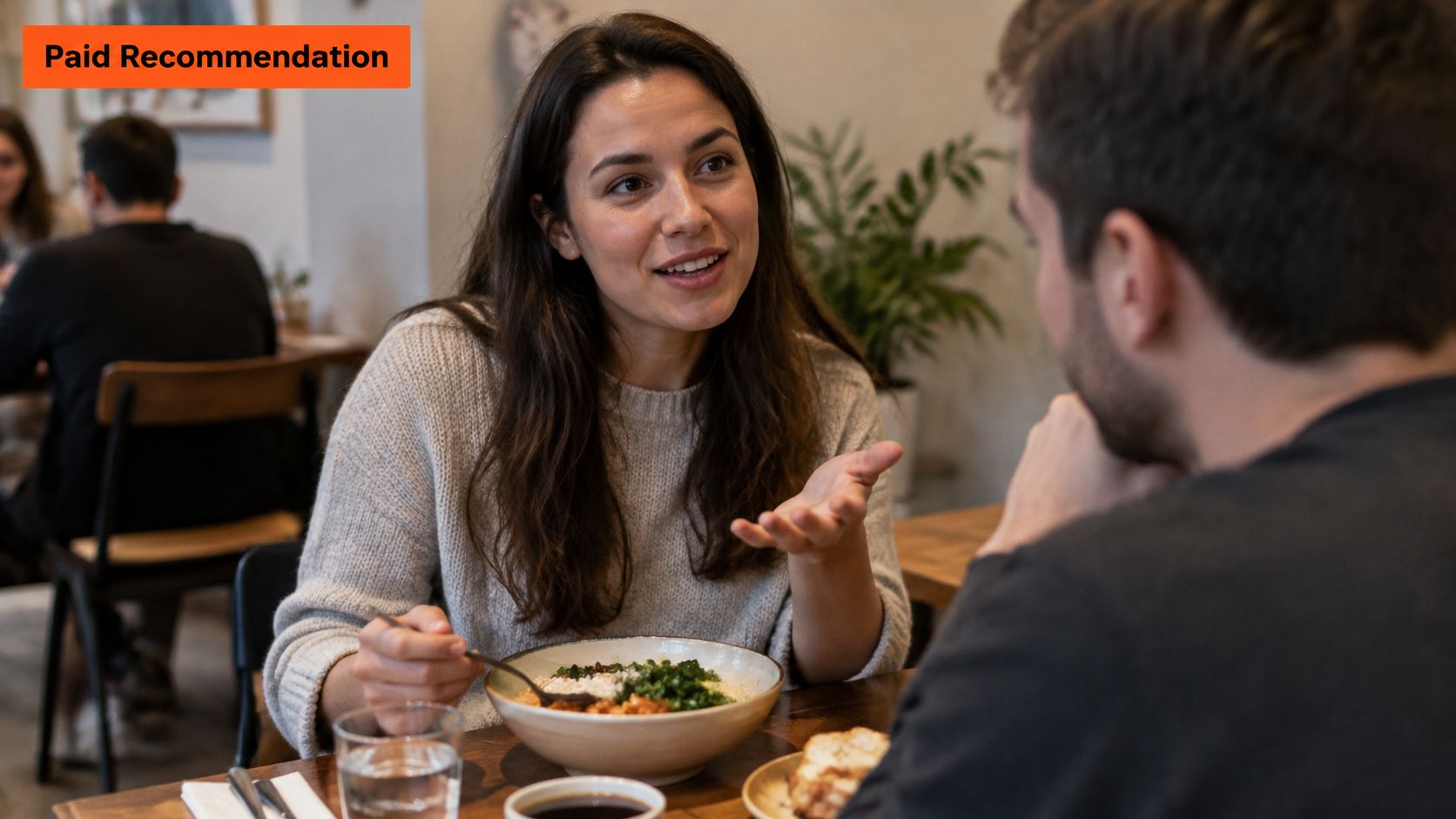
Payment usually shows up in one of four shapes:
- Flat fee: A set amount for a defined post, so the cost is known before anyone films.
- Product gifting: The item goes out, and a post is not guaranteed unless the deal says so.
- Commission: You pay when a sale comes through that creator's link or code.
- A mix: A fixed amount for making the content, plus a bonus tied to sales or sign-ups.
Each shape moves the risk around. A flat fee puts it on you, since the creator gets paid whether or not anyone clicks. Commission flips it onto them, and creators who know their audience converts will often ask for it. Gifting is cheap up front but gives you no guarantee of coverage, which works for seeding and fails completely when you need a post live by a launch date. Pick the shape based on who should carry the risk, not on what is easiest to expense.
Two myths burn budget. Sponsorship isn't free product in exchange for a casual mention, and it isn't reserved for celebrities. A niche creator with a loyal audience can move a metric a famous face never touches.
Estimates of how much money flows through influencer marketing vary depending on whether they count creator fees, agencies, software, and related services. Either way, this spend is real budget now, and it deserves the same scrutiny you would give any paid channel.
Buy the credibility, then judge the deal on a business result. If sign-ups, sales, or qualified demand don't move, the reach was a costume.
Sponsorship Formats and Platform Fit
The format determines how much attention you receive and how much control you retain. The platform decides who is in the room.
| Format | Platform | Best for | Main metric |
|---|---|---|---|
| Feed post or Reel | Awareness and product showcase | Reach, saves, link clicks | |
| Stories | Quick promotions and time-sensitive offers | Taps, link clicks | |
| Long-form integration | YouTube | Explaining complex or high-consideration products | Watch time, code redemptions |
| Shorts | YouTube | Cheap reach and finding new viewers | Views, click-through rate |
| Creator video with Spark Ads | TikTok | Turning a strong organic post into a paid ad | View-through rate, conversions |
| Live sponsorship | Twitch | Real-time demos, Q&A and community trust | Live viewers, codes used |
| Gifting and UGC | All platforms | Authentic content you can reuse across channels | Content quality, reuse rate |
| Affiliate or promo code deal | All platforms | Pay-for-results arrangements | Sales, commission per order |
Read that table as three jobs, not eight tactics.
- Short-form placements such as Reels, TikTok videos, and YouTube Shorts are a cheap way to meet people who don't know you. You trade depth for speed, and a weak hook dies in the first second.
- Long-form YouTube integrations give you room to explain a complicated product and earn trust. They cost more to make, and a bored viewer leaves before the offer.
- Live Twitch sponsorships put the product in front of questions you didn't script. Community trust can be high. You also can't edit a bad answer after the stream.
Rights before you boost
Usage rights are the line teams skip until the post is already live. If you want to run a creator's TikTok as your own ad, including through Spark Ads, that permission belongs in the contract before anyone hits publish. The same goes for running an Instagram handle as a partnership ad. No clause, no boost. A strong organic post you can't legally use is a souvenir, not an asset.
In 2024, Instagram accounted for 42% of influencer campaigns and TikTok accounted for 41%, according to Collabstr's analysis of influencer collaborations reported by WFTV. A crowded platform isn't automatically your platform. Fit beats share.
Where buyers already are
Instagram suits polished visuals in beauty, fashion, and food, and Stories carry a short offer that expires. TikTok rewards video that feels native, not a TV spot cropped into a square. YouTube fits reviews and tutorials that keep earning views after launch week. Twitch fits gaming and tech communities that will ask hard questions out loud.
Say a fintech app needs both explanation and reach. Pair a YouTube integration that walks through signup with Shorts that isolate the one feature people misunderstand. Say a game publisher wants players in week one. Run live streams with a community code, and judge the flight on codes used, not on how loud the chat got.
Practical rule: Match the format to the job first, then pick the platform where your buyers already spend time and where you can track the result.
How to Choose Creators Who Actually Fit
Follower count is the wrong first filter. A big number doesn't tell you who is watching, where they live, or whether they buy. I would leave the follower total alone until the rest of the check passes. We screen for audience quality, brand fit, and past sponsored-content performance, not the size of the account.
Run this check before you shortlist
- Location and age: The audience should match people you can sell to. A US shipping brand doesn't need a creator whose viewers are mostly somewhere you don't deliver.
- Real engagement: Comments that ask how a product works beat a like rate nobody can explain. Bought followers show up as generic praise and empty profiles.
- Style and tone: Their usual videos should be able to hold your product without a costume change.
- Older sponsored posts: Look for a clear label, a voice that still sounds like them, and any result they can point to.
| Tier | Audience size | Strength | Trade-off |
|---|---|---|---|
| Nano | Under 10k | Tight community, high trust, low fees | Limited reach per post |
| Micro | 10k to 100k | Strong engagement and niche fit | Reach adds up slowly across many posts |
| Mid-tier | 100k to 500k | Balance of reach and trust | Higher fees and more negotiation |
| Macro | Over 500k | Fast broad awareness | Weaker control over audience fit, highest cost |
Nano and micro creators often bring a tight community, lower fees, and stronger trust, with limited reach on any single post. Mid-tier creators balance those two pressures, and you'll negotiate harder on usage and exclusivity. Macro creators can put a product in front of a lot of people quickly. You pay more, and you have less say over whether those people are your buyers.
Start with three to five creators across two tiers, on the same brief, and compare them before you scale. A useful creator can say why the product fits their audience.
If they only want a script to read, you're buying a reading, not a recommendation.
Disclosure, Trust and Compliance Basics
A hidden payment does not protect performance. The leak usually starts when viewers sense an ad, cannot tell what kind, and decide the creator is grading homework they were paid to like. Clear labeling changes what people think they are seeing: an ad with a useful opinion inside it, not a recommendation that came with an invoice.
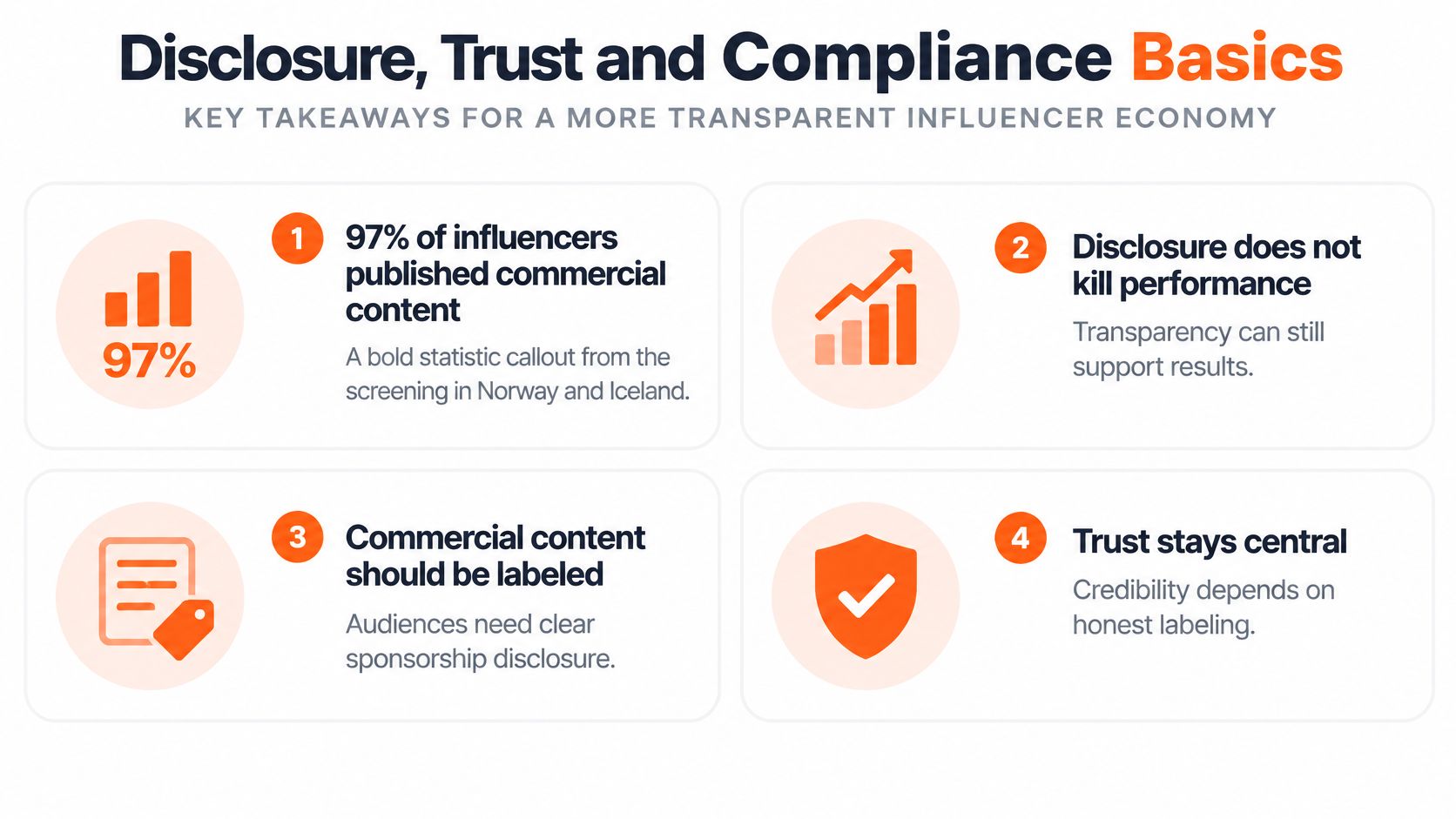
In a European Commission-led screening of influencer posts in Norway and Iceland, 97% of influencers published commercial content, but only 20% systematically identified it as advertising, and 38% did not use platform-native disclosure labels such as Instagram's paid-partnership toggle. Soft words like "collaboration" and "partnership" do not clearly tell someone they are looking at an ad.
The uncomfortable part is that honesty can cost a little polish. A 2024 meta-analysis combined 288 effect sizes from 37 studies involving 12,721 participants and found that disclosure increased persuasion knowledge and brand recall, reduced perceived credibility, and left overall effects on attitudes and behavioral intentions statistically insignificant. So judge disclosure like a measurement problem too: clean labels can depress cheap clicks while making branded search, direct traffic and later conversions easier to trust.
Before every post goes live
- Say it in plain language. Put the paid relationship in the first caption line or the opening seconds of the video.
- Use the platform label. Turn on the paid-partnership tool, and don't treat that toggle as the whole disclosure.
- Match the local language. An English hashtag on a German video isn't clear to the people watching.
- Keep it on screen. Repeat it in longer videos, and don't let it flash off a short clip.
- Score it. Track a disclosure-compliance rate by creator, platform, and market, and review it weekly. The Social Cloud guide to influencer marketing compliance shows how that rate can sit next to the performance numbers instead of in a separate legal doc.
In the US, the FTC treats money, gifts, free products and discounts as material connections that should be obvious. The influencer and the brand share that job. It is not the platform's homework, and a platform tool does not make a buried caption clear.
Sponsored product claims need the same proof you would demand in any other ad. If the creator says a jacket is waterproof, a app cuts invoice time, or a supplement does anything beyond tasting nice, the claim needs support before the post ships.
If a creator wants to drop in a clip, a track, or someone else's photo, don't guess. By Design Law Firm & Legal Consultancy, PLLC has a clear primer on fair use for digital content creators, and the contract should still name exactly what they may use.
Measuring Whether Sponsorship Actually Pays
Teams still argue about what "worked," and they often aren't measuring the same thing. In Modern Retail's marketer research, impressions were the leading success metric for 28% of respondents, only narrowly ahead of conversions at 27%. Watch time accounted for 17%, click-through rate for 14%, and commerce or sales for 13%.
Someone can watch a creator, buy the next day on a laptop, and have seen three other creators first. A last click thanks the wrong post. Cookies miss the second device. A code misses the person who remembered the name and typed the URL.
| Method | What it captures | What it misses |
|---|---|---|
| Unique links | Direct clicks and sessions from each creator | Views that never lead to a click |
| Promo codes | Purchases where the customer typed the code | Customers who remember the brand but skip the code |
| Post-purchase survey | Self-reported discovery source | Memory bias and low response rates |
| Platform lift studies | Estimated uplift from exposure on the platform | Effects outside the platform |
| Geo or holdout tests | Incremental lift against a control group | Needs budget, planning time and a clean split |
How I would read the numbers
Give each creator a unique link and a code. Add one post-purchase question about where the buyer heard about you. Run a holdout or a geo test so you can compare people who could see the posts with people who couldn't. Put ROAS next to an estimate of incremental lift. A platform lift study is one input, not the verdict.
One ROAS figure feels tidy. It also hides every sale that never touched the link.
On the campaigns we run, every placement carries a tracking link and a promo code, and the weekly view is views, CTR, conversions, and ROAS by creator. The longer version of that stack is in how to measure influencer marketing ROI.
Record sales for the weeks before the campaign starts. Without that baseline, a good week and a sponsored week look identical.
Pricing Models and Contract Terms
Compare how you pay before you compare creators. The model decides who carries the risk when a post is quiet.
A flat fee buys a fixed deliverable, one feed post or one YouTube integration. You know the cost on Monday. You don't know the response on Friday. Product gifting is useful when you want footage you can reuse, and it guarantees nothing unless a post is required. A cost per thousand impressions prices reach and says almost nothing about whether anyone acted. Cost per install or cost per sign-up fits an app or a lead offer when the action is tracked back to that creator. An affiliate commission pays on sales through a link or code, so the creator carries more of the risk and the recommendation has to be strong enough to earn it.
A mix usually behaves better than a pure model. Pay a fixed fee so the video gets made, then add a commission for the result you care about.
Put these in the contract
- Deliverables and dates: What goes live, on which account, and by when.
- Disclosure wording: The exact line, not "please disclose somehow."
- Usage and whitelisting: How long you may run the content as an ad, including Spark Ads access.
- Exclusivity, revisions, and takedown: How long they stay away from a rival, how many edits you get, and what happens if a post has to come down.
Rates move with platform, niche, and tier. I wouldn't copy a public rate card and call it a plan. Set benchmarks from your own tests. Podcast buyers hit the same trap, and these host-read sponsorship cost examples from Podmuse show why a published number rarely matches the deal you can defend. For the creator fee ranges we use in planning, see influencer marketing rates.
Every fee should attach to a deliverable the article already names. If it isn't named, it isn't on the invoice.
Plan Your First Sponsorship Campaign
Run a small test you can read. A splash you have to defend teaches you less.

- Set one goal and one metric. Awareness, sign-ups, or sales. A single target keeps the test readable when the comments get noisy.
- Pick two formats and two platforms where your buyers already spend time. Add a third and you won't know what moved.
- Split the budget between a fixed fee and a performance component if you're using one. You'll see whether the extra pay bought extra action.
- Shortlist five to ten creators, then book three to five. Give them all the same details, or the comparison is theater.
- Put the legal bits in writing. Disclosure wording and the usage rights you need should be written before anyone films. For an Instagram-specific way to connect those posts to revenue, measure Instagram creator campaign ROI from HarvestMyData is a practical walkthrough.
- Set up tracking before the first post. Unique link, code, a post-purchase question, and a holdout group.
- Check disclosure, then review weekly by creator and platform. Don't wait for a wrap-up deck to notice a missing label or a dead link.
- Scale the creators who move your metric and stop the rest. A friendly relationship doesn't earn a second flight by itself.
If staffing that in-house is too much, compare an agency and an internal team on the same brief and the same tracking. That's the only comparison that's fair. You can request a proposal from us with the Request proposal button. Before you lock fees, our free download, The 2026 influencer marketing report, has CPM, CPI, and engagement benchmarks by tier, and our ROI calculator lets you forecast the campaign.
Sponsorship on social media is easier to trust when one team owns creator choice, contracts, disclosure, and the numbers behind each post. Social Cloud plans and measures creator campaigns across YouTube, Instagram, TikTok, and Twitch, with tracking on every placement and fees tied to the outcome you agree up front. If you want that setup on your next brief, visit Social Cloud.

