
You launch a supplement affiliate program because creators already talk about protein, vitamins, recovery, and daily wellness. A few weeks later, the dashboard is full of clicks, coupon codes are appearing on deal sites, and nobody can explain which partners generated new customers. Meanwhile, a creator publishes a casual health claim that your legal team never approved.
That setup isn't a growth channel. It's a referral link dump with regulatory exposure.
A serious program treats affiliate spend like paid acquisition. You need approved claims, accountable partners, refund-adjusted commissions, reliable attribution, and a margin model that rewards incremental customers rather than whoever grabs the final click.
Table of Contents
Why Most Supplement Affiliate Programs Stall Before They Scale
The common failure pattern is predictable. A brand opens an application page, sets one commission for everyone, generates tracking links, and waits for “influencers” to arrive. The first applicants are often coupon publishers, cashback sites, or creators with broad audiences and little evidence that their recommendations influence buying decisions.
The dashboard then reports attributed revenue. That number looks useful until you inspect the orders. A coupon site may have intercepted a shopper who had already searched for the product. A creator may have introduced the brand, while a retargeting ad or discount code received the final credit. If the program pays both without testing incrementality, the brand confuses attribution with causation.
Practical rule: If you can't explain why an order was commissionable, you don't have a measurement system. You have a payout habit.
Define the program before recruiting partners
In supplements, a program includes more than links and commission rates. It needs a controlled operating model covering:
- Partner eligibility: Decide whether you want sports nutrition publishers, vitamin educators, comparison sites, wellness communities, or general lifestyle creators.
- Claim permissions: Give partners approved language, prohibited language, required disclaimers, and a review route.
- Commercial rules: Define commissionable revenue, refund treatment, payment timing, exclusions, and traffic restrictions.
- Attribution rules: Record which click, code, or other signal earned credit, then test whether the referral created incremental demand.
- Accountability: Keep the right to pause traffic, reject orders, remove content, and withhold commissions tied to noncompliant activity.
The category has enough demand to support specialized partners. The FTC's health-claims resource notes that the U.S. supplement industry reported approximately $25 billion in sales in 2009, up 6% from the previous year. That historical scale shows why the category attracts publishers, creators, and comparison businesses, but it doesn't prove that any particular offer will work.
Your baseline should be simple: revenue, conversion rate, repeat purchase, refund-adjusted CPA, contribution margin, and incremental orders by partner. If the current setup only shows clicks and gross sales, stop recruiting and fix the ledger first.
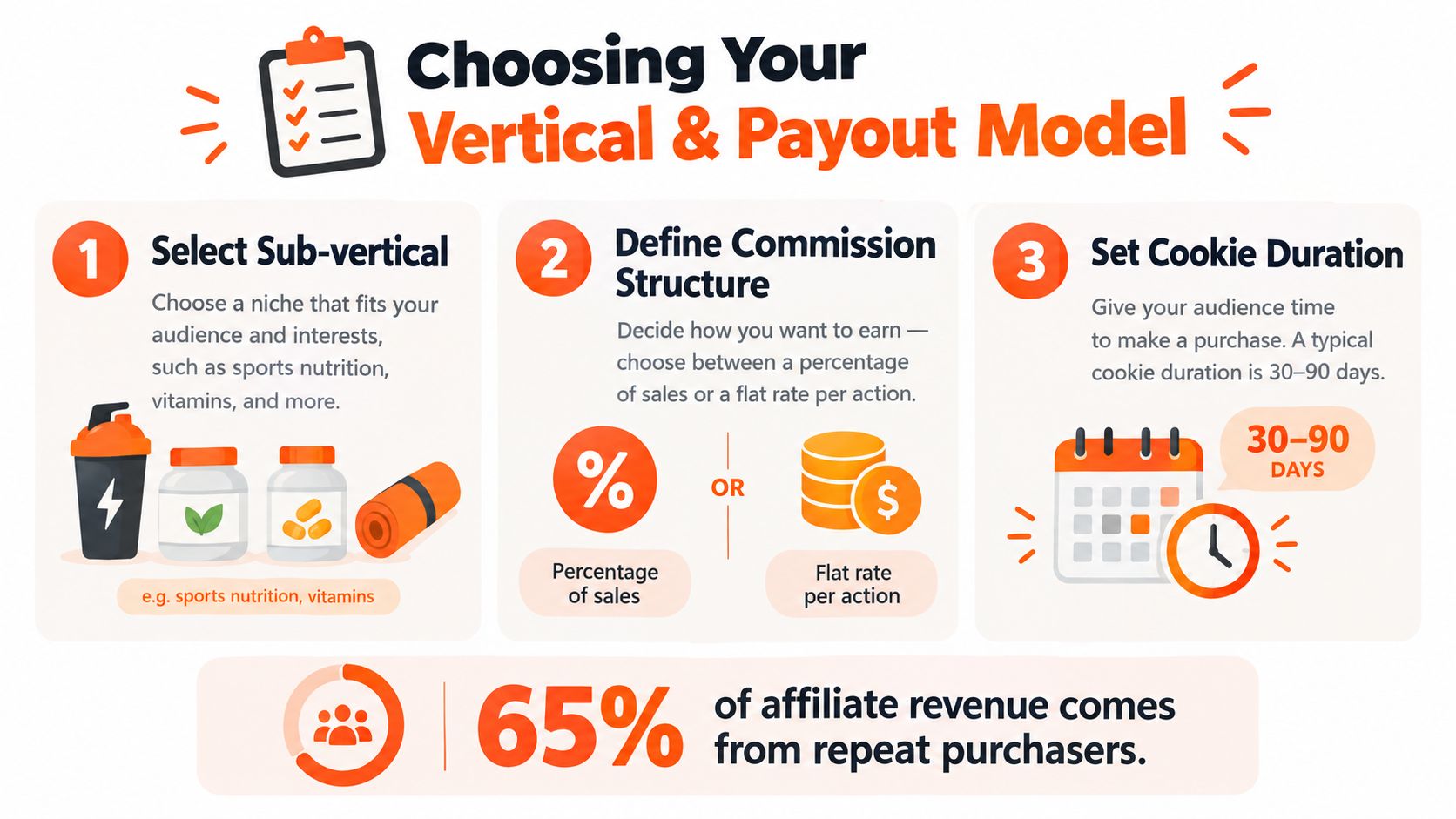
Choosing Your Vertical, Terms, and Payout Model
Start with the customer problem, not the platform. Sports nutrition, vitamins, weight management, and preventive health attract different audiences, content styles, claim risks, and purchase patterns. A sports nutrition publisher can explain training routines and product use. A weight-management creator may need much tighter controls because casual language can drift into body, disease, or guaranteed-outcome claims.
Select a narrow commercial position
Choose one primary sub-vertical for the initial program. A focused offer gives creators a clearer reason to promote you and gives your team a manageable claim library. Expand only after you know which partner types produce compliant, profitable customers.
Then decide whether to run through affiliate software, a network, or a hybrid setup. Your platform should support unique links and codes, refund status, fraud review, partner approvals, tax documentation, and exportable order data. A network can simplify recruitment and administration, but it may also introduce publishers you wouldn't choose directly. In-house software offers control, yet your team must own partner vetting, payment operations, and policy enforcement.
For a broader comparison of commercial models and platform economics, SleekPost compares platform payouts. Use resources like that to frame questions, not to copy another brand's terms without checking your own margins.
Write terms that protect the economics
Your agreement should define the following in plain language:
- Commission basis: State whether the rate applies to net product revenue, excludes shipping and taxes, and changes by SKU or customer type.
- Refund clawbacks: Hold or reverse commissions for cancelled, refunded, fraudulent, self-referred, and policy-violating orders.
- Payment timing: Pay after your refund window is known, not immediately after checkout.
- Traffic restrictions: Ban trademark bidding, misleading redirects, forced clicks, unauthorized coupon distribution, and unapproved paid media.
- Geographic limits: Match partner rights to the countries where you can legally sell, ship, and advertise.
- Minimum payout threshold: Avoid costly micro-payments, while keeping the threshold reasonable for smaller educators and creators.
- Content rights: Specify whether you can reuse approved videos, reviews, or posts in paid campaigns.
Your partner program should sit beside, not replace, your wider performance-based influencer marketing strategy. Keep affiliate terms, creator contracts, and paid amplification rights aligned so one piece of content doesn't receive conflicting instructions.
A useful setup checklist looks like this:
- Pick one sub-vertical and one primary customer need.
- Map the margin available after product cost, fulfilment, refunds, and commissions.
- Select software that exposes order-level data.
- Publish prohibited traffic and claims policies before recruitment.
- Create an approval process for partners and promotional assets.
- Define the countries, products, and customer types the program can serve.
Use the following video as a general visual reference for how affiliate mechanics can fit into a wider acquisition system. Validate every commercial and compliance detail against your own operating model.
Commission Structures That Motivate Creators Without Killing Margin
Commission design is where most brands become either too generous or too complicated. A flat rate is easy to explain, but it ignores customer quality. A high rate can attract aggressive coupon traffic while failing to motivate the educators who spend time making credible product content.
Use your contribution margin, not a competitor's headline offer, as the starting point. Calculate what remains after product cost, fulfilment, payment processing, refunds, customer support, and any subscription incentives. Then decide how much of that margin you can exchange for a genuinely incremental first order.
Choose the model that matches customer value
A flat percentage works when products have similar margins and order values. It gives creators a clean reason to promote the entire catalog, but it can overpay partners for low-margin products or underpay them for high-effort educational content.
A tiered structure rewards volume, but volume should mean quality-adjusted volume, not raw order count. Tie higher tiers to refund-adjusted revenue, new-customer orders, or contribution margin. Otherwise, a partner can earn a better rate by sending customers who cancel or use a discount that destroys profitability.
Recurring commissions can make sense for subscriptions, provided the agreement defines the duration and the conditions. Don't promise lifetime payouts casually. Retention can change, payment methods can fail, and partners may continue receiving commission for customers they no longer influence.
A hybrid model can work for established creators. Offer a controlled base fee for production, then add a performance component tied to approved outcomes. Keep the affiliate component separate in the ledger so you can see whether the content fee and the sales payout each earn their place.
| Model | Typical Range | Best For | Watch Out For |
|---|---|---|---|
| Flat percentage | Set from contribution margin | Broad catalogs with consistent economics | Overpaying on low-margin SKUs |
| Tiered percentage | Graduated by quality-adjusted volume | Partners with proven new-customer demand | Coupon or refund volume triggering tiers |
| Recurring commission | Defined subscription period | Subscription products with measurable retention | Paying indefinitely for inactive influence |
| Hybrid base plus bonus | Negotiated production fee plus outcome payout | High-effort creator content and launches | Losing visibility into total acquisition cost |
The table's “typical range” should be replaced with your own approved rate bands. Don't publish invented market benchmarks as if they were universal. A supplement program's acceptable rate depends on product margin, repeat purchase, refund exposure, and whether the partner supplies original demand or merely captures existing intent.
Treat cookie duration as a policy decision
A longer attribution window can help a reviewer or educator whose audience researches before buying. It can also give coupon sites too much time to intercept a purchase. Set the window around the actual consideration cycle, then exclude orders where another prohibited source receives the final interaction.
Cross-device behavior creates another limit. A link clicked on a phone may not connect to a desktop purchase, while a code can survive that transition but may be shared publicly. Use both signals where lawful, document precedence rules, and never present the result as more precise than it is.
Recruiting Creators, Educators, and Publishers That Fit the Brand
Follower count is a poor screening shortcut. A smaller nutrition educator with a trusted audience can produce better customers than a large lifestyle account whose audience has no clear reason to buy supplements.
Assess partners across four dimensions: audience relevance, content quality, commercial intent, and compliance discipline. Review recent sponsored posts, comment quality, product explanations, disclosure habits, and any history of exaggerated health claims. Ask how the partner plans to introduce the product before discussing a rate.
Build a partner mix with different jobs
Creators can demonstrate routines, taste, packaging, or personal product use. Educators can explain ingredients and fit the product into a broader wellness context. Comparison publishers can capture high-intent research traffic. Communities can provide trust, but they also require careful moderation because members may repeat claims that your approved copy never allowed.
Shortlist partners in batches, then run a small pilot with a clear brief. The pilot should test the partner's communication and process as much as sales. Can they use the required disclosure? Do they submit captions for review? Do they use the assigned code? Can they explain the product without turning support language into a treatment promise?

A useful creator brief fits on one page:
- Product story: What the product is, who it's for, and what experience the creator may describe.
- Approved claims: Exact wording, evidence notes, required qualification, and examples of language to avoid.
- Disclosure line: A clear statement that the creator may earn a commission from purchases.
- Link and code: The unique URL, promo code, placement rules, and expiry details.
- Creative direction: Required product facts, allowed demonstrations, prohibited implications, and brand-safety limits.
- Review process: Submission channel, reviewer, expected turnaround, and correction procedure.
- Usage rights: Whether the brand can reuse the content in email, landing pages, or paid social.
- Reporting: The information the creator receives and the date used for performance review.
The FTC says material connections between endorsers and advertisers must be disclosed clearly and conspicuously, and it can hold advertisers responsible for deceptive or unsupported claims made through endorsements. Treat disclosure as part of the creative, not as fine print added after filming.
For teams expanding from creator partnerships into a more formal channel, scaling Amazon brands with affiliates offers useful context on partnership operations. Apply the principle selectively. A supplement program needs its own claims controls and customer-quality checks.
Say no to partners who resist review, hide traffic sources, publish unsupported medical promises, or insist on universal discounting. A clean rejection is cheaper than onboarding a partner who forces your team into constant corrections.
Tracking, Attribution, and the Difference Between Clicks and Customers
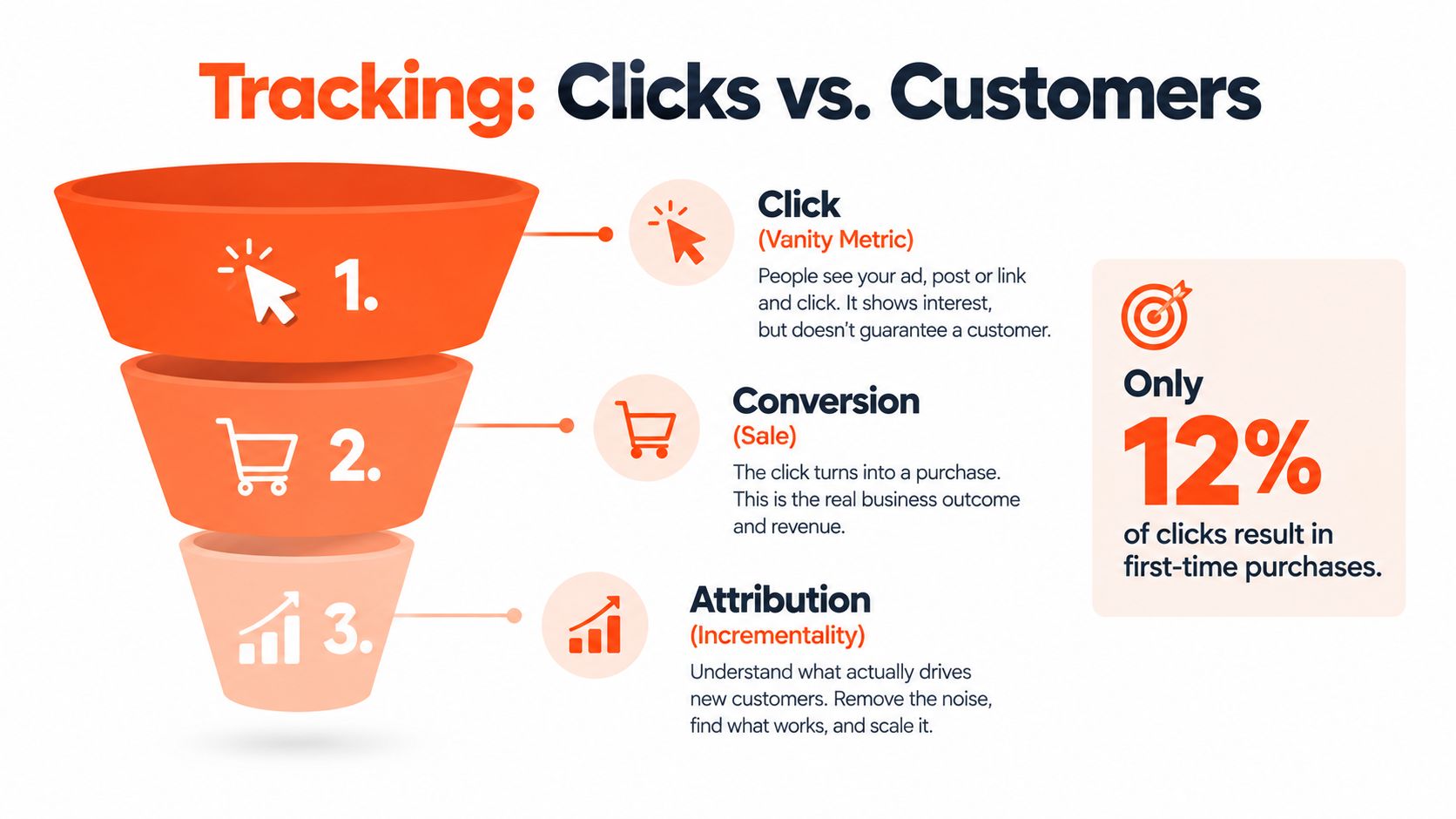
A click proves interest in a message. It doesn't prove that the affiliate created demand, and it certainly doesn't prove a profitable customer.
Use links and codes together. Links provide source and campaign context. Codes help with cross-device purchases and offline recall. Neither signal proves incrementality by itself, so the program needs an order-level ledger and a test design.
Compare the mechanics honestly
Unique affiliate links are easy to deploy and useful for channel reporting. They become unreliable when customers switch devices, share links, clear cookies, or purchase after another marketing interaction.
Creator-specific promo codes can capture sales that links miss. Public codes also spread beyond the intended audience, especially through coupon sites, so code usage needs source and fraud review.
First-party cookies where lawful can improve continuity on your own site. They still depend on consent, browser behavior, and a defined attribution window.
A server-side ledger is the source of truth for commissionable orders. Pass click ID, order ID, SKU, refund status, and net commissionable revenue into one record. Without that connection, your affiliate dashboard can report a conversion while finance later absorbs a refund that never reaches the payout logic.
The correct exclusions matter as much as the tracking. Remove cancelled, refunded, self-referred, fraudulent, and prohibited coupon-site orders. Define which touchpoint wins when a creator link, paid ad, email, and public code all appear in the same journey.
A practical guide to how to attribute conversions properly can help your team document the mechanics, but your own rules must reflect your checkout, consent model, and partner contracts.
Test for incremental demand
Compare affiliate-exposed customers with a holdout, geographic control, or time-based control where the design is credible. Watch incremental orders, contribution margin after commissions, refund-adjusted CPA, repeat-purchase rate, and payback period.
As a directional ecommerce benchmark, a Shopify supplement-store dataset reports a 2.5% median session conversion rate, 3.9% for the top 20%, and 4.5% or higher for the top 10%. The Littledata supplements benchmark also makes clear that these figures aren't guaranteed affiliate rates. Creator intent, mobile traffic, subscription structure, landing-page speed, and attribution rules can materially change outcomes.
Use influencer marketing ROI measurement as a complementary discipline, but don't merge dashboards blindly. If a creator appears in both an influencer campaign and the affiliate program, assign ownership rules before launch and prevent double-counting.
Claims Control and Disclosure as an Operating System
Compliance controls conversion quality. They determine what creators can say, which landing pages can be reused, whether paid amplification can continue, and whether a customer arrives with realistic expectations.
The FTC's health-products compliance guidance states that objective health and safety claims generally need competent and reliable scientific evidence. It also explains that advertisers can face liability when endorsements or testimonials make claims that would be deceptive or inadequately supported if the advertiser made them directly.
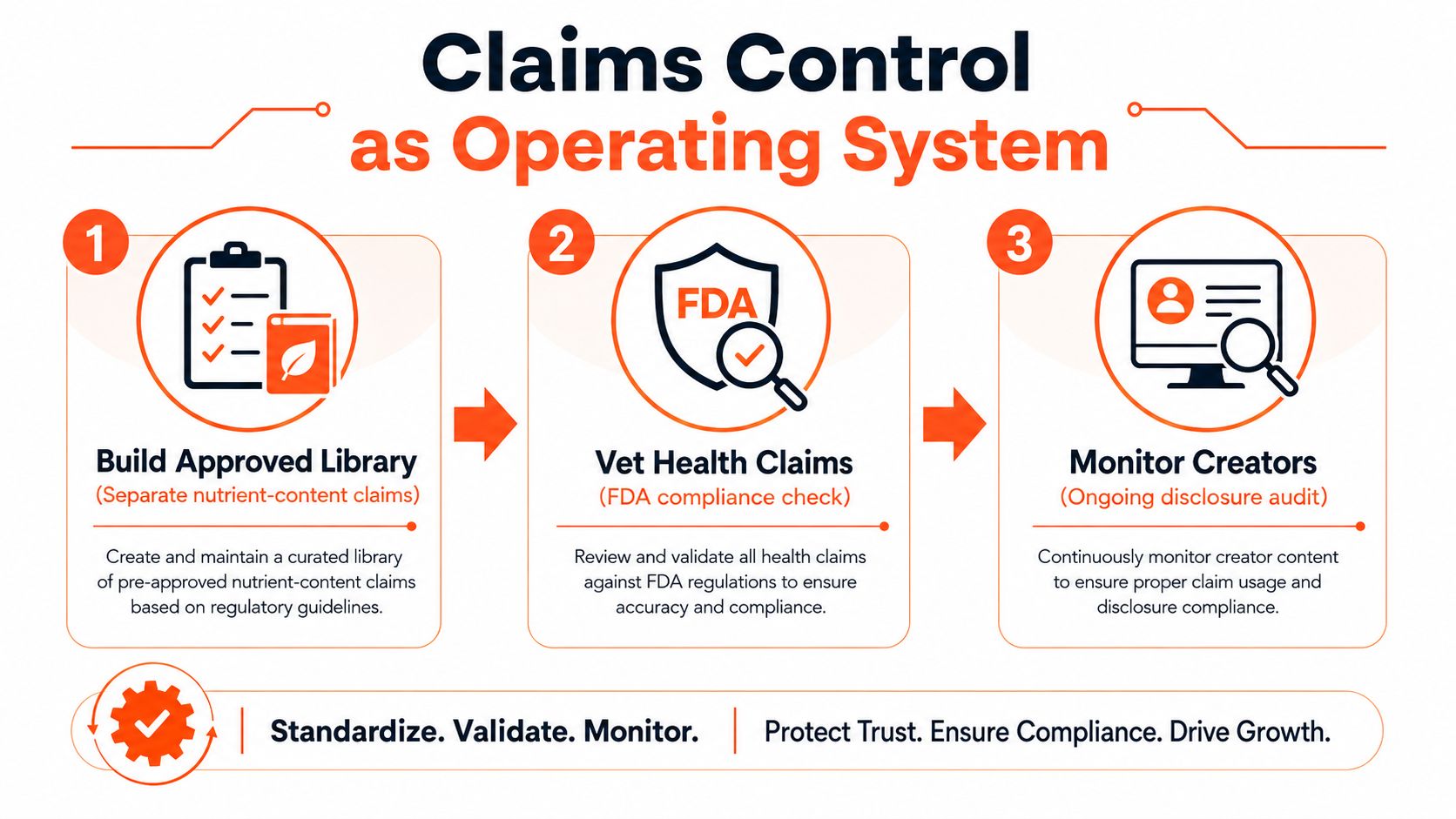
Build the claim library first
Separate the library into nutrient-content claims, health claims, and structure/function claims. For every approved statement, record the ingredient or product evidence, permitted wording, prohibited implications, required disclaimer, market, reviewer, approval date, and evidence location.
The distinction must be operational. “Supports immune function” isn't interchangeable with “prevents infection” or “treats illness.” The first may fit an approved structure/function framework, while the second can create a disease-related claim that requires a much stricter substantiation analysis.
In the United States, structure/function claims require the FDA disclaimer that the product isn't intended to diagnose, treat, cure, or prevent disease. The NIH Office of Dietary Supplements consumer fact sheet notes that the FTC has brought 120 cases challenging supplement health claims over the past decade. That enforcement history makes creator wording a commercial risk, not a copy-editing detail.
Require controlled execution
Give affiliates only approved wording, then retain the evidence behind each statement. Review scripts, captions, landing pages, email copy, and paid versions before publication. After publication, monitor the live content because creators can edit captions, add comments, or answer questions with language that wasn't in the original draft.
A compliance record should include:
- Partner and campaign identifier.
- Asset URL and publication date.
- Exact approved claim.
- Required disclosure.
- Reviewer and approval timestamp.
- Market and applicable claim matrix.
- Correction, takedown, or escalation history.
The FTC also requires clear disclosure of material connections. An affiliate commission is a financial relationship, so the disclosure should be easy to notice and understand, such as: “I may earn a commission if you purchase through my link.” Put it near the recommendation, not buried behind a profile link or an ambiguous hashtag.
For international programs, maintain country-specific matrices. An expert survey cited by the NIH resource found that 74% of respondents reported certain weight-loss-supplement claims prohibited in their countries, while 52% reported that claims must have a scientific basis. U.S. wording doesn't automatically transfer to another market.
Use health influencer marketing guidance as a broader reminder that disclosure, briefing, review, and monitoring belong in one workflow. Make commissions conditional on compliant traffic and orders. Give the brand rapid takedown and correction rights, and train partners before they publish rather than correcting them after a post spreads.
Measuring, Optimizing, and Running the 90-Day Cadence
A program improves when the team reviews the same evidence on a predictable rhythm. Don't wait for a monthly revenue report to discover that a partner's claims created refunds or that a public code displaced organic demand.
Establish the operating rhythm
Each week, review partner-level clicks, new-customer orders, refund-adjusted CPA, contribution margin, code leakage, rejected orders, and compliance incidents. Look for changes in traffic quality, not just higher attributed revenue.
Each month, compare creative themes, landing pages, product bundles, and partner types. Test approved variations in the page and offer, then keep the claims stable enough that performance differences remain interpretable. Review whether paid amplification is increasing incremental sales or only shifting credit toward an affiliate code.
Each quarter, prune partners who generate poor-quality or noncompliant orders, recruit partners that fill clear audience gaps, and renegotiate terms only when the data supports it. Review the attribution window, exclusion rules, refund treatment, and control design as the program matures.
A practical 90-day sequence is straightforward:
- Early phase: Audit margins, approve the claim library, configure links and codes, define exclusions, and recruit a small set of high-fit partners.
- Middle phase: Compare partner quality, review every asset, test landing pages, and validate whether the reported orders are incremental.
- Final phase: Scale the partners with strong contribution margin and clean compliance records, expand carefully into adjacent sub-verticals, and remove sources that capture existing intent.
Troubleshoot the common breakdowns
Refund spikes usually signal a mismatch between the claim, the product experience, and the buyer's expectation. Audit the exact words used in videos, captions, comments, and landing pages before changing the commission.
Coupon hijacking means the program is rewarding interception. Remove unauthorized coupon traffic, tighten code distribution, and compare customers exposed to the partner with an appropriate control.
Creator churn often comes from unclear payout timing or opaque rejection logic. Give partners order-level explanations, publish refund treatment, and pay reliably for compliant incremental sales.
Track serious customer complaints through customer service and route potential adverse events to the responsible internal team. The NIH resource notes that fewer than 1% of adverse events have historically reached the FDA reporting system, which makes affiliate monitoring and clear escalation paths an important safeguard.
Scale only when three conditions hold: the partner brings new customers, the orders remain profitable after refunds and commission, and the content stays within the approved claims system. That combination turns affiliate activity into a durable acquisition channel instead of a monthly argument over whose dashboard is right.
Social Cloud can help you plan, vet, brief, track, and optimize creator campaigns across YouTube, Instagram, TikTok, and Twitch with per-placement attribution and outcome-linked pricing. Visit Social Cloud to build a supplement affiliate program that connects creator content to compliant, refund-adjusted revenue.