You've just launched your first TikTok search ads campaign. The keywords look sensible, the landing page is ready, and everyone's waiting for the conversion data to confirm that TikTok can behave like a lower-funnel channel. Then the first report arrives. Impressions are moving, video views look healthy, but the search terms feel more exploratory than transactional.
That tension is normal. TikTok search ads can capture explicit queries, but they don't turn TikTok into a text-led search engine. The platform's search behavior sits between discovery and intent, which means the strongest campaigns usually capture demand that creators, trends, and feed content have already helped create.
Table of Contents
- When a Growth Lead Turns on TikTok Search Ads
- The matching layer matters
- A view isn't the same as deliberate engagement
When a Growth Lead Turns on TikTok Search Ads
The growth team at a mid-market DTC brand has spent weeks preparing for launch. The campaign manager expects a clean performance channel, with a controlled keyword set and a CPA target that can be judged quickly. The creative team has supplied several strong In-Feed videos, and the media buyer has imported product-related queries into Ads Manager.
By the end of the first day, the questions start arriving:
- Should we broaden the category terms? More reach could uncover demand, but it could also invite loosely related discovery queries.
- How much spend is enough for a fair read? A tiny test may protect efficiency while starving the campaign of useful delivery signals.
- Should the feed creative stay unchanged? A video that earns attention in the For You feed may not answer a searcher's question clearly enough.
- What counts as success before purchases accumulate? Search-page impressions, query relevance, landing-page visits, and assisted conversions may all matter before a last-click purchase appears.
TikTok's rollout helps explain why teams often have mismatched expectations. The platform began beta testing search-result ads with selected partners in March 2022, expanded search ads to all advertisers by August 2023, and introduced the more advanced Search Ads Campaign in September 2024, according to TikTok's Search Ads Campaign announcement. The product has become more structured, but it's still built around video discovery rather than plain text responses.
The practical framing: treat TikTok search ads as a demand-capture layer, not an automatic replacement for Google Search.
That distinction affects everything from keyword selection to creative production. A brand that's already producing useful creator assets may find that search ads give those assets another route to people who are actively exploring a category. Teams still learning the basics can use this guide to starting TikTok ads, while production teams exploring faster testing workflows may find these Veo3 AI promotional videos useful for developing search-specific variations.
The rest of the operating model follows from that premise: understand the mechanics, separate stable features from rollout constraints, write better keyword rules, build creative for the search page, measure incrementality, and connect search capture to creator-led discovery.
How TikTok Search Ads Actually Work
A person searches for a product, problem, or category in TikTok's search bar. TikTok compares that query with eligible advertiser keywords, then decides whether a video ad can enter the Search Results Page auction beside organic content. Keyword selection sets the eligibility conditions, not a guaranteed text-ad placement. Relevance, auction pressure, and the creative itself still affect delivery.
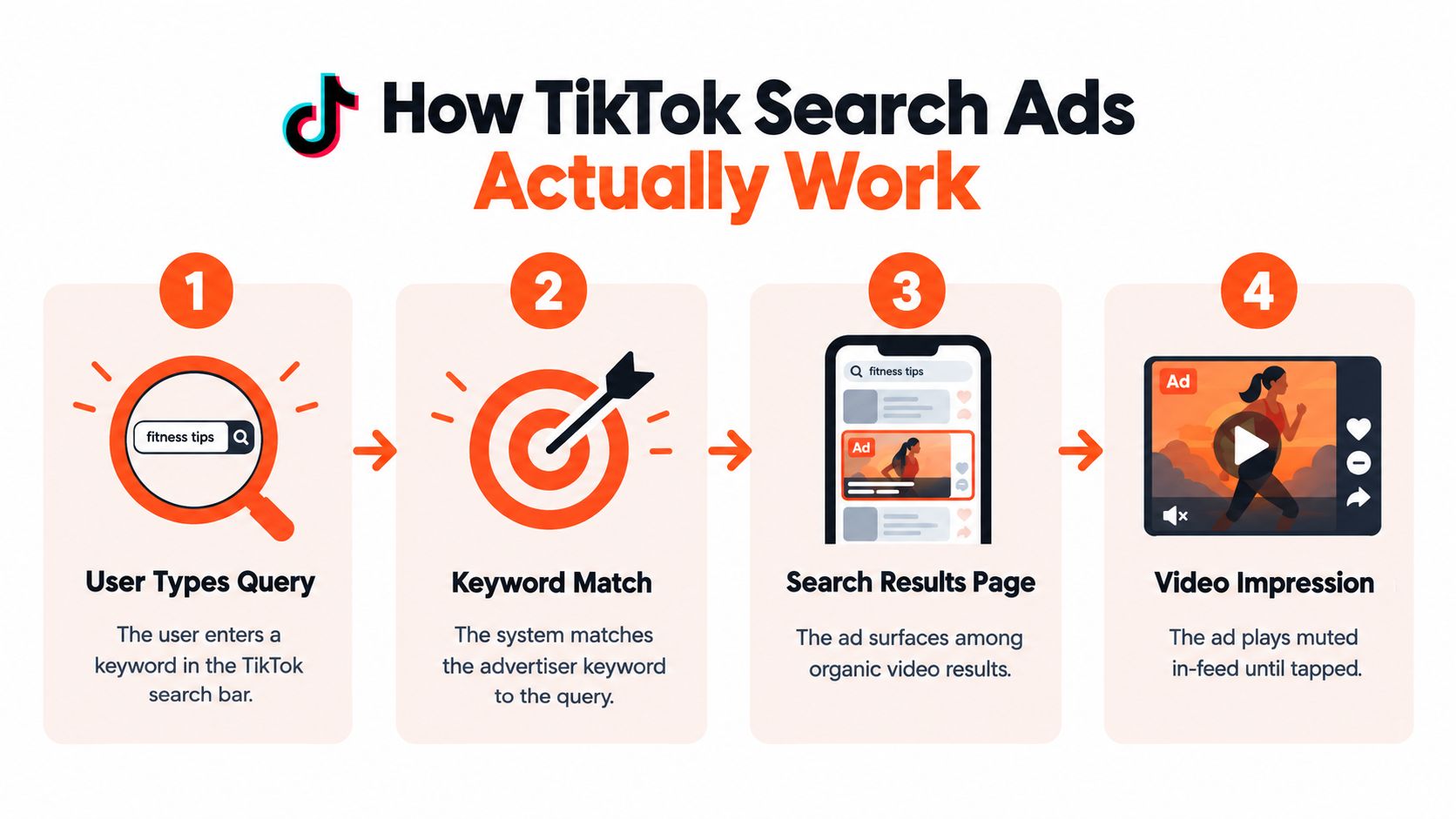
TikTok's newer Search Ads Campaign places ads on the Search Results Page against selected keywords and supports Traffic and Web Conversion objectives. The campaign can capture people who have moved from creator-led discovery into active research, but it still requires video-first evaluation rather than the reporting logic of a conventional text-search account.
The matching layer matters
The platform maps advertiser-selected keywords to user queries before serving eligible creative. The result is a keyword-led video auction, not a direct handoff from query to a line of ad copy. The caption, opening visual, product fit, and landing page all shape whether the ad feels relevant once the searcher sees it.
Negative keywords help control that match. Set them before scaling, then review query quality as spend accumulates. They filter searches that may look adjacent in the category but have little chance of producing a useful visit or conversion.
A view isn't the same as deliberate engagement
TikTok search creative can behave like in-feed video. Autoplayed videos count as both an impression and a view, while still-image ads count only impressions, according to TikTok's search creative guidance. Video view totals can therefore rise without a corresponding increase in active attention.
A searcher may scroll past an autoplayed video without tapping, listening, or watching through. Track impressions, views, hold rate, clicks, and conversions as separate signals. For attribution, connect search exposure and post-click actions to the same conversion definitions used for creator and Spark campaigns. That separation shows whether search is capturing existing demand or merely taking credit for discovery that happened elsewhere.
From 2022 Beta to 2025 Global Maturity
TikTok search advertising has moved from a limited experiment to a strategic product line in a relatively short period. The important point for budget owners isn't just that the product exists. It's that different parts of the product have different levels of maturity.
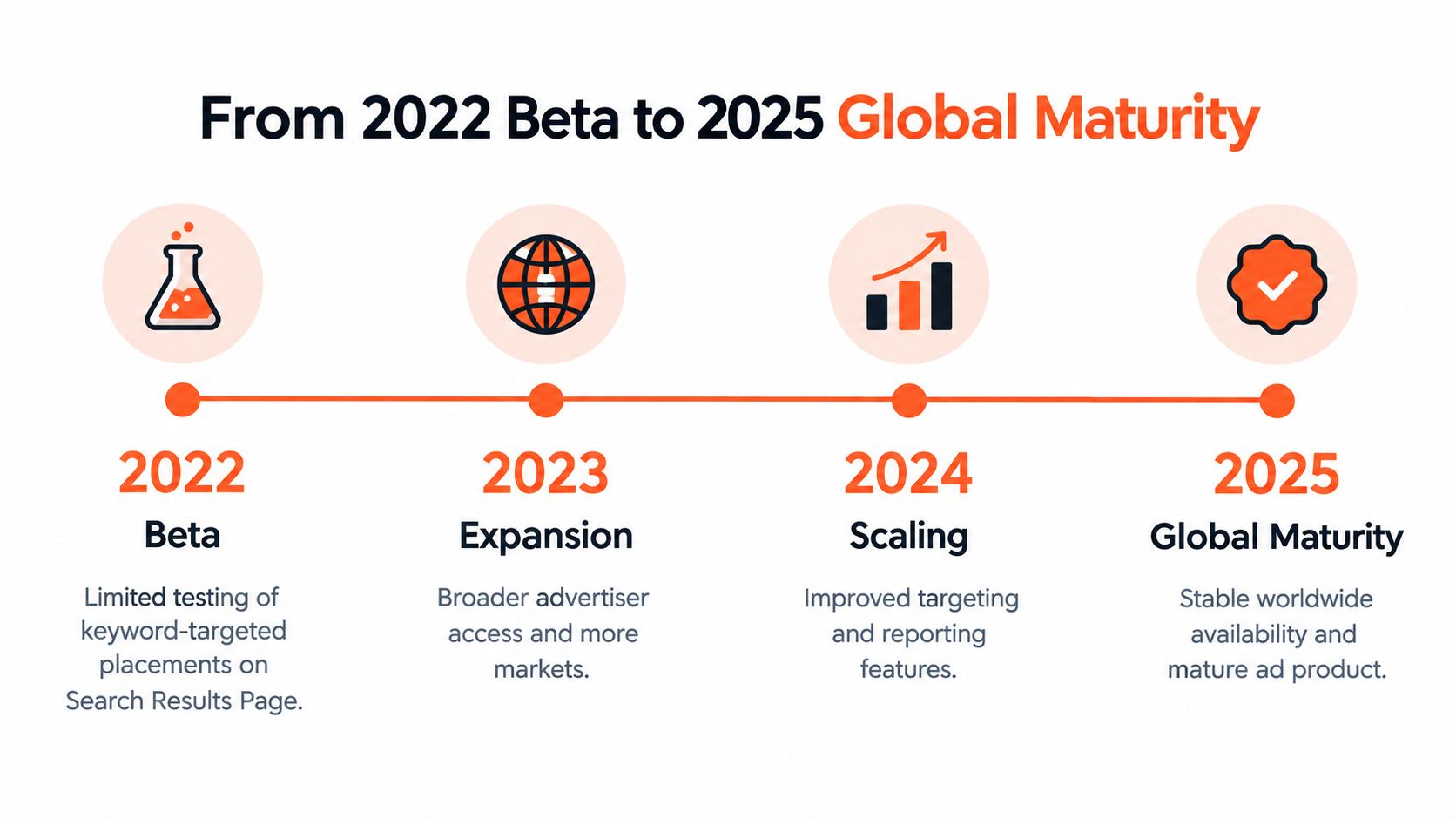
The rollout looked like this:
- March 2022: TikTok began beta testing ads in search results with selected partners.
- August 2023: Search inventory expanded to all advertisers through a toggle in the ad platform. Ads could be built from existing In-Feed creative, matched to relevant queries, and refined with negative keywords.
- September 2024: TikTok introduced Search Ads Campaign, a more advanced keyword-based solution with direct targeting of the Search Results Page in the United States, while testing continued in other markets.
- June 2025: TikTok said Search Ads Campaign was available in the United States and being tested in other markets, reinforcing that search had become an evolving performance product rather than a one-off feature.
The distinction between the older search toggle and Search Ads Campaign matters. The former made search inventory broadly accessible through existing creative and automation. The latter gives performance teams a more deliberate keyword and search-page structure.
That doesn't mean every market has identical inventory, objectives, or delivery behavior. A mature planning process should treat rollout status as a campaign input, not a footnote. Before allocating meaningful spend, confirm the account's actual eligibility, available objectives, supported formats, and reporting behavior in the target market.
The product is stable enough to test with a real budget and a clear measurement plan. It isn't stable enough to copy a legacy search playbook once and leave it untouched. Keyword relevance, creative fit, auction pressure, and attribution need recurring review as TikTok continues refining the product.
Targeting, Keywords, and Market Reality
Start with the market, not the keyword list. TikTok says Search Ads Campaign is available globally in Ads Manager, but its documented market traffic is concentrated in major markets including the United States, Canada, the United Kingdom, Germany, France, Italy, Spain, Mexico, Brazil, Saudi Arabia, and Australia, along with rest-of-world advertisers targeting the United States. The latest availability guidance from TikTok should be the source of truth for your account.
The buying type is auction-only, and the available formats include Search Ads Video, Carousel Image Ads, and Search Catalog for Sales and Travel and Entertainment. In practice, that means inventory planning is market-specific. You can't assume that a campaign structure working in the United States will have the same reach or format access in another region.
Build the keyword set around query intent
Group keywords by the question or category need they represent. A product name, a product type, a use case, and a problem query can all belong in the same account, but they shouldn't automatically share the same creative.
Use a small, coherent launch set rather than mixing every possible phrase into one ad group. Then review the actual search terms and remove queries that attract attention without a credible path to conversion.
Negative keywords are especially useful for:
- Irrelevant use cases: Terms that describe a different product application.
- Unqualified intent: Queries focused on free resources, jobs, or unrelated education.
- Brand confusion: Searches that refer to another company or product category.
- Poor landing-page fit: Queries your destination can't answer directly.
Keep the market comparison honest
The following table describes the planning constraints to validate before launch. TikTok's documentation doesn't provide one universal objective and match-type matrix for every market, so don't fill gaps with assumptions.
| Market Tier | Supported Objectives | Match Types | Spark Ads Eligible |
|---|---|---|---|
| Documented major markets | Verify Traffic and Web Conversion eligibility in Ads Manager | Verify available keyword controls in the account | Confirm by market and campaign setup |
| Testing or expanding markets | Availability can be more restricted | Controls may differ by rollout stage | Confirm before creative planning |
| Rest of world targeting the United States | Validate account and destination eligibility | Use the controls shown in Ads Manager | Confirm before launch |
Audience layering is not the same as Feed targeting. Keywords carry much of the intent signal, so aggressive demographic and interest restrictions can make delivery unnecessarily narrow. Start with the query architecture, then add only the audience controls that solve a clear business problem.
Creative That Performs on the Search Page
Search-page creative has one job before it earns a click: make the user recognize that the ad answers the query. A polished creator story can work, but it needs a sharper opening than a general For You Page video.
TikTok's search creative guidance confirms that autoplayed video views count alongside impressions, while still-image ads generate impressions without video views. That makes impression efficiency and actual video engagement separate questions, not interchangeable reporting lines.
Answer the query in the opening frame
Lead with the product, problem, or outcome named by the searcher. Put the central phrase in readable on-screen text, especially because autoplay may begin without sound. A person searching for a product comparison should see the comparison immediately, not wait through a brand introduction.
Useful creative patterns include:
- Query mirror: Repeat the searcher's problem in natural language, then demonstrate the solution.
- Immediate proof: Show the product in use before explaining the background.
- Visible distinction: Make the reason to choose this product clear without requiring audio.
- Direct destination: Match the landing page to the promise in the first frame.
Long-form storytelling isn't automatically wrong. It's harder to justify when the opening doesn't acknowledge the search context. Feed content can earn attention from a cold viewer. Search content must quickly confirm relevance to someone who has already typed something.
For teams building production systems, a practical review of AI in advertising examples can help generate variations, but automation shouldn't replace query-specific judgment. Test different openings against the same keyword cluster, then evaluate whether stronger view numbers also produce better clicks and qualified actions.
Separate passive views from active response
Watch hold rate, click quality, landing-page behavior, and conversion paths. Don't celebrate a rise in views if the increase comes mainly from autoplay exposure and doesn't improve downstream behavior.
A useful control is to compare search-specific edits with the original Feed version. Keep the core product truth consistent, but change the first frame, text overlay, pacing, and call to action so the creative speaks to search intent rather than passive browsing.
Why TikTok Search Intent Is Not Google Search Intent
Treating TikTok search ads like Google Search is one of the quickest ways to misprice the channel. Google users often arrive to solve a defined problem, find a product page, compare options, or locate a tutorial. TikTok users may search after seeing a creator, a trend, or a product category in the feed, then continue browsing visual answers.
Consider searches such as “best foundation for dry skin,” “what to wear to a rooftop wedding,” or “how to clean an AirPods case.” Each query has intent, but the user may still be collecting examples and opinions rather than choosing a supplier immediately.
That changes the role of the landing page. A hard-sell product page may work for a specific product query, while a category or problem query may need education, comparisons, demonstrations, or creator proof before the visitor is ready to buy.
Categories with a natural visual decision
Beauty, fashion, food, and home products often fit TikTok's discovery-plus-intent environment because users can imagine the product through demonstrations and styling content. Search ads can capture that interest after the user has encountered related content.
Categories with complex education requirements, regulated claims, or long consideration cycles need more caution. Finance, B2B software, and healthcare may capture valuable curiosity on TikTok, but the conversion path can continue through other channels and later sessions. Search should support the journey rather than receive credit for every outcome that follows.
The budget question is therefore not “Does TikTok have intent?” It does. The better question is whether your category can turn visual exploration into a measurable next step, and whether creator content is supplying enough context for search capture to work.
Measuring Lift and Attribution Honestly
Platform-reported ROAS is useful for daily optimization, but it does not prove incremental revenue. TikTok reports that search campaigns can produce 2.0x higher purchase lift overall and 2.2x higher purchase lift for enterprise advertisers, as described in its incremental revenue guidance. Treat those figures as a reason to test search for incremental contribution, not as permission to accept every attributed conversion.
The measurement plan should answer one question: what changed because search ads ran?
Build the validation layer before launch
Use the strongest feasible combination of these methods:
- Geo or audience holdout: Keep a comparable group out of search exposure where the media plan allows it.
- Post-purchase surveys: Ask customers how they discovered the brand, then compare responses with platform attribution.
- Marketing-mix modeling: Give search its own line item when channel history is sufficient for the model to distinguish its contribution.
- Analytics reconciliation: Compare TikTok reporting with site analytics, order data, and new-customer reporting.
A clear process for measuring influencer marketing ROI also matters when creator activity runs beside search. Creator content can create branded demand, after which search ads may receive credit for users whose initial interest came from a creator. Separate creator, Feed, and search exposure in reporting so branded search does not absorb the full value of discovery activity.
TikTok reports approximately eight hours of latency for search-ad metrics in Ads Manager. Avoid changing bids from incomplete same-day data. Use early delivery signals to identify tracking or setup problems, then wait for conversions and independent validation before making structural budget decisions.
Use a staged review
After two weeks, check query relevance, delivery, creative fit, click quality, and tracking integrity. The goal is to find waste and broken measurement, not name a final winner.
After four weeks, compare platform-attributed conversions with analytics, survey responses, and any holdout result. Check whether branded terms are capturing demand generated by Feed or creator activity.
After eight weeks, decide whether search adds value at the business level. Keep, restructure, or reduce the campaign according to validated contribution, not platform ROAS alone.
Measurement rule: use platform data for optimization, but require independent evidence before expanding the budget.
Pairing Search Ads With Creator and Spark Campaigns
TikTok search ads work best when they capture demand that creator content has already helped shape. Running search alone can work for an established category, but the channel has less to capture when audiences haven't encountered the product, language, or use case anywhere else on TikTok.
The sequencing matters. Creator content creates associations and examples. Spark Ads amplify the strongest posts in the Feed. Search ads then meet users who type the product, problem, or category terms that the content helped make familiar.
Use a deliberate sequence
- Brief creators around real search language. Ask creators to address the questions customers already ask, not just deliver a generic product endorsement.
- Approve several creative angles. Keep creator voice intact, but make sure the content contains a clear product truth that can support later search variants.
- Let organic and Spark activity establish demand. Watch which phrases, product attributes, and use cases appear in comments, captions, and follow-up searches.
- Build search-specific edits. Use the winning creator hooks, then adapt the opening frame and text overlay so the ad answers the query quickly.
- Launch search against those associations. Start with tightly related keyword groups and maintain negative keywords as the search-term report develops.
- Keep budgets distinct. Separate creator amplification and search spend in reporting so the team can see whether search adds value or harvests demand generated by another line item.
This structure doesn't require identical creative across placements. A Spark ad can prioritize social proof and watchability. A search ad can lead with the product answer, demonstration, or comparison that corresponds to the query.
A rollout checklist for this week
- Confirm market access: Check the target market, available objective, eligible format, and Search Ads Campaign access in Ads Manager.
- Map existing content: Connect creator captions, recurring phrases, comments, and Spark winners to a provisional keyword set.
- Create search variants: Produce opening-frame, overlay, pacing, and destination versions that match specific query groups.
- Define the test: Choose the holdout approach, reporting window, primary business outcome, and independent validation source before spend begins.
- Protect the read: Separate search, Feed, Spark, and creator costs in the dashboard, even when the campaigns use related assets.
- Maintain exclusions: Review negative keywords regularly and remove queries that show attention without commercial relevance.
- Set checkpoints: Review delivery and relevance at day 14, the early lift picture at day 30, and the budget decision at day 60.
- Document optimization rules: Record bid changes, budget cadence, creative swaps, and the reason behind each material adjustment.
For brands building a repeatable creator pipeline, a creator marketing agency can help coordinate briefing, rights, Spark-ready assets, and measurement across the discovery and capture layers. The operating principle remains the same whether the work is internal or outsourced.
Avoid four predictable mistakes:
- Google substitution: Don't assume TikTok keywords carry the same purchase readiness as conventional search queries.
- View inflation: Don't treat autoplay views as proof of active engagement.
- Premature scaling: Don't expand search before creator and Feed activity has had time to establish recognizable demand.
- Attribution shortcuts: Don't skip holdouts, surveys, or analytics reconciliation when multiple TikTok campaigns run together.
TikTok search ads deserve a place in the performance mix, but their role is specific. They capture intent inside a discovery environment. Creator programs create more of that intent, while search gives it a more direct route to a product page, lead form, or conversion event.
Social Cloud helps growth teams connect creator discovery with TikTok search capture through creator selection, Spark-ready content, campaign execution, and placement-level attribution. Visit Social Cloud to plan a measurable creator and search program built around your next performance test.