

Most advice about user generated content creators starts in the wrong place. It tells brands to find more creators, send more products, and test more videos. That sounds scalable, but a bigger pool doesn't automatically produce a dependable production pipeline. It can just give you more people to screen, chase, brief, revise, and replace.
The useful question in 2026 isn't “How do we access more creators?” It's “Which creators can repeatedly deliver usable assets, on time, with clear rights, credible product use, and economics tied to outcomes?” Creator supply is an operations problem before it's a creative problem. Brands that understand that distinction build a content engine. Brands that don't end up with attractive clips, weak attribution, and a calendar full of missed deliverables.
Table of Contents
- Build attribution at the placement level
- Separate weekly reporting from creative review
- Put economics beside performance
Why the UGC Boom Is Not the Same as a Reliable Creator Supply
The creator economy is large, but large doesn't mean reliable. Goldman Sachs Research estimated 50 million creators in 2023 and projected annual growth of 10% to 20% over the following five years, with a total addressable market of approximately $250 billion and a projection that it could approach $480 billion by 2027. Those figures describe participation and economic potential, not the number of creators available for repeat commercial production. Goldman Sachs Research
The supply issue becomes clearer in the 2026 CreatorIQ survey of 5,095 creators across 100 regions. 67% earned less than $10,000 annually from content creation, fewer than 5% earned more than $100,000, and content creation wasn't the primary income source for 62% of respondents. CreatorIQ's 2026 State of Creators report A person may be talented on camera and still lack the time, cash flow, process, or commercial motivation to handle recurring briefs.
The hidden cost of an oversized pool
Part-time availability creates predictable friction:
- Deadlines move: A creator's main job, studies, or personal commitments can take priority over your campaign.
- Revisions stall: The first cut may arrive, but follow-up edits compete with newer opportunities.
- Output varies: A creator who makes one strong clip may not have a repeatable production setup.
- Retention breaks: Performance-based terms can feel unattractive to smaller creators carrying most of the production risk.
That last point matters. A growing creator population can increase screening and coordination costs rather than reduce them. Don't treat a marketplace profile as proof of capacity. Treat it as an application.
Practical rule: A creator who can't explain their turnaround time, revision process, and available production capacity isn't part of your supply yet.
Build a smaller working roster from the larger market. Track responsiveness, revision quality, product understanding, and repeat delivery. The goal isn't to collect names. It's to create a dependable bench that can produce the next asset without restarting the search.
What Counts as a UGC Creator in 2026
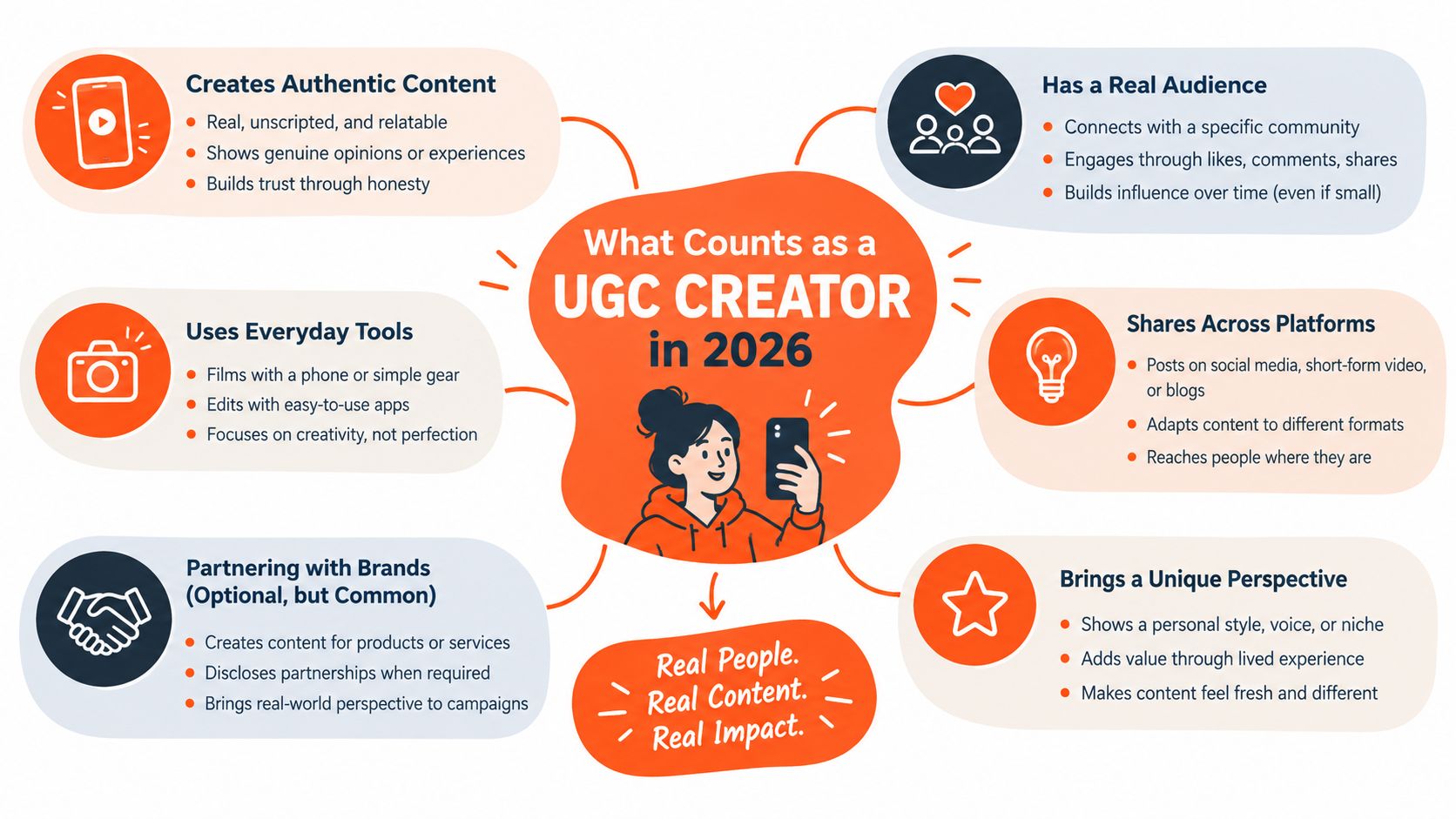
A UGC creator is closer to a freelance product reviewer or voice-over artist than to a media owner. You hire that person to produce an asset, hand over the agreed files and rights, and let your team decide where the content runs. Their follower count may matter, but it isn't the core value exchange.
Three conditions usually define the relationship:
- Paid production: The creator is compensated for making content, whether through a fixed fee, product, affiliate arrangement, or an agreed performance component.
- Asset handoff: The brand receives files it can edit, publish, or adapt within negotiated usage rights.
- Brand-led distribution: Your team carries primary responsibility for placing the asset on paid social, product pages, email, or brand channels.
Don't confuse production with influence
An organic customer post is unsolicited or community-led content. You may request permission to reuse it, but you didn't necessarily commission the production. A traditional influencer partnership is different again. You pay for access to the creator's audience, their publishing channel, and often their endorsement.
UGC creators can have audiences, but the audience isn't automatically what you're buying. A useful test is simple: if the creator's followers disappeared tomorrow, would the delivered asset still have value in your paid account? If yes, you're probably buying UGC. If no, you're probably buying influence, or a blend of both.
The distinction affects where you invest. A creator making product demonstrations for your ads needs a strong setup, clear delivery habits, and believable product use. A creator publishing to their own audience needs distribution credibility, audience fit, and a relationship with followers. If you're exploring creator-led products or merchandise alongside content production, you can browse creator merch solutions as a separate creator-business use case.
UGC Creators vs Traditional Influencers
UGC and influencer campaigns often share the same people, platforms, and production formats. They still solve different problems. UGC supplies creative assets. Influencer marketing supplies access to an existing audience. Confusing those jobs leads to poor briefs and bad performance expectations.
| Dimension | UGC creator | Traditional influencer |
|---|---|---|
| Primary purchase | A usable content asset | Access to the creator's audience |
| Distribution | Brand usually distributes the asset | Creator publishes to their own channel |
| Main KPI | Creative efficiency, conversion, CPA, ROAS | Reach, engagement, traffic, conversions, earned attention |
| Fee logic | Production fee plus usage rights, sometimes performance terms | Audience access, publishing, exclusivity, and usage rights |
| Rights | Asset handoff and paid-media rights are central | Creator-channel post and any amplification rights are central |
| Best use | Ad testing, product demonstrations, paid social variations | Credibility, category reach, launches, and earned media |
| Main risk | Weak delivery or generic creative | Audience mismatch or expensive distribution |
| Editing control | Brand usually has more control | Creator's publishing style carries more weight |
Choose based on the bottleneck
Choose UGC when your paid team needs a steady stream of hooks, demonstrations, testimonials, and format variations. The creator's job is to make the product understandable and watchable in a native style. Your media team can then test openings, cuts, captions, and calls to action without negotiating a new audience placement each time.
Choose an influencer when distribution and trust inside a specific community are the constraint. A creator who already has authority with a niche audience can make a product relevant faster than an unfamiliar paid asset. The cost isn't just filming. It's the relationship between the creator and the people who chose to follow them.
Blended campaigns work when the contract separates those values. Pay for the influencer's publication and audience access. Pay separately for reusable assets and paid usage. Otherwise, your team may assume it owns a clip that was only licensed for an organic post, or expect a UGC creator to deliver reach they never promised.
Why Performance Teams Now Budget for UGC
UGC moved into performance budgets because creator advertising became measurable media, not just informal social activity. The Interactive Advertising Bureau reported that U.S. creator-economy advertising rose from $13.9 billion in 2021 to $29.5 billion in 2024. The IAB projected $37 billion in 2025, a 26% year-over-year increase, compared with projected growth of 5.7% for the broader U.S. media industry. IAB's 2025 Creator Economy Ad Spend and Strategy Report
The buying behavior changed with the spend. 48% of creator-ad buyers considered creators a “must buy,” putting creator advertising just behind paid search and social media in perceived importance, according to the same IAB report. The category includes sponsored partnerships, amplification, and planned creator-media adjacencies, so it reflects a wider shift than brands just paying for unpaid posts.
What changes inside the team
Once UGC has a budget line, treat it like a media input:
- Forecast supply: Estimate how many usable assets each brief needs, not just how many creators you can contact.
- Report weekly: Show spend, delivery, creative status, clicks, conversions, and learnings by asset.
- Separate fees: Track production, usage rights, amplification, and performance components as different costs.
- Fund iteration: Reserve room to remake winning concepts and cut weak ones instead of protecting every initial asset.
A UGC program also needs creative operations. Store source files, hooks, claims, rights windows, disclosures, landing pages, and tracking identifiers in one system. If your team is producing faceless or product-led variations, ClipCreator.ai on faceless video ads offers a relevant production reference, but automation doesn't replace creator vetting or performance review.
The operating principle is straightforward: don't fund UGC because it looks native. Fund it because you can connect production decisions to measurable distribution and conversion outcomes.
How to Find and Vet UGC Creators
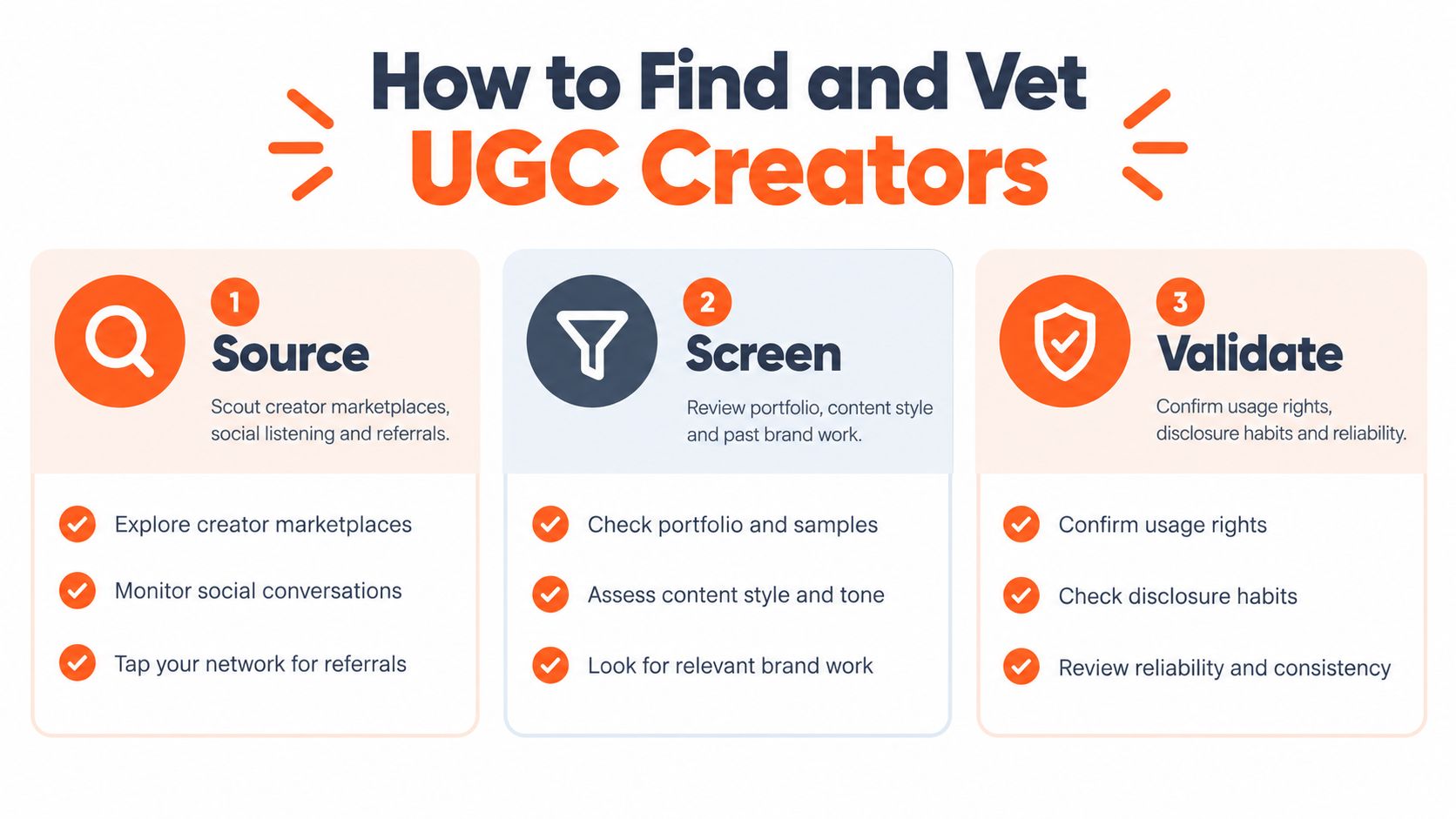
Start with three sourcing channels, then apply the same evidence standard to each. Your existing customer or creator roster gives you context and repeatability. Vetted agency networks reduce search time. Open marketplaces and social discovery widen the pool, but they require the most screening.
Use a staged screening process
First, screen the portfolio. Look for clear product handling, natural speech, useful framing, readable audio, and openings that communicate a problem quickly. A polished selfie isn't enough. Ask whether the creator can explain a product without sounding like they copied a landing page.
Next, inspect commercial behavior. Review past sponsored work for claim discipline, disclosure placement, brand safety, and whether the creator followed a brief without flattening their voice. For influencer discovery, a structured approach to rating influencers by audience and content signals can help junior team members avoid choosing only by follower count.
Then, run a paid test. Give shortlisted creators a narrow assignment with a real product angle, a deadline, and a defined revision process. Don't ask for an unpaid audition. You want to observe how they interpret instructions, ask questions, shoot, edit, and respond to feedback.
Score reliability, not just talent
Use a simple internal scorecard:
- Audience quality: Relevant only if the creator will also publish. Check geography, suspicious engagement patterns, comment relevance, and audience fit.
- Content voice: Does the creator sound credible in your category, or do they use the same generic praise for every product?
- Production capacity: Confirm equipment, filming environment, availability, and expected turnaround.
- Revision behavior: Note whether feedback produces a better asset or an argument about creative control.
- Compliance habits: Check whether paid relationships and gifted products are disclosed clearly and consistently.
- Rights readiness: Confirm that the creator understands organic use, paid use, editing rights, and the agreed term.
The best shortlist is not the largest one. It's the group you can forecast.
Briefing and Creative Guidance That Protects the Voice
A weak brief creates two bad outcomes. The creator improvises around missing information, or your team writes every line and gets an ad that feels like an ad. The brief should define the commercial guardrails and leave the performance of the delivery to the person on camera.
Include these fields:
- Objective: State whether the asset is intended to drive trial, conversion, app action, lead generation, or another defined outcome.
- Audience and problem: Explain who needs the product and what objection the video must address.
- Hook direction: Offer a few strategic openings, not a mandatory sentence.
- Product beats: List the features, proof points, demonstrations, and claims that must appear.
- Disclosure: Specify the required language and placement.
- Rights: Define platforms, paid usage, editing permissions, territory, and usage window.
- Production terms: State the deliverables, deadline, fee, revision rounds, and file format.
- Tracking: Attach the creator or asset identifier, landing page, code, and reporting requirements.
The FTC treats compensation, free products, affiliate relationships, and other brand connections as material connections that should be disclosed clearly and conspicuously when they aren't obvious from context. Responsibility sits with both the creator and advertiser. The FTC's guidance for social media influencers recommends placing disclosures where viewers can see them without expanding a caption or opening a description, such as near the beginning of a video or above the “more” cutoff.

Give direction without writing a commercial
Tell the creator what the viewer must understand, then let them choose the phrasing. Ban unsupported claims, not personality. Ask for a real use case, a visible demonstration, and a clear next step.
Avoid these briefing mistakes:
- Line-by-line scripts: They create stiff delivery and remove the creator's natural vocabulary.
- Excessive banned-word lists: They make creators self-monitor instead of communicating.
- Unclear rights: They create disputes when a winning asset needs paid amplification.
- Late compliance review: It forces expensive reshoots and weakens launch timing.
A practical briefing framework should feel more like a product truth sheet than a screenplay. This influencer marketing briefing guide can help teams formalize the information creators need before production begins.
Integrating UGC With Influencer Campaigns and Paid Amplification
UGC performs best when it sits inside a creator system with distinct jobs. Use influencers to create attention and category credibility. Use UGC creators to produce a larger volume of ad-ready assets. Use paid amplification to put the strongest ideas in front of audiences that aren't already following either creator.
TikTok Spark Ads, Instagram Reels boosts, and YouTube Shorts variants all support different versions of the same operating model. The creator-style asset keeps the native look. The paid account controls budget, audience, placement, and conversion optimization. Your contract must say whether the brand can edit the asset, run it from the creator's account, or adapt it into a brand-owned ad.
Decide how much control you need
Organic-style or whitelisted distribution can preserve the creator's identity and social context. It may also leave less room for heavy edits, claim changes, or brand-led restructuring. Fully edited brand ads give your team tighter control over pacing, compliance, and message hierarchy, but they can lose the informal quality that made the original clip useful.
Use a shared naming system across the campaign. The creator ID, concept, hook, platform, rights status, and conversion event should travel with every file. Teams working at higher volume may also benefit from production workflows such as RenderIO's guide to video automation for brands, especially when they need to create platform-specific versions without losing asset traceability.
For TikTok, document the difference between a creator post, an asset licensed for brand use, and a Spark Ad authorization. This overview of TikTok Spark Ads is useful when teams need to align publishing permissions with paid amplification.
Keep the measurement layer unified
Don't give influencer activity an awareness dashboard and UGC a conversion dashboard if both contribute to the same customer journey. Use shared landing pages, creator-specific tracking, consistent conversion definitions, and post-purchase questions where appropriate. Otherwise, the team will reward whichever channel has the easiest metric instead of the channel contributing the most value.
Measurement and Attribution for UGC
UGC measurement starts with a useful distinction: exposure tells you what was seen, while outcome data tells you what changed. Views, hold rate, watch-through, thumb-stop behavior, and engagement help diagnose creative. CPA, conversion rate, revenue, and ROAS help decide whether the asset deserves more distribution.
A quantitative study of 300 respondents found that UGC statistically predicted purchase intention and explained 39.2% of its variance. The study reported a significant indirect effect of 0.321, with SE = 0.0334, Z = 9.61, and p < .001, linking creator-produced content with trust and authenticity as partial mediators. The study on UGC, authenticity, and purchase intention That result supports measuring credibility and downstream action, but it does not mean every campaign produces a 39.2% lift. It describes explained variance in that sample, not campaign ROI.
Build attribution at the placement level
Give each creator and asset its own identifiers. A practical setup includes:
- Tracking links: Use a unique URL or parameter for each creator, platform, and creative concept. Keep the destination and conversion event consistent enough to compare performance.
- Promo codes: Assign a code when a direct-response offer makes sense. Codes capture some activity that links miss, particularly when people switch devices or remember the creator rather than clicking.
- Post-purchase surveys: Ask customers where they first heard about the product or what influenced the purchase. Include creator names or channel categories that customers can recognize.
- Branded search: Watch branded query behavior around major creator pushes, but don't treat search movement as proof of a single placement's incremental effect.
- Assisted purchases: Record conversions where a creator touch preceded the final click. Define the lookback window before reporting begins so the team can't change the rule after seeing results.
Survey attribution is directional, not perfect. Customers may forget a creator's name, select the most visible channel, or report multiple influences. That doesn't make the method useless. It gives performance data a layer that click tracking can't provide, especially when trust affects people who don't click immediately.
Separate weekly reporting from creative review
Your weekly performance report should answer whether the program is producing business outcomes:
| Reporting layer | Useful measures | Decision |
|---|---|---|
| Delivery | Spend, assets delivered, approval status, rights status | Can the campaign run safely and on schedule? |
| Exposure | Reach, views, watch-through, engagement | Is the creative earning attention? |
| Response | CTR, landing-page behavior, code use | Does the message create interest? |
| Business outcome | Conversions, CPA, revenue, ROAS | Should distribution or budget increase? |
| Assisted impact | Survey responses, assisted purchases, branded search context | Is direct click data undercounting influence? |
| Operations | Turnaround, revision count, missed deadlines, creator retention | Is the supply dependable? |
Don't optimize solely on reach. A video can generate attractive view numbers while bringing the wrong audience, creating weak landing-page behavior, or failing to communicate the offer. Conversely, a creator may produce modest visible engagement but strong conversion quality because the audience understands the problem and trusts the recommendation.
Put economics beside performance
Track the full cost of each usable asset, including production fees, product costs, rights, revisions, editing, and amplification. Then compare the cost against the conversion outcome. A low creator fee isn't efficient if the asset requires repeated chasing, extensive editing, or a replacement shoot.
Performance-linked compensation can align incentives, but it must be structured carefully. Smaller creators may lack the negotiating power or cash flow to absorb all production risk, particularly when attribution is incomplete. Use a clear base payment for completed work, define the performance component in advance, and specify which conversion events count.
The operating model is simple:
- Source through rosters, networks, referrals, and open discovery.
- Screen for creative fit, reliability, audience quality where relevant, disclosure habits, and rights readiness.
- Brief the objective, product truths, compliance fields, deliverables, and usage terms.
- Distribute through brand-owned ads, creator-authorized placements, influencer channels, or a combination.
- Measure each asset with links, codes, surveys, assisted-conversion rules, and operational records.
- Iterate toward creators and concepts that improve business outcomes, not just visible engagement.
Before the next campaign starts, check five things: forecasted turnaround, signed usage rights, disclosure status for every asset, a weekly reporting cadence, and an outcome-linked fee structure. That checklist protects the campaign from the supply problem that most UGC advice ignores.
Social Cloud can help performance teams source vetted creators, manage briefs and usage rights, coordinate disclosure compliance, amplify assets across creator and paid channels, and attribute placements with links, codes, and post-purchase surveys. Visit Social Cloud to discuss a UGC or influencer program built around measurable conversion outcomes rather than creator volume.