Pew Research Center found that 40% of U.S. adults get health and wellness information from social media influencers or podcasts, rising to 57% among women aged 18 to 29 (Pew Research Center). That changes the job. Wellness creators aren't just producing attractive routines, recipes, or product reviews. They're participating in health information behavior, which makes wellness influencer marketing a performance channel with real trust, compliance, and attribution requirements.
The brands winning here don't optimize for views alone. They select creators whose expertise fits the product, build claims controls into the brief, track each placement, and measure whether exposure leads to a sale, install, subscription, or qualified action.
Table of Contents
- Start with audience quality
- Review sponsored content history
- Test expertise instead of assuming it
- Use benchmarks as filters, not verdicts
- Finish with brand safety
- Disclosure must be clear
- Separate descriptions from medical claims
- Make review operational
- Protect usage rights
- Layer one: placement-level links
- Layer two: code-driven demand
- Layer three: assisted conversions
- Match KPIs to the campaign job
- How should brands handle campaigns in the EU or Canada?
- How should a brand split budget between macro and micro creators?
- How long should a partnership run before evaluation?
- Can brands repurpose creator content as paid advertising without a separate license?
What Wellness Influencer Marketing Actually Is
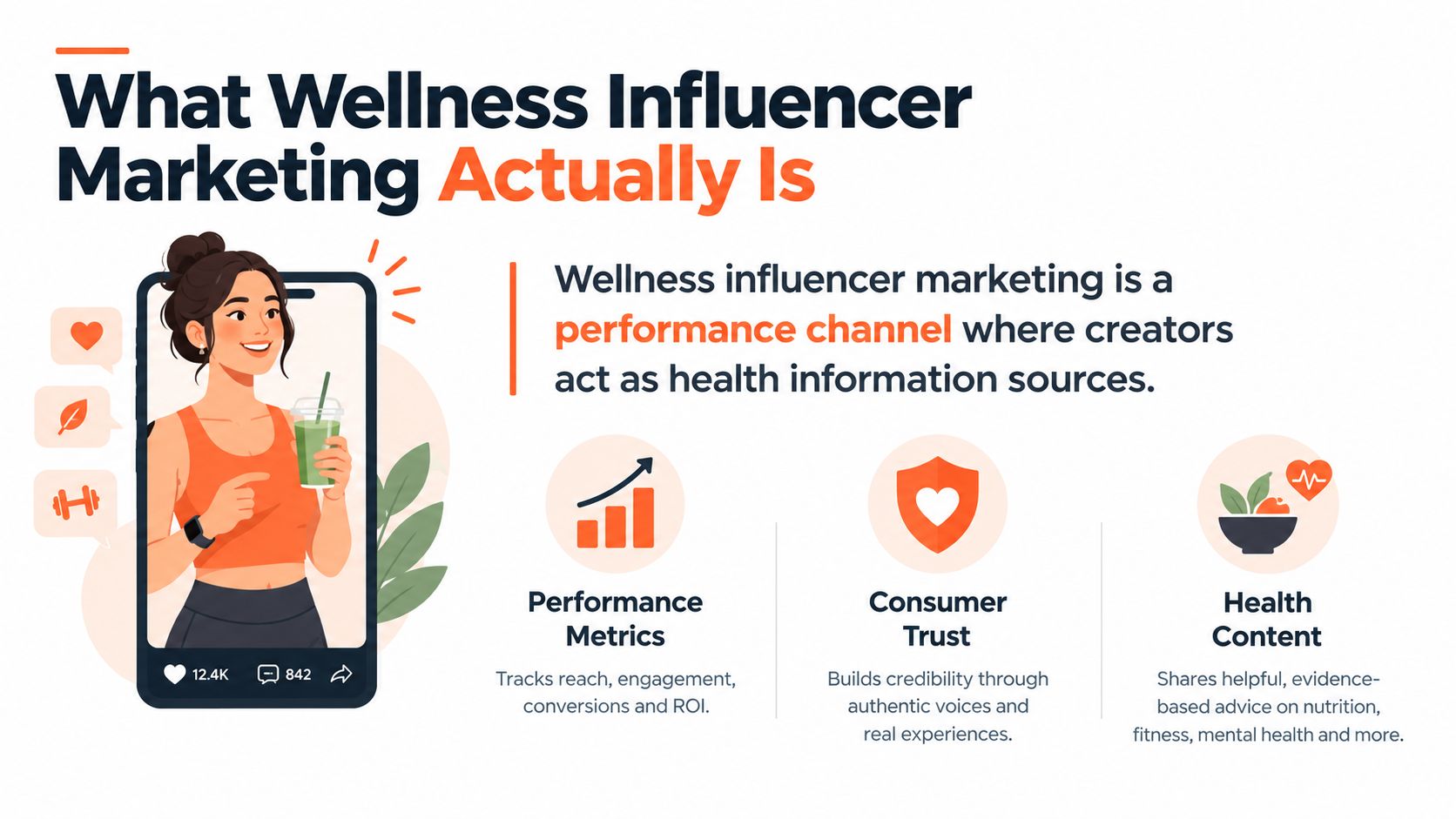
Wellness influencer marketing is creator-led customer acquisition in a health-adjacent category. A creator introduces a product, explains how it fits into a routine, answers objections, and gives the audience a reason to act. The brand then connects that activity to measurable outcomes through tracking links, promo codes, surveys, app attribution, or controlled testing.
That definition is more useful than calling every sponsored yoga clip a wellness campaign. The audience may be interested in supplements, fitness, nutrition, mental well-being, preventive care, sleep, recovery, or healthy food. Pew's methodology treats health and wellness broadly, covering treatments and lifestyle practices used to improve or maintain physical or mental health (Pew Research Center's wellness influencer report).
The category is larger than fitness content
The commercial opportunity extends across a huge underlying market. The Global Wellness Institute estimated the global wellness economy at about $6.3 trillion in 2023, with industry coverage projecting it near $9 trillion in the coming years (industry coverage of wellness influencer marketing). That scale explains why supplements, fitness apps, meditation products, healthy food brands, preventive-care services, and wellness software compete for similar creator relationships.
Search interest also appears to be moving upward. One industry summary reported global monthly searches for “wellness” at about 30,000 in 2020 and about 60,000 by 2025, implying a doubling over that period (IQFluence's healthcare influencer marketing summary). Treat search demand as a directional signal, not a campaign forecast. Your creator's audience, offer, landing page, and claims still determine the result.
Generic influencer marketing can often tolerate looser product-context matching. Wellness can't. A creator's perceived authority affects whether the audience treats the recommendation as useful guidance or just another ad. That raises the standard for creator selection, disclosure, claim review, and post-campaign analysis.
Performance rule: Treat every wellness creator as a health-information distribution partner, not simply as rented reach.
Brands should also understand the role of trust in creator partnerships before they negotiate rates or forecast conversions. A large following may create awareness, but a credible fit gives the audience a reason to believe, remember, and act. The rest of the operating model follows from that distinction: identify the right authority signal, deploy it in the right format, control the claims, and prove incremental value instead of reporting impressions alone.
Why Trust Is the Performance Variable in Wellness
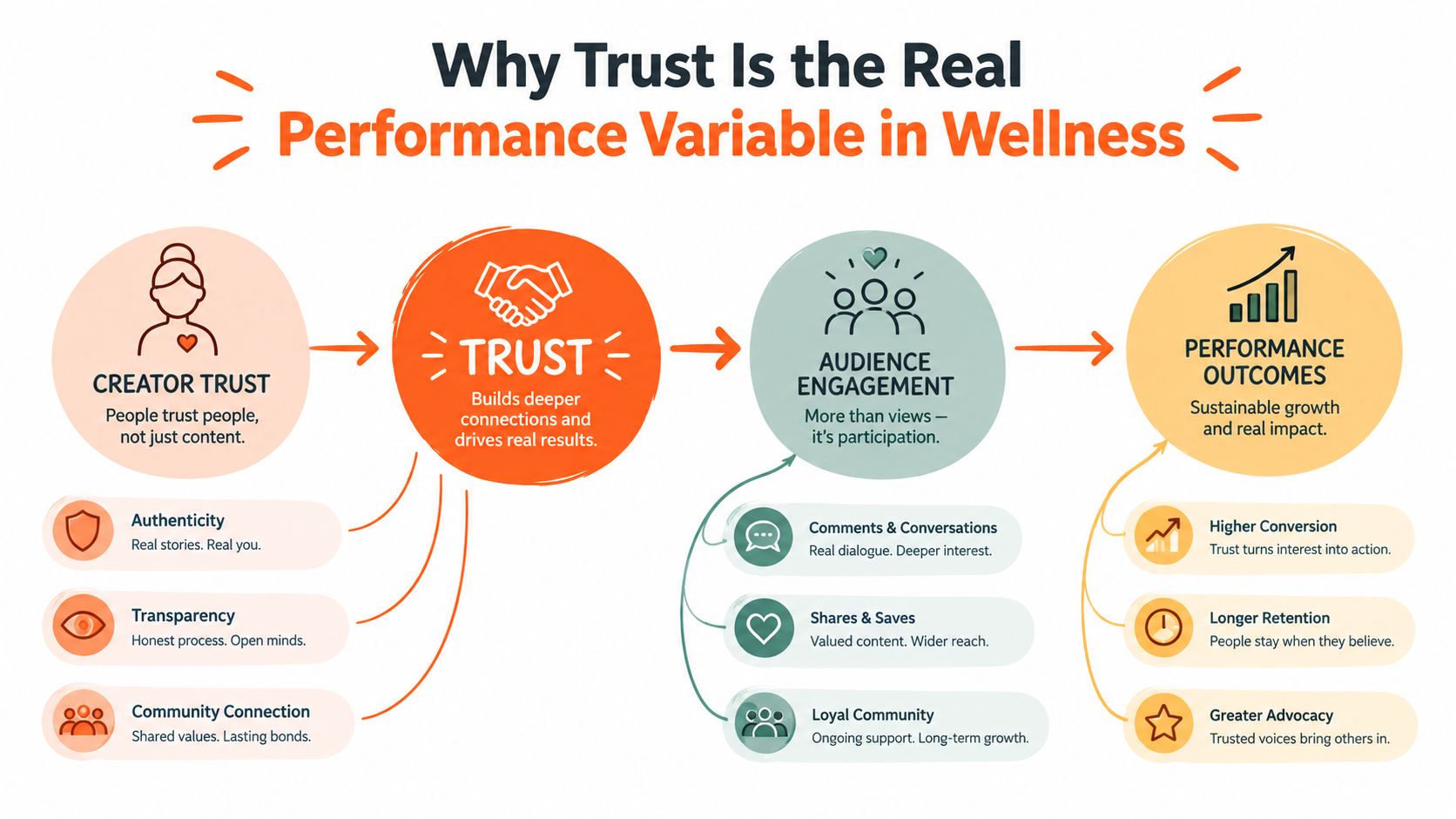
Only 10% of people who get health and wellness information from influencers trust all or most of it, while 65% trust some information and question the rest (Pew Research Center's trust analysis). That split makes trust a performance input, not a soft brand metric. Audiences assess the messenger, test the claim against what they already know, and notice whether the recommendation belongs in the creator's usual content.
Follower count cannot prove incremental lift. A broad lifestyle creator may generate a large view total and little qualified demand. A smaller creator with relevant expertise and audience similarity may produce fewer views, stronger clicks, more code usage, and better retention. Compare exposed audiences with a holdout, where possible, and track lift in qualified actions rather than treating reach as the result.
Three signals predict downstream intent
A 2026 health-influencer study identified expertise, similarity, and trustworthiness as characteristics that directly predicted sharing and purchase intentions. It also found that trust in the message fully mediated those effects (the 2026 health-influencer study).
Use those attributes to score creators before buying media:
- Expertise means the creator has a credible reason to address the problem. Credentials can help, but consistent subject knowledge and responsible explanations matter just as much.
- Similarity means the audience recognizes its goals, constraints, identity, or routine in the creator. A recovery product needs more than an athletic-looking partner. It needs an audience with a relevant recovery problem.
- Trustworthiness comes from clear sponsorships, realistic language, appropriate caveats, and recommendations that remain consistent over time.
A sports nutrition creator may fit a recovery product, while a general lifestyle creator may suit a habit-tracking app. The better choice is the creator whose audience believes they have earned the right to make that recommendation. Treat that belief as a condition for purchase intent, then test whether it produces incremental conversions.
The practical metric is trust-signal density. Review how often the creator demonstrates relevant knowledge, explains decisions, discloses partnerships, answers questions, and respects the product's limits. Start with a qualitative review, then convert those observations into a consistent score for selection and post-campaign analysis.
The following video provides another visual view of creator trust and audience response.
Before approving a partnership, ask why this audience would accept this creator's recommendation. If the answer is only reach, the campaign is buying views instead of performance.
How to Vet Wellness Creators Before You Spend a Dollar
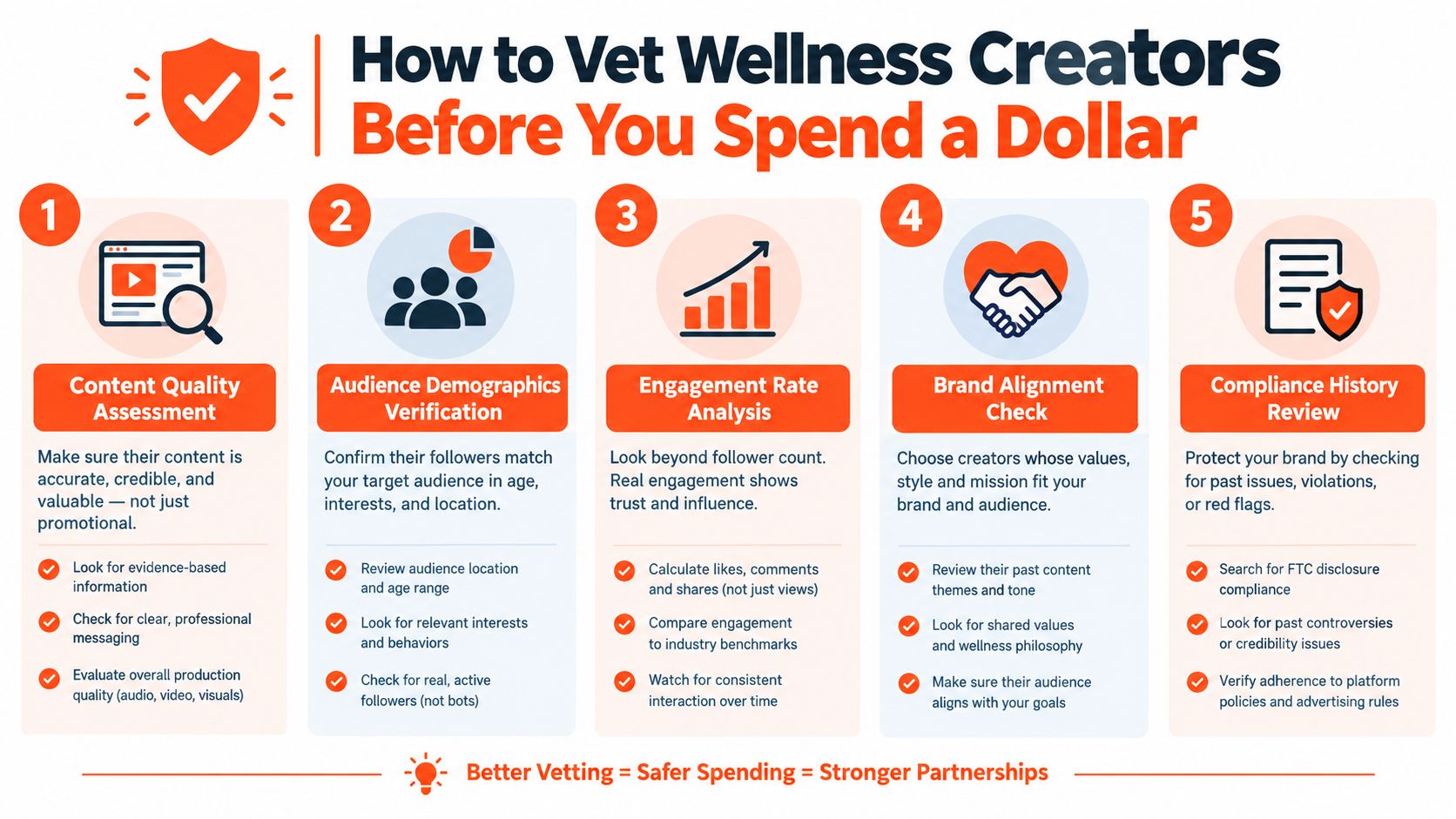
Creator vetting should look more like due diligence than influencer browsing. Start with the audience, then inspect the creator's commercial history, authority signals, performance, and risk profile.
Start with audience quality
Ask for native platform analytics before discussing final spend. Check geography, age, gender where relevant, interests, average views, watch time, and audience growth patterns. Use a third-party creator evaluation tool when you need additional checks for suspicious follower growth or engagement anomalies.
A creator can have an attractive audience profile on paper and still be a poor commercial fit. Review comments and recurring questions. They reveal whether followers discuss real health goals or merely react to visual content.
Review sponsored content history
Look at the creator's recent paid integrations, not just their strongest organic posts. Compare engagement quality on sponsored content with normal content, then inspect whether disclosures are visible and whether the creator has promoted competing or contradictory products.
Pay attention to recommendation continuity. A creator who promotes a different supplement, diet philosophy, or health protocol every week may create skepticism even if individual posts perform well.
Test expertise instead of assuming it
Credentials are useful, but they're not a substitute for content review. Look for sustained focus, clear explanations, responsible sourcing, and the ability to distinguish personal experience from general health advice.
Pew's research identifies doctors, coaches, moms, and entrepreneurs among the people audiences use for wellness information (Pew Research Center's creator archetype analysis). Match the archetype to the offer. A parent creator may be highly persuasive for family routines, while a sports medicine professional may carry more relevant authority for injury recovery.
Use benchmarks as filters, not verdicts
One 2026 industry report cited health and wellness brand engagement averaging 2.0% to 2.5% on TikTok and 1.0% to 2.0% on Instagram (IQFluence's healthcare influencer marketing report). Flag creators who sit well below the relevant baseline, but don't reject them automatically. Audience quality, content format, comment substance, and conversion history can outweigh a single engagement figure.
Finish with brand safety
Search for exaggerated health claims, controversial content, undisclosed sponsorships, and partnerships that conflict with your product. Ask for examples of how the creator handles corrections. A creator who edits, clarifies, and accepts reasonable review is easier to manage than one who treats every constraint as interference.
Record the findings in a consistent scorecard. A structured influencer rating framework helps teams compare creators on the same criteria rather than choosing the person with the most impressive media kit.
Platform Playbooks for Wellness Campaigns
The platform determines what the creator can explain, how quickly the audience moves, and how much control the brand has over the conversion path. Don't copy one integration across every channel. Adapt the creative job to the environment.
YouTube
YouTube suits long-form education, supplement reviews, protocol walkthroughs, and app demonstrations. YouTube wellness views were reportedly up 193% year over year in a 2026 industry report (NeoReach's wellness influencer marketing coverage), but the useful advantage is depth, not the headline growth figure.
Use a dedicated video when the offer needs context, comparison, or demonstration. Use a mid-video integration when the product naturally fits a broader topic and the creator's existing editorial structure can carry the explanation. Give the creator a clear end-screen CTA, a memorable code, and a reason to act. Many viewers won't follow a description link after watching, so make the next step visible and easy.
TikTok
TikTok offers fast discovery and strong creative testing, but health claims need tight controls. Open with the problem, show the routine or product quickly, and keep the explanation concrete. Avoid turning a short format into a compressed medical promise.
Use TikTok LIVE when the creator can answer questions responsibly. Boost proven organic posts through Spark Ads rather than forcing every concept into paid creative before the audience has validated it. The winning workflow is usually creator-led testing followed by selective amplification.
Instagram works best as a sequence rather than a single post. Reels create discovery, while Stories carry the conversion step through reminders, FAQs, product demonstrations, and link access.
Collab posts can extend distribution through the brand handle without requiring a second creator fee, provided the partnership terms and usage rights support that use. Keep the Reel focused on the audience problem, then let Stories handle objections and the offer details.
Twitch
Twitch is underused for fitness apps, gaming wellness, and mental health products aimed at men aged 18 to 34. Live integrations feel less interruptive when the creator connects the product to an existing evening routine, training session, or community discussion.
Panel placements, stream integrations, and creator-specific promo codes make the channel measurable. Twitch needs a stronger contextual fit than a generic pre-roll. The product has to belong in the streamer's world.
| Platform | Best Format | Avg Engagement, Wellness | Compliance Risk | Best Campaign Type |
|---|---|---|---|---|
| YouTube | Reviews, tutorials, dedicated videos | Not specified in the verified data | High for medical-style claims | Education and considered purchase |
| TikTok | Short creator videos, LIVE, Spark Ads | 2.0% to 2.5% (IQFluence) | High | Discovery and creative testing |
| Reels plus Stories | 1.0% to 2.0% (IQFluence) | High | Reach followed by conversion | |
| Twitch | Live integrations and panels | Not specified in the verified data | Medium to high | App installs and community-led action |
Allocate budget by role, not by platform fashion. YouTube can explain, TikTok can test, Instagram can remind, and Twitch can build live intent. The strongest programs let each channel do a different job.
Compliance and Claims Management in Wellness Campaigns
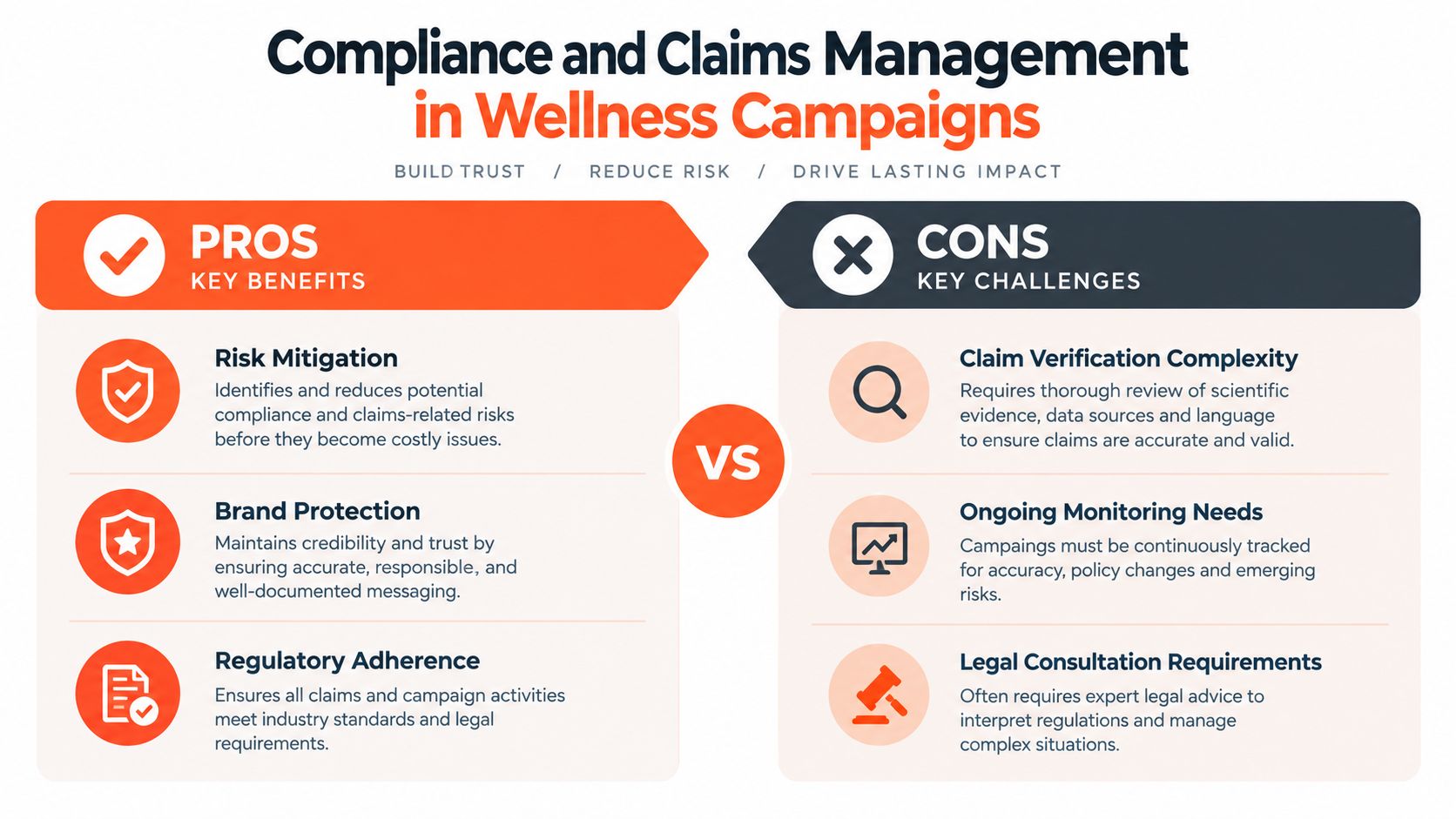
Compliance must shape the campaign before a creator records a word. The brief, script, product page, creator agreement, paid amplification plan, and monitoring process should all define the claims the brand can support. Treating legal review as the final checkpoint leaves too much room for an expensive correction after publication.
Risk rises around longevity, biometrics, mental health, and preventive care. “Science-backed protocol” may sound credible and drive attention, yet it can imply a medical outcome the product cannot substantiate. That weakens audience trust and can turn strong creative into a liability.
Disclosure must be clear
A paid relationship is a material connection. Put the disclosure where viewers will notice it, understand it, and connect it to the recommendation. Do not hide “#ad” at the end of a long caption or use vague wording that obscures the commercial relationship.
Use platform controls alongside plain-language disclosure:
- TikTok: Enable branded content disclosure and include clear wording in the video or caption.
- Instagram: Apply the paid partnership label and make the sponsorship clear within the content.
- YouTube: Use the paid-promotion disclosure and ensure the spoken integration identifies the sponsorship.
Legal counsel should confirm requirements for each market and product category. Platform tools support disclosure, but they do not make an unclear script compliant.
Separate descriptions from medical claims
Creators can explain intended use without promising to diagnose, treat, cure, or prevent a condition. Phrases such as “clinically proven,” “treats anxiety,” and “reverses aging” require immediate review because they may imply evidence or outcomes beyond the approved substantiation.
Build a claims library with approved language, prohibited language, and the evidence required for each claim. Give creators room to sound natural, while keeping every promise inside those boundaries.
Make review operational
Use a defined approval process:
- Tie each approved claim to product evidence.
- Maintain a banned-phrases list with examples of implied claims.
- Require review before publication.
- Set a correction and removal process for inaccurate statements.
- Store final scripts, captions, edits, and disclosures.
Authority creators make this control more important because their expertise can increase purchase intent and make unsupported claims sound more credible. NeoReach's wellness influencer marketing report connects growing interest in wellness video with science-backed protocol content and highlights the implied medical-claim risk (NeoReach's wellness influencer marketing report). Brands should also understand trust in creator partnerships before negotiating rates, since credibility affects both response and compliance exposure.
Protect usage rights
A creator's permission to post on their own account does not automatically give the brand rights for paid ads, product pages, email, retail screens, or other markets. Specify duration, channels, territories, edits, whitelisting, and paid-media rights in the contract.
Teams planning broader ecommerce content use cases should settle licensing before production, not after a post performs. An influencer contract template can organize the commercial terms, but counsel should adapt it to the product, market, and campaign. Clear rights and claim controls protect the revenue generated by the creative.
Measuring Wellness Influencer Campaigns That Convert
A wellness campaign can generate strong view counts while producing little qualified demand. Views, likes, and comments describe distribution. They do not prove that a creator caused revenue, valuable traffic, installs, or retention.
Treat influencer marketing as a performance channel. Build a three-layer attribution stack with a trackable path for each placement, an offline recovery method, and a way to capture assisted influence. For a practical framework, see this guide to measuring influencer marketing ROI.
Layer one: placement-level links
Create unique UTM links for every creator and placement. A creator posting on YouTube, Instagram, and TikTok needs separate tracking for video, Story, bio, and paid amplification paths. That structure shows which distribution point generates qualified sessions and conversions.
Match each link to a landing page that continues the creator's promise. A creator explaining sleep support should not send viewers to a generic home page. Consistent messaging gives analysts a cleaner conversion path and gives visitors a clearer next action.
Layer two: code-driven demand
Assign a creator-specific promo code even when a trackable link is available. Codes capture direct traffic, remembered recommendations, and purchases made on devices where the original click cannot be connected.
This matters for TikTok organic content and YouTube descriptions, where viewers may act later. Keep the code easy to remember, and include it in the creator's spoken call to action. Compare code redemptions with link conversions instead of treating either source as a complete view of demand.
Layer three: assisted conversions
Add a post-purchase or post-install survey asking, “How did you hear about us?” Include creator names and channel options, then compare responses with link and code data. Surveys will not produce perfect attribution, but they expose demand that last-click reporting misses.
Use performance findings to turn measurement into distribution. Promote the hooks, formats, and creators that generate qualified action, not just the posts that attract the largest audience.
Match KPIs to the campaign job
| Campaign objective | Primary metrics | Useful diagnostic |
|---|---|---|
| Awareness | Reach, view-through rate, branded search lift | Comment quality and repeat exposure |
| Ecommerce conversion | CPA, code redemptions, ROAS by creator | Assisted conversion survey responses |
| App acquisition | CPI, install quality, D7 and D30 retention by cohort | Onboarding completion and subscription action |
Use category benchmarks as reference points, not promises. Your offer, audience, funnel, and creator fit determine whether the campaign beats a baseline. Creator attributes matter here: audience relevance, explanation quality, and credible product integration often signal purchase intent more clearly than raw reach, while forced claims can erode trust.
Report weekly by creator and platform. Include views, click-through rate, conversions, code use, assisted conversions, and return on ad spend where available. Aggregate reporting hides weak placements. A per-creator view lets the team cut waste, improve the brief, and expand partnerships that earn both attention and action.
Wellness Campaign Playbooks and Real-World Examples
The following scenarios show how the operating pieces fit together. They are illustrative campaign playbooks, not verified case studies, so the outcome is the decision logic, not a claimed performance result.
A supplement campaign built around explanation
A protein and recovery brand targeting women aged 25 to 40 might begin with YouTube creators who have sports nutrition backgrounds or relevant dietitian credentials. The team would review audience fit, sponsored content history, expertise signals, engagement quality, and brand safety before signing anyone.
The brief should give creators a clear product role. They can explain how the product fits into recovery or a daily routine, but they shouldn't claim that it builds muscle, treats an injury, or delivers an unsupported clinical outcome.
A sensible execution could include:
- Creator-specific attribution: Give each creator a unique tracking link and promo code.
- Review before publication: Require a compliance review of the script, captions, on-screen text, and description.
- Format adaptation: Turn approved long-form footage into Shorts and Reels only when usage rights cover those placements.
- Conversion continuity: Send traffic to a landing page that repeats the same product use case and approved language.
- Weekly optimization: Compare click quality, code use, conversion rate, and assisted responses by creator.
The campaign team shouldn't judge a creator after one post. A nutrition educator may need time to answer questions, demonstrate use, and establish the product in a broader routine. The team should also watch for comment-level objections about ingredients, taste, pricing, or evidence. Those objections can improve the next brief.
An app campaign using live context
A mindfulness and sleep app targeting men aged 28 to 45 could use TikTok for short discovery creative and Twitch for longer community-led integrations. TikTok creators might test concise problem-solution hooks, while Twitch streamers could introduce the app during evening sessions when the audience already thinks about winding down.
The channel roles should remain distinct:
- TikTok testing: Publish several creator-native concepts, then use Spark Ads only on posts that earn strong engagement and qualified traffic.
- Twitch integration: Use a natural spoken explanation, panel placement, or live demonstration rather than an unrelated scripted interruption.
- Install measurement: Give every creator a separate app link and code, then connect installs to retention cohorts.
- Audience diagnosis: Compare not just install volume, but onboarding completion, subscription action, and retention quality.
- Mid-campaign adjustment: Move creative support toward the hooks that attract users who continue using the product.
The central lesson is that platform choice should follow the conversion event. If the product needs trust and explanation, long-form or live formats may carry more weight. If the product benefits from fast creative iteration, short-form video can generate more testing opportunities. Neither channel deserves budget because it is popular. It earns budget when its audience and format match the user's next decision.
A strong campaign doesn't ask every creator to deliver the same ad. It gives each creator the same commercial objective and enough room to make the recommendation believable.
Frequently Asked Questions About Wellness Influencer Marketing
How should brands handle campaigns in the EU or Canada?
Treat each market as a separate compliance environment. Disclosure language, health-claim standards, platform rules, product classifications, and evidence requirements can differ from U.S. expectations. Your contract should specify the territories covered, the creator's disclosure duties, the approved claims for each market, the review process, and who carries responsibility for local adaptation. Don't translate a U.S. script and assume it remains compliant. Have local counsel or a qualified regulatory reviewer approve the claims before launch, especially for supplements, mental-health products, preventive-care services, and biometric tools.
How should a brand split budget between macro and micro creators?
Use a portfolio rather than committing the whole budget to one tier. Larger creators can deliver efficient awareness and useful creative scale, while smaller specialists often offer closer audience fit and stronger authority signals. Start with the creator attributes that predict trust, then use reach to extend proven content. Don't assume smaller automatically means more credible or larger automatically means less credible. Compare qualified traffic, conversion rate, code use, and downstream quality by creator. A performance-based fee component can also reduce the pressure to choose solely on headline reach.
How long should a partnership run before evaluation?
Give the program enough time to generate repeated exposure, delayed conversions, and meaningful creator-level data. An 8 to 12 week observation window is a practical minimum for many wellness programs, particularly when customers need education before purchase. Cutting a creator after two weeks can confuse low initial familiarity with poor fit. Set interim checkpoints for disclosure, content quality, clicks, and early conversion signals, but reserve the final decision for a window that captures direct and assisted outcomes. Extend the partnership when the audience responds constructively and performance improves with iteration.
Can brands repurpose creator content as paid advertising without a separate license?
Usually, no. A creator's organic publishing agreement doesn't automatically grant paid-media, website, email, retail, territory, duration, editing, or whitelisting rights. Put those permissions in writing before production. TikTok Spark Ads and Instagram Collab posts can support platform-native amplification, but they still need to fit the contract and disclosure terms. Specify who can run the ad, for how long, in which markets, with what edits, and whether the creator can revoke approval. If you want durable ecommerce assets, negotiate those rights upfront and price them clearly.
Before launch, confirm the creator fit, approved claims, disclosures, usage rights, tracking links, promo codes, survey questions, conversion event, reporting cadence, and stop-loss rules. Then review performance by creator rather than hiding weak placements inside a campaign total.
Social Cloud plans and measures creator campaigns across YouTube, Instagram, TikTok, and Twitch, with creator selection, contracting, disclosure and usage-rights management, placement-level attribution, and weekly reporting. If you want wellness influencer marketing tied to measurable outcomes instead of view totals, visit Social Cloud to discuss your campaign.